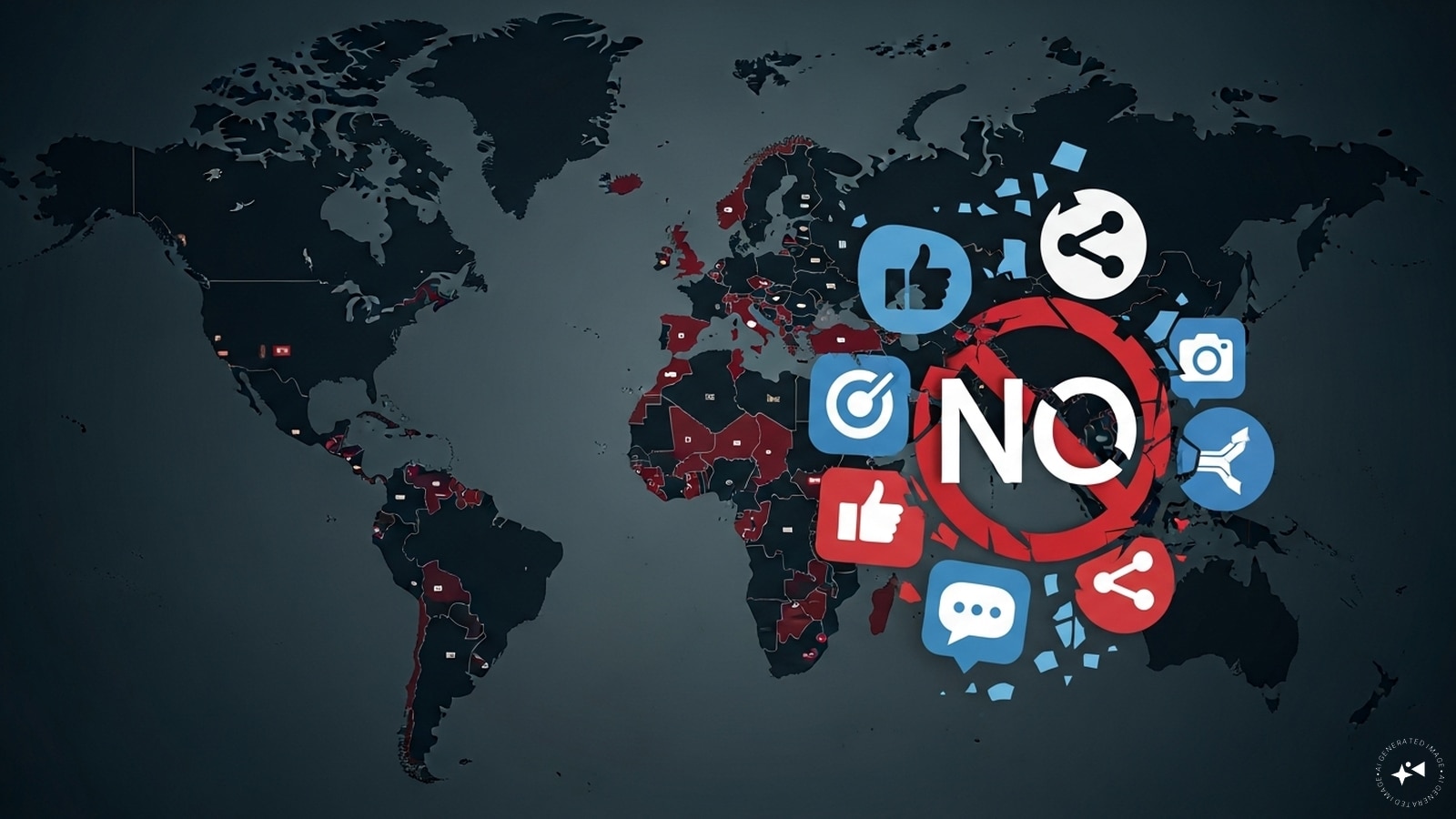
The house is entirely too quiet at seven in the evening. For years, this hour carried a specific rhythm. It was the sound of a thumb rapidly flicking against glass. It was the tinny, erratic burst of three-second audio loops leaking from a bedroom door. It was the blue light spilling across a teenager’s face, turning skin a pale, ghostly hue.
Then, the screens went dark. Don't forget to check out our recent article on this related article.
Last winter, Australia drew a line in the sand. It became the first nation to enforce a blanket ban on social media accounts for anyone under sixteen. The law shifted the entire burden onto the tech giants. Build the walls, the government demanded, or face multi-million-dollar fines. Within weeks of the law taking effect, tech companies reported wiping millions of underage accounts from their servers. The UK quickly followed suit. Dozens of other nations from Europe to Asia are now drafting their own versions of the digital eviction notice.
But what does a geopolitical shift look like when it hits the kitchen table? If you want more about the context here, MIT Technology Review offers an excellent breakdown.
Consider a hypothetical household. Let us call the daughter Maya. She is fourteen. For Maya, the ban did not feel like a protection policy. It felt like an overnight power outage that only hit her bedroom. The infrastructure of her social world dissolved between a Tuesday afternoon and a Wednesday morning. Her group chats vanished. Her saved videos disappeared. Her carefully curated digital identity, built over years of middle school transitions, was deleted by an automated script.
The initial reaction was anger. Loud, door-slamming anger. But that eventually gave way to a strange, heavy stillness.
Parents who championed these laws envisioned a sudden return to an idyllic past. They pictured children riding bicycles through neighborhoods, reading paperbacks by lamplight, and talking at dinner. The reality is far more complicated. When you remove the digital square where an entire generation gathers, they do not automatically find their way back to a world that no longer exists. They sit in the quiet. They look at their hands. They try to remember how to fill the empty space.
The push back against these platforms is rooted in hard data. Over the past decade, psychological studies have tracked a stark, upward trajectory in teen anxiety and sleep deprivation. The mechanics of the infinite scroll were never designed with a developing brain in mind. They were designed to capture attention and hold it hostage. Behavioral scientists have long pointed out that the constant feedback loops of digital approval create an unstable foundation for adolescent self-worth.
Yet, implementing a global shutdown is proving to be a game of digital whack-a-mole.
Recent data reveals the cracks in the fortress walls. In the months following the Australian ban, researchers found that a vast majority of restricted minors still found ways to log in. They bypassed identity checks. They created alternate accounts under false birthdays. They turned to Virtual Private Networks to mask their locations.
The digital world is fluid. It resists borders. When a government builds a wall, a fourteen-year-old builds a ladder.
This creates a deeper dilemma for families. Trust becomes a casualty of the enforcement mechanism. When a child uses a VPN to check a message from a classmate, they are no longer just scrolling; they are actively evading the law. A simple act of communication is transformed into a minor digital crime. Parents are left in an agonizing position. They must either police every byte of data entering their home or look the other way, teaching their children that some laws are meant to be ignored.
The problem runs deeper than simple defiance. There is an isolation that policy cannot easily fix. For a kid who feels out of place in a small-town school, an online community can be a lifeline. A teenager discovering their identity or struggling with a niche passion often finds solace in a scattered global network of peers. When we pull the plug on the platforms, we also pull the plug on those connections.
There is an undeniable vulnerability in admitting that we do not know what comes next. We are living through a massive, uncoordinated human experiment. One half of the world is doubling down on restriction, while the other warns that bans simply drive vulnerable teens into darker, unmonitored corners of the web.
A different path exists, though it demands more effort than a legislative signature. It involves shifting the focus from total isolation to digital literacy. It means forcing tech corporations to fundamentally redesign their algorithms rather than just checking birth certificates. It requires treating the internet like a public road: you do not ban teenagers from walking near the street; you build sidewalks, install crosswalks, and teach them how to look both ways.
Back in the quiet house, Maya sits on the living room rug. The silence is finally broken, not by the hum of a smartphone, but by the rhythmic clack of plastic tiles. She has unearthed an old board game from the back of the closet. Her parents join her. For an hour, there are no notifications, no algorithmic recommendations, and no curated perfections. There is just a family, sitting together, trying to rebuild a physical world from scratch.
The glow has faded. The real work is just beginning.