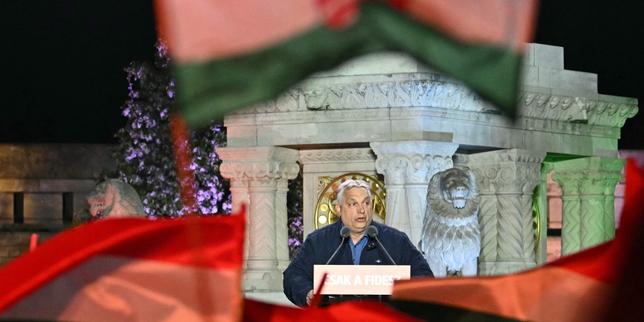
Viktor Orban stands at his most precarious crossroads in nearly two decades as a new political force led by Peter Magyar shatters the illusion of Fidesz invincibility. For years, the Hungarian Prime Minister maintained a stranglehold on the national narrative through a sophisticated mix of media control, gerrymandering, and a "family-first" nationalist rhetoric that resonated with the rural heartland. However, recent polling data and massive street protests indicate that the populist playbook is finally hitting a wall of economic frustration and internal fatigue. The latest rallies show a leader no longer dictating the terms of the debate but reacting—often clumsily—to an opposition that speaks his own language.
The Magyar Defection and the End of Monolithic Power
The current crisis did not start with an external threat or a directive from Brussels. It began from within the tightest circles of the Fidesz elite. Peter Magyar, a former insider and the ex-husband of former Justice Minister Judit Varga, did what no one else could: he provided a credible alternative to the Orban machine by using their own aesthetic and nationalist vocabulary.
Magyar’s Rise is not merely a polling anomaly. It represents a fundamental shift in Hungarian demographics. While the traditional left-wing opposition was easily painted as "foreign agents" or "remnants of the past" by the state-controlled media, Magyar is a product of the system. He knows where the bodies are buried, and more importantly, he knows how the patronage networks function. When he calls out the corruption of the "centralized power will," he isn't speaking as a liberal intellectual from Budapest; he is speaking as a disillusioned true believer. This has allowed him to siphon off voters who are tired of the constant "war" with the European Union but aren't ready to embrace a traditional progressive platform.
Economic Gravity Always Wins
Orban’s longevity was built on a simple, unspoken social contract: political loyalty in exchange for steady economic growth and subsidized utility bills. For a decade, that contract held. But the bill has finally arrived.
Hungary has faced some of the highest inflation rates in the European Union over the last two years. Food prices skyrocketed, and the "utility price caps"—a cornerstone of Orban's popularity—had to be partially rolled back. When people can no longer afford the basic components of a middle-class life, the rhetoric about "defending national sovereignty" begins to sound hollow. The government’s attempt to blame everything on the war in Ukraine or "Brussels sanctions" is losing its effectiveness.
The numbers tell a grim story for the Prime Minister. Real wages have struggled to keep pace with the cost of living, and the freezing of billions in EU funds due to rule-of-law concerns has left a massive hole in the state budget. Orban used to bridge these gaps with Chinese investments or Russian energy deals, but these are no longer the quick fixes they once were. The infrastructure is aging, the healthcare system is in a state of quiet collapse, and the brain drain of young professionals to Western Europe continues unabated.
The Propaganda Machine Meets Its Match
For years, the Fidesz-controlled media empire, KESMA, could silence any dissenting voice by burying it under a mountain of coordinated character assassination. If a rival appeared, they were branded a traitor within forty-eight hours across every regional newspaper and television station in the country.
This time, the machine is stuttering.
Social media has bypassed the traditional gatekeepers. Magyar’s use of Facebook and YouTube to broadcast directly to the people—often via unedited, hours-long speeches—has created a digital counter-infrastructure that Fidesz cannot simply turn off. The government’s response has been to double down on the "war" rhetoric, claiming that any vote against them is a vote for Hungary’s involvement in a global conflict. It is a desperate play. By framing every election as an existential struggle for the survival of the nation, Orban has left himself no room for moderate governance.
The Rural Urban Divide Is Closing
The traditional strategy for Fidesz was to concede Budapest to the liberals while securing massive, lopsided victories in the countryside. They relied on a "voter-transport" system and local mayors who functioned as feudal lords.
Recent field reports and local election data suggest the provinces are no longer a guaranteed vacuum. Small-town Hungarians are feeling the same economic pinch as the city dwellers. They see the local hospitals losing doctors and the schools losing teachers. When the Prime Minister holds a "final meeting" or a rally, the crowds are still there, but the energy has shifted. It feels more like a mandatory attendance event than a grassroots movement. The fear of losing state-dependent jobs still keeps many in line, but the secret ballot is a different matter.
The Geopolitical Tightrope Has Frayed
Orban’s "Eastern Opening" policy—balancing relations between the West, Russia, and China—was once seen as a masterstroke of "realpolitik." In the current climate, it looks more like a liability.
By constantly vetoing EU aid to Ukraine or delaying NATO accessions for Sweden and Finland, Orban isolated Hungary from its most natural allies, particularly Poland and the Baltic states. The Visegrad Four alliance, which once gave Orban a powerful bloc within Europe, is effectively dead. He is now a man on an island. While he waits for a potential political shift in the United States or a surge of far-right parties in the European Parliament, his domestic base is starting to wonder if being the "bad boy of Europe" is actually providing any tangible benefits to the average Hungarian family.
The Institutional Capture and Its Limits
The judiciary, the media, and the electoral commission are all headed by Fidesz loyalists. On paper, it should be impossible for Orban to lose. They have rewritten the rules of the game so many times that the goalposts are practically in the parking lot.
However, institutional capture cannot prevent a massive, coordinated shift in public sentiment. We saw this in Poland. We saw it in various "managed democracies" across the globe. When the tide turns, the very bureaucrats who were installed to protect the leader begin to look for their own exits. The recent clemency scandal, which forced the resignation of President Katalin Novak, showed that the system is prone to massive unforced errors. It proved that the "moral core" Fidesz claimed to represent—protecting children and traditional values—was a thin veneer that could be pierced by a single investigative report.
The Looming Shadow of the Next Generation
Orban’s rhetoric is increasingly aimed at a demographic that is shrinking. His focus on 19th-century notions of national struggle appeals to those who remember the Cold War, but it fails to capture the imagination of those born after 1990.
These younger voters are not necessarily "liberal" in the Western sense. They are, however, pragmatic. They want a country that functions, a currency that holds its value, and a government that doesn't treat them like soldiers in a permanent ideological war. The Prime Minister’s inability to speak to this cohort is perhaps his greatest long-term failure. You can control the history books, but you cannot control the expectations of a generation that sees the rest of the world through a smartphone.
The aura of invincibility is a dictator's most valuable currency. Once it is spent, you can never get it back. Orban is currently spending his last reserves. Whether through the ballot box this year or the steady erosion of his coalition over the next two, the "Orban System" has entered its twilight phase. The fortress isn't being stormed from the outside; the walls are simply turning back into dust because the people who built them no longer believe the architect's promises.
The Prime Minister’s final meetings are no longer about a vision for the future. They are frantic attempts to hold onto the past. In politics, once you start looking backward to justify your presence, you’ve already lost the room.