The dust of the eastern desert does not settle easily. It clings to windshields, filters through window frames, and coats the city in a perpetual, muted gray. For decades, the beating heart of Egypt’s power lived right in the middle of Cairo. It occupied cramped ministries, colonial-era blocks, and bustling districts where the noise of traffic and the press of twenty million citizens formed an inescapable daily rhythm.
Then came the concrete.
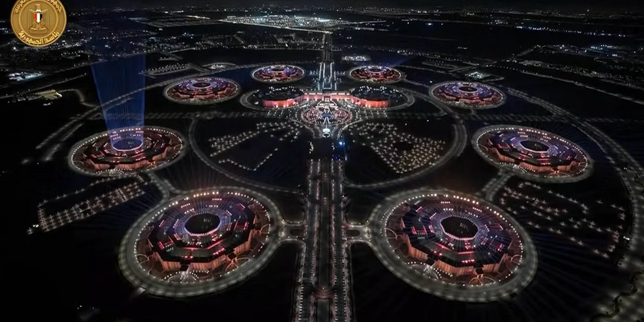
Far out on the highway toward Suez, past the smog and the sprawling informal settlements, something colossal began to take shape. Out of the empty expanse of sand, a massive ring structure rose. Officials call it the Octagon. It is the new headquarters of the Egyptian Ministry of Defense, a sprawling military city designed to house every branch of the armed forces under one heavily fortified roof.
To look at satellite photographs of the Octagon is to witness geometry asserting absolute control over nature. Eight octagonal buildings, connected by radial wings and centered around a central administrative core, mimic the Pentagon across the Atlantic, but on a grander, more forbidding scale. It is a monument built with staggering amounts of granite, steel, and security clearance.
Cairo has always been a city of proximity. For centuries, rulers lived within breathing distance of the ruled. Even the most autocratic pharaohs, sultans, and presidents maintained palaces nestled against the Nile or embedded within the urban sprawl. Power was visible, even if it was untouchable. You could walk past the high walls of old security compounds. You could hear the sirens. You could feel the pulse of the state beating against the pavement beneath your feet.
The Octagon shatters that proximity.
Consider what it means to move an entire military-industrial apparatus forty miles into the desert. This is not merely an architectural relocation. It is a psychological retreat. When the architects of a state pack up their maps, their encrypted servers, and their armored motorcades and drive them out to an isolated compound surrounded by checkpoint-studded perimeters, they are sending a message written in stone.
They are leaving the city behind.
Imagine a young lieutenant colonel, twenty years ago, navigating the congested labyrinth of central Cairo to deliver a morning briefing. His car would crawl through neighborhoods choked with vendors, students, and protesters. He would see the daily struggles of ordinary citizens firsthand. The rising price of bread. The frayed tempers in traffic. The raw, unfiltered frustration of a population trying to survive under immense economic pressure. That friction matters. It keeps power tethered to reality, no matter how insulated the upper echelons might be.
Now, imagine that same officer driving down the new Mohamed Bin Zayed Axis toward the New Administrative Capital. The road is wide, smooth, and deliberately empty of civilian congestion. There are no street vendors here. No spontaneous street life. There are only sweeping expanses of desert, towering flagpoles, and the looming silhouette of the Octagon.
Inside this colossal headquarters, the environment is sterile, climate-controlled, and utterly removed from the chaos of the Nile Valley. Security is absolute. Access is restricted by biometric scanners, multi-layered clearance protocols, and miles of perimeter walls designed to withstand modern threats.
This is what power looks like when it decides to barricade itself.
The Egyptian military has long been more than just an army. It is an economic empire, managing everything from pasta factories to mega-highways, cement plants to gas stations. It acts as the ultimate guarantor of stability in a volatile region. But as the economic crisis deepens, as inflation bites hard into the savings of the middle class, and as the Egyptian pound loses its footing against the dollar, the gap between the rulers and the ruled widens into a chasm.
The Octagon is the physical manifestation of that chasm.
Critics look at the billions spent on the New Administrative Capital and see a staggering misallocation of resources while millions struggle to buy basic staples. Supporters argue that Cairo was bursting at the seams, paralyzed by congestion, and that a modern state requires modern, centralized infrastructure to function efficiently in the twenty-first century. Both statements can be true. Yet the emotional core of the issue remains untouched by spreadsheets and architectural blueprints.
Buildings tell stories. They reveal the anxieties and ambitions of those who commission them.
When a government builds a fortress in the desert, it is acknowledging a deep-seated fear of its own populace. It is planning for a future where separation is safer than engagement. The walls of the Octagon do not just keep external threats out; they keep internal realities away. They ensure that the men who command the state's most powerful apparatus never have to look at the cracks in the pavement outside their windows.
Night falls quickly over the eastern desert. The temperature drops, turning the vast expanse of sand cold and silent. Out on the highway, the lights of the Octagon blaze against the darkness, a constellation of power shining in total isolation, watching over a country it no longer has to touch.