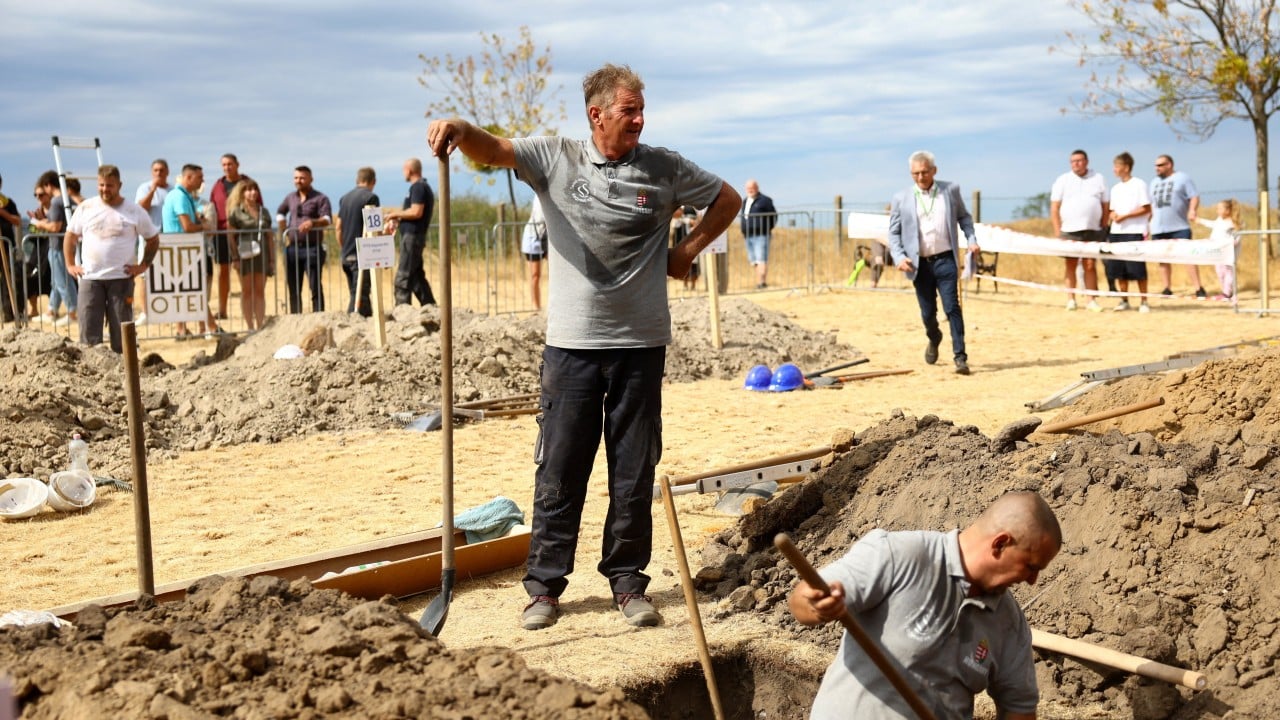
Every year, journalists descend upon Central and Eastern Europe to gawk at the Hungarian national gravedigging championships. They write the exact same piece. You know the formula. They frame it as a quirky, macabre curiosity. They marvel at how fast men and women can chuck dirt out of a standard-issue six-foot trench, treating a grueling test of athletic endurance like a carnival sideshow or a morbid local festival.
The lazy consensus is that these events are historical reenactments or dark novelties designed to blow off steam in a dying profession.
That perspective is arrogant, shortsighted, and completely wrong.
These competitions are not relics of the past. They are a brutal, unfiltered preview of the future of skilled labor in an economy that has systematically alienated people from physical competence. While white-collar workers obsess over ergonomic keyboards and productivity hacks, these competitors are executing a masterclass in biomechanics, spatial awareness, and efficiency under absolute physical duress.
We romanticize the digital nomad while mocking the physical anchor. We treat manual labor as something to be automated away or pitied, entirely ignoring the profound psychological clarity and mechanical precision it requires. If you want to understand why modern work feels so hollow, look at how we misinterpret the people who still know how to move earth.
The Anatomy of the Trench
Watch a novice pick up a shovel and you will see an immediate failure of leverage. They use their lower back. They lift with their arms. Within ten minutes, they are exhausted, blistered, and inefficient.
A professional gravedigger does not fight the earth. They negotiate with it.
At the championship level, teams of two do not just dig holes quickly; they sculpt them. The rules demand strict dimensions: usually two meters long, eighty centimeters wide, and a standardized depth. Precision matters more than raw speed. A sloppy wall collapses. A poorly angled shovel blade wastes precious calories.
Novice Approach:     Upper Body Force -> Lower Back Strain -> Rapid Fatigue
Professional Method: Gravity Leverage -> Core Stabilization -> Sustainable Rhythm
I have spent years watching skilled tradespeople operate in environments where margins for error are razor-thin. The mechanics required to move a cubic meter of dense clay without destroying your rotator cuffs rival the technical demands of a complex surgical procedure or writing production-grade code.
When competitors in Hungary clear a trench in under thirty minutes, they are not relying on brute strength alone. They use a synchronized cadence, shifting weight through their hips, utilizing the rebound of the shovel handle, and maintaining an exact angle of attack that preserves momentum. It is a kinetic choreography born of thousands of hours of repetition.
We look at this and call it backbreaking work. The truth is worse: desk jobs break bodies far faster than disciplined physical labor ever will. The sedentary worker suffers from chronic postural degradation, metabolic dysfunction, and repetitive strain injuries from clicking a mouse millions of times. The professional digger has calluses, sure, but they also possess functional strength that outlasts the corporate wellness programs offered in glass towers.
The Myth of Automation Anxiety
The standard narrative surrounding manual trades is that technology is coming to replace them. We are told that autonomous excavators, robotic trenchers, and heavy machinery will render human physical labor obsolete.
This argument reveals a profound ignorance of actual job sites.
Cemeteries are tight, delicate spaces. Roots, unmarked utility lines, shifting water tables, and proximity to existing headstones create a logistical nightmare for heavy equipment. A backhoe tears up turf, destroys surrounding plots, and requires a crew just to clean up its wake.
Human hands with a shovel remain the ultimate low-latency, high-adaptability tool.
Imagine a scenario where a sudden storm hits a historic cemetery, requiring emergency burials amidst unstable ground and tight constraints. A robotic unit stalls out, gets bogged down in the mud, or lacks the tactile feedback required to sense a hidden obstruction beneath the soil line. The human worker feels the shift in resistance through the shaft of the tool and adjusts instantly.
We suffer from a tech-solutionist bias. We assume that because a task is physical, it is automatically primitive and ripe for technological displacement. In reality, the physical dexterity required to shape earth cleanly under pressure is light-years ahead of what current robotics can achieve cost-effectively in constrained spaces.
The Dignity We Engineered Out of Work
Why do these competitions draw massive local crowds and fierce national pride? Because they honor competence.
Modern corporate structures have abstracted work so far away from tangible outcomes that millions of people can no longer point to a single physical thing and say, "I made that today." That abstraction breeds a very specific kind of existential dread.
When you spend eight hours shifting virtual spreadsheets that get reorganized by middle management the next morning, your brain knows it is trapped in a loop of circular nothingness.
The gravedigger suffers from no such delusion. The trench is either dug to specification, or it is not. The earth is moved, or it remains. There is an absolute, undeniable finality to the output. That clarity provides a psychological ballast that modern knowledge work has systematically destroyed.
We treat physical trades as a fallback option for those who could not hack the academic track. That is a cultural failure. We have created a caste system that devalues the people who literally build, maintain, and close out our physical existence.
The competitors in Hungary are not anomalies, nor are they performers in a morbid circus. They are the custodians of an unglamorous, essential truth: civilization rests on the backs of people who know how to do hard, physical things without complaining about their work-life balance.
Stop pitying the manual laborer. Start wondering how your desk job would hold up if the power went out and the soil started pushing back.