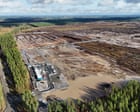
The frost in southern Finland does not just coat the pine needles; it settles into the bones. In small towns like Kirkkonummi, winter is an absolute condition. It dictates the rhythm of firewood, the crunch of frozen gravel under rubber boots, and the silent, heavy mist that rolls off the Baltic Sea before dawn.
For generations, the only things breaking that silence were the wind, the occasional migration of wild geese, and the hum of electric grid lines carrying power through the snow.
Then came the servers.
Walk into a modern hyperscale data center construction site, and you will not smell pine or woodsmoke. You will smell hot dust, curing epoxy, and the frantic, sweet exhaust of diesel generators idling outside. You will hear the low, mechanical drone of thousands of hard drives spinning up in unison—a metallic heartbeat that never sleeps, never shivers, and never adjusts to the changing seasons.
Google wanted to plant that heartbeat deep into the Finnish earth. They chose a plot near Hamina, and later expanded their ambitions, betting on the cool northern climate to naturally chill the thousands of processors required to feed the global appetite for searches, videos, and machine learning models. The logic was simple, seductive, and fundamentally arrogant: cold air is cheap, land is wide, and the digital cloud has to live somewhere.
Except the cloud is heavy.
When Google officials drew up blueprints to expand their operations, they ran straight into a wall of bureaucratic amber and local fury. Environmental authorities in Finland did not blink at the corporate stationery. They issued a halt. Stop working. Pause the concrete mixers. Turn off the trenching engines.
Why? Because cold air is not free when you trap millions of watts of thermal energy inside an enclosed box.
To understand what happened in Finland, you have to look past the corporate press releases and visit a local trout stream or an underground aquifer. Imagine standing on the banks of a shallow, peat-stained river where the water stays near-freezing for eight months of the year. Local fishermen have cast lines here since their grandfathers were boys. They know every snag, every deep pool where perch hide from the pike.
Now, imagine pumping millions of gallons of cooling water through a multi-story fortress of server racks, heating that water by twenty degrees, and discharging it back into the local watershed. To a tech executive in Mountain View, a slight thermal shift in a drainage ditch looks like a rounding error. To an ecologist tracking native salmonid spawning beds, it is an extinction event.
Water is the invisible tether of the digital age. We talk about the cloud as if it were vapor, weightless and drifting across the blue sky. We swipe our phones, stream high-definition documentaries, and prompt large language models without ever picturing the pump station humming three thousand miles away. We forget that every query requires energy, and every kilowatt of energy generates heat, and heat requires water to wash it away.
In Finland, water is not just a resource; it is part of the national identity. Lakes are numbered in the tens of thousands, and the right to roam and fish in clean waters is a constitutional birthright. When regional environmental agencies stepped in to halt the data center expansion, they were defending a boundary line. That line separates the infinite, frictionless expansion demanded by Silicon Valley from the finite, fragile reality of a local ecosystem.
Consider the human cost of this friction.
Mikko is a municipal planner in a coastal Finnish district. He is fifty-four years old, wears heavy wool sweaters under his parka, and spends his evenings looking at municipal balance sheets that do not quite add up. When tech giants arrive promising hundreds of high-tech jobs and millions in municipal tax revenue, they look like saviors to a town dealing with brain drain and aging populations. Mikko wanted to welcome them. He wanted his children to have careers in software engineering and cloud architecture without having to move to Helsinki or Stockholm.
Yet Mikko is also the person who has to answer to the local fishing cooperative when the temperature of the local bay rises by a fraction of a degree, altering the algae blooms and confusing the migration cues of local whitefish. He sat in meetings where corporate lawyers in sharp suits used words like "mitigation strategy" and "closed-loop thermal transfer," while local elders simply pointed out that the ice on the bay formed two weeks later than it did when they were kids.
The halt on Google’s datacentres is not merely a legal technicality or a zoning dispute. It is a collision between two different definitions of progress.
One definition views the earth as a platform—a passive substrate whose primary purpose is to dissipate heat and supply cheap hydroelectric power to fuel the computational engine of human history. In this view, every delay is an inefficiency, a bottleneck in the relentless march toward total connectivity.
The other definition views the earth as a home—a complex, interconnected web of physical limits where actions have immediate, localized consequences that cannot be smoothed over by a software patch.
When Finnish authorities ordered the heavy machinery to stop, they exposed a crack in the myth of the green transition. For years, the tech industry has marketed itself as clean because it does not belch black smoke into the sky like a nineteenth-century coal furnace. There are no smokestacks on a server farm. There are only sleek, windowless concrete bunkers surrounded by chain-link fences and security cameras.
But the smoke has simply been displaced. It has been converted into thermal pollution in rivers, massive baseload energy demands on national grids, and thirsty cooling towers that drink millions of gallons of municipal water every single day.
We are living through a quiet reckoning. The digital infrastructure that powers our modern lives is physical, heavy, and ravenous. It requires land, water, and power on a scale that few ordinary users ever pause to consider. When a corporation like Google is told to halt its work, it sends a tremor through the global tech ecosystem. It signals that even the most powerful companies on earth are bound by the carrying capacity of local watersheds and the stubborn resistance of communities who refuse to trade their environment for a server rack.
Standing by that frozen Finnish stream, watching the breath turn to ice crystals in the air, the silence returns. The excavators are parked, their tracks frozen into the mud. For a moment, the natural order reasserts itself. The water flows cold and dark over the stones, indifferent to the algorithms waiting to be run, the queries waiting to be answered, and the massive, hungry data centers waiting to be built.