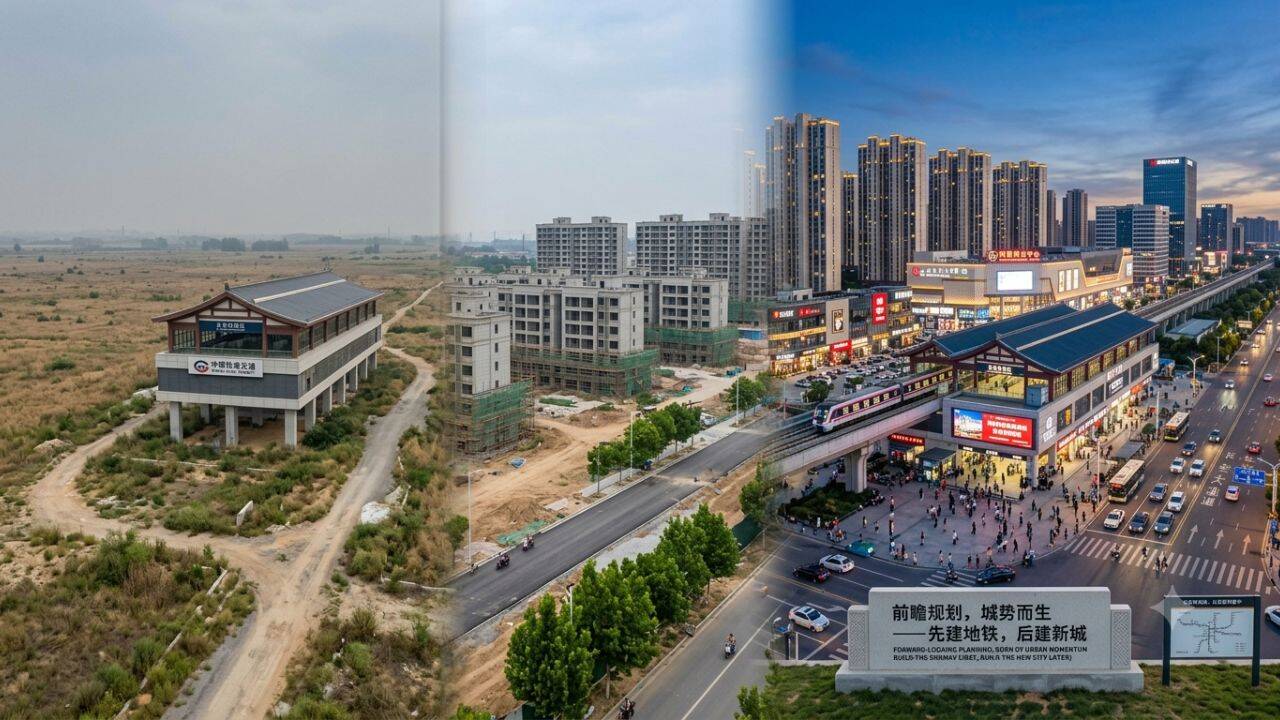
Western media laughed when photos of the Caojiawan subway station went viral in 2017.
The images looked dystopian. An isolated concrete block poked out of an overgrown, weed-choked field in Chongqing. There were no roads, no houses, and no passengers. Just an elevator and a staircase leading underground into a fully functioning, modern transit hub. Critics mocked it as the ultimate symbol of Chinese government waste. They called it a ghost station, a classic example of central planning gone mad.
Fast forward a few years. The weeds are gone. The dirt tracks have been replaced by multi-lane paved avenues. High-rise apartment buildings block the horizon, housing thousands of residents who walk to that exact same station every morning to commute to work.
The joke, it turns out, was on the critics.
Building infrastructure in the middle of nowhere looks stupid if you only think about the next fiscal quarter. But China plays a different game. They use a strategy called transit-oriented development. They build the subway first, and let the city grow around it. It turns out that building a city around a subway station is vastly cheaper, faster, and more efficient than trying to retroactively wedge a subway line into an already crowded metropolis.
The Viral Mystery of Caojiawan Station
Let's look at the actual facts of the Chongqing example because the timeline matters. Line 6 of the Chongqing Rail Transit opened its extension in 2015. Caojiawan was one of those stations. When the station opened, only one of its three planned exits was operational. The other two were hidden by dense brush.
Commuters who got off there were usually lost or lived in tiny rural villages nearby. To the untrained eye, it made zero financial sense. Millions of dollars spent on an underground station that served more goats than humans.
By 2020, the entire scene had transformed. Major real estate developers like Sunac and Longfor Properties bought the surrounding land. They built massive residential complexes. The local government put down primary schools, commercial plazas, and secondary roads connecting to the main station. The ghost station became a neighborhood anchor.
This was not an accident or a lucky break. It was the plan from day one.
When you build a transit system through an empty field, you don't have to worry about displacing thousands of residents. You don't have to pay billions in compensation to property owners. You don't have to navigate a maze of existing underground gas lines, water pipes, or older foundations. You just dig.
Why Retrofitting Infrastructure Fails in the West
Look at how major cities in Europe or North America build transit. They wait until a neighborhood is completely congested. The traffic becomes unbearable. The residents complain for a decade. Finally, the city approves a new subway line or light rail extension.
Then the real nightmare begins.
Property acquisition costs skyrocket because the land is already developed. Environmental impact reports take five years. Utility companies spend months moving ancient pipes. Neighbors file lawsuits over construction noise and falling property values. By the time the first train runs, the project is ten years late and billions over budget.
New York's Second Avenue Subway is the poster child for this approach. It took decades to build a tiny three-station extension, costing over 4 billion dollars per mile. That is an insane amount of money.
China avoids this entire mess by flipping the script. They acquire cheap rural land on the outskirts of growing cities. They run the rail line through it. Then they rezone the surrounding land for high-density housing and commercial use.
The value of that land skyrockets the moment the subway station opens. The local government then sells the development rights to private real estate companies. The profit from those land sales pays for the construction of the subway itself. It is a self-funding urban growth machine.
The Financial Engine of Infrastructure-Led Growth
The economics of this model are fascinating. Local governments in China rely heavily on land lease sales for revenue. If they sell a piece of raw farmland to a developer, it fetches a low price. But if they run a subway line directly through that farmland first, the value of that land multiplies by ten or twenty times.
Think about it from a developer's perspective. You can buy cheap land far from the city center, but you know a subway line is already operating there. You can market your new apartments to young buyers by promising a 30-minute commute to the downtown core. The apartments sell fast. The city gets a new tax base. The residents get affordable housing with built-in public transit.
It is a stark contrast to the suburban sprawl seen in places like Houston or Atlanta. In those cities, developers build massive subdivisions out in the fields first. Then everyone drives a car, creating traffic jams on the highways. Decades later, the city tries to figure out how to extend buses or trains out to them, which is often logistically impossible.
Chongqing did not just do this at Caojiawan. They repeated this strategy across their massive network. The city has over 30 million people and some of the most challenging terrain on earth, sitting on mountains and split by massive rivers. Yet, their rail transit network has grown to hundreds of miles in just two decades.
The Risks of the Build-It-First Model
This strategy is not flawless. It requires massive upfront capital and a lot of confidence that the population will keep growing.
If the national economy slows down or urbanization stalls, those ghost stations can stay ghosts for a long time. China has faced a massive real estate slowdown recently. Some cities that overbuilt infrastructure based on overly optimistic population projections are now struggling with immense debt.
When local governments borrow billions from state banks to build subways through empty fields, they expect to pay off those debts quickly via land sales. When the real estate market slumps, those land sales dry up. You are left with high interest payments and low ridership.
We see this happening in some lower-tier cities. They tried to copy the Chongqing or Shanghai model but lacked the economic gravity to attract new residents. A subway station in an empty field only works if people actually want to move to that city. If the local job market is weak, the field stays a field, and the station just eats up maintenance money.
But in premier economic hubs, the model has proven itself over and over.
What Planners Can Learn From the Long Game
If you want to understand how cities should grow, look at the integration between transport planning and land use. You cannot separate the two.
When you look at a transit map of a city like London or Paris, you are looking at layers of history. The lines curve and twist to avoid old historic buildings or difficult geography. In contrast, Chinese urban planners have the luxury of a blank canvas on the city fringes. They can design straight, fast, efficient rail corridors.
The real lesson here is about time horizons.
Urban planning shouldn't be judged by how a project looks in its first twelve months. True infrastructure takes a decade to mature. If you visit a new station and see empty fields, you are simply looking at a movie that has been paused in the first ten minutes. You have to wait for the rest of the plot to unfold.
For anyone analyzing global infrastructure or real estate trends, the takeaway is clear. Stop looking at immediate ridership numbers to judge the value of a new transit line. Look at the zoning laws around the stations. Look at the population flow. Look at the long-term master plan.
The next time you see a picture of a random subway exit surrounded by weeds and dirt, don't assume someone messed up. Assume that in five years, you will be looking at a thriving neighborhood.
If you are evaluating urban real estate markets or municipal bonds, look for cities that prioritize infrastructure before development. It is the single most reliable indicator of sustainable, long-term economic growth. Avoid the cities that wait for the crisis before they build the solution.