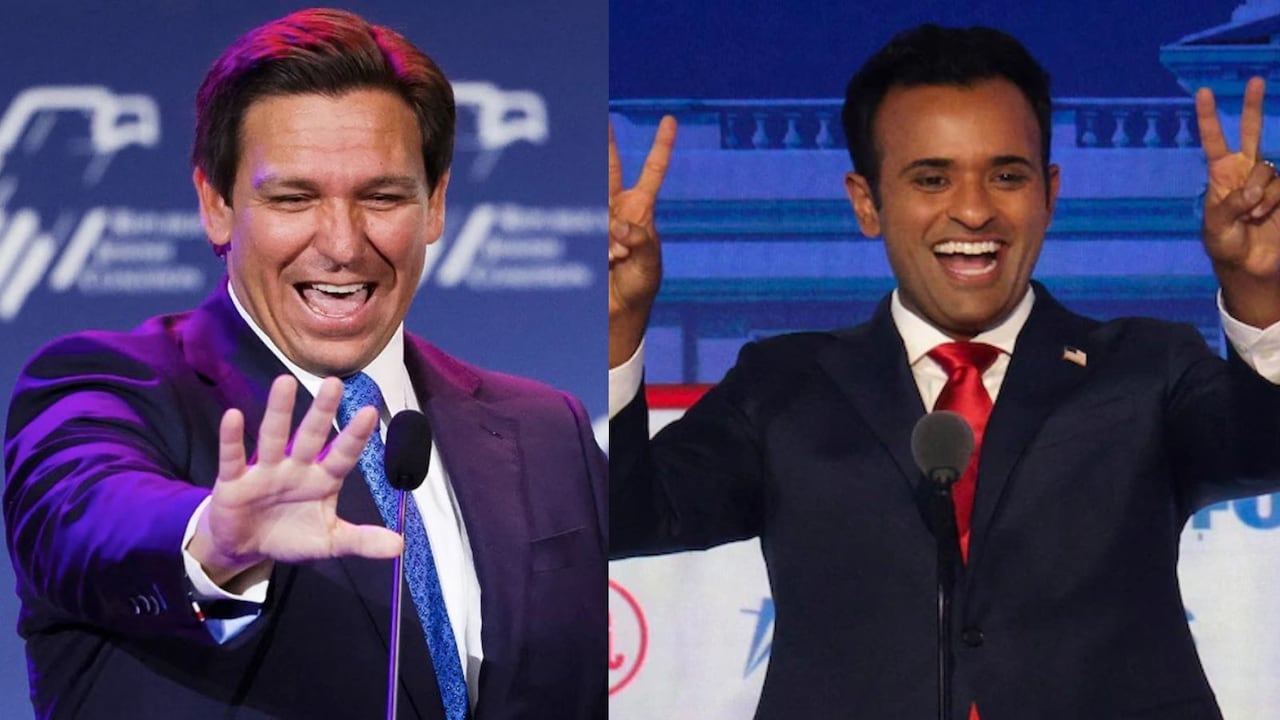
Political commentators love a neat label. When Florida Governor Ron DeSantis reportedly dismissed Vivek Ramaswamy as merely a "tech guy" following political setbacks in Ohio, the pundit class immediately latched onto the soundbite. According to political analysts and standard campaign narratives, framing an opponent as a Silicon Valley-adjacent outsider is a classic move designed to paint them as out of touch with working-class voters and traditional governance.
That framing relies on an outdated understanding of both the technology sector and modern political machinery.
To understand why the "tech guy" label fails as a political critique, we first have to correct a basic factual misunderstanding. Vivek Ramaswamy did not build his career writing code in Palo Alto. According to public corporate filings and financial reporting, Ramaswamy made his fortune in biotechnology and finance—founding Roivant Sciences, a pharmaceutical holding company, and later launching Strive Asset Management. Lumping biotech and financial engineering under the generic umbrella of "tech" demonstrates a fundamental lack of precision in how political operatives analyze business backgrounds.
More importantly, the critique assumes that a background in high-growth, data-driven industries is a liability in governance. In reality, the mechanics of modern political campaigns and executive administration increasingly mirror the operational playbooks of venture-backed enterprises.
The Myth of the Traditional Executive
The lazy consensus in political strategy holds that traditional legislative or gubernatorial experience is the only valid preparation for high office. Critics of business-sector candidates argue that government is not a company, pointing out that public administration requires coalition-building, statutory compliance, and constituent service rather than quarterly profit maximization.
There is truth in that distinction. Elected officials cannot simply lay off underperforming agencies or pivot away from unprofitable public services. According to public administration scholars, executives who treat government strictly like a startup often collide with civil service protections, legislative gridlock, and constitutional constraints.
However, traditional political executives frequently suffer from the exact opposite flaw: institutional capture. Career politicians are trained to manage existing bureaucracies rather than question whether those bureaucracies should exist in their current form. When a career governor critiques an outsider as a "tech guy," they are defending an institutional model of governance that prioritizes incremental management over structural overhaul.
How Data and Capital Actually Move Voters
Look closely at how modern campaigns operate. The days of relying solely on county party chairs, television ad buys, and retail diner stops are over.
Today, winning a primary or a general election requires:
- Algorithmic micro-targeting: Campaign teams use massive datasets to model voter behavior down to the individual household.
- Direct-to-voter media ecosystems: Candidates bypass legacy journalists entirely, building independent distribution networks on podcasts, X, and YouTube.
- Venture-style fundraising: Small-dollar digital fundraising operates on the exact same customer acquisition cost (CAC) and lifetime value (LTV) metrics used by consumer software companies.
According to campaign finance disclosures and digital strategy reports from recent election cycles, candidates who master these direct-to-consumer mechanics consistently outperform traditional politicians in earned media per dollar spent. Ramaswamy's rise from near-zero name recognition to a prominent national figure was not an accident; it was the direct result of applying high-velocity media distribution principles to a stagnant political market.
The Ohio Factor and the Limits of Disruption
Dismissing a candidate's regional performance—such as struggles in a specific state like Ohio—as proof that their background is disqualified ignores the actual mechanics of local politics.
In states with deeply entrenched party apparatuses, primary outcomes are heavily dictated by local endorsements, ballot access rules, and institutional muscle. Political operatives in Ohio have noted that statewide races often hinge on long-standing relationships with county-level leaders and established donor networks. An outsider running a nationalized, media-first campaign will naturally face friction when colliding with localized, relationship-driven political machines.
That friction is not an indictment of a candidate's industry background. It is a structural clash between two completely different operating systems:
- The Institutional Model: Relies on hierarchy, endorsements, legislative track records, and geographic coalition building. It is slow, predictable, and resilient against sudden shifts in public sentiment.
- The Disruptor Model: Relies on narrative velocity, direct audience engagement, asymmetric media appearances, and ideological disruption. It scales rapidly, generates massive attention, but lacks local ground-game infrastructure.
When DeSantis or any traditional executive attacks a rival as a "tech guy," they are attempting to validate the Institutional Model while delegitimizing the Disruptor Model. Yet, as political historians point out, the Republican Party—and American politics broadly—has spent the last decade moving decisively away from institutional gatekeepers.
The Real Risk of the Outsider Playbook
Acknowledging the power of the business-outsider approach does not mean ignoring its glaring vulnerabilities. Anyone who has watched corporate executives transition into politics knows where the model breaks down.
First, business leaders often mistake attention for persuasion. In the attention economy, generating clicks, podcast downloads, and viral clips is the primary metric of success. In politics, polarizing rhetoric that maximizes online engagement can simultaneously alienate the median primary voter needed to win a statewide race.
Second, corporate founders are accustomed to unilateral decision-making. When a CEO issues a directive, the organization executes. When a political candidate or officeholder issues a directive, they face immediate pushback from independent legislators, courts, and rival factions within their own party. Without the patience for tedious political retail work, outsider candidates frequently stall when their initial media surge plateaus.
What Voters Actually Want to Know
When voters search for comparisons between traditional politicians like Ron DeSantis and business outsiders like Vivek Ramaswamy, they are rarely asking about resumes. They are asking a much more fundamental question: Which model of leadership is capable of breaking through bureaucratic inertia?
The "tech guy" insult attempts to frame the debate as competence versus naivete. Career politicians want voters to believe that knowing how to pass a bill through a state legislature is the ultimate test of executive readiness. Meanwhile, business-sector candidates argue that knowing how to build an organization from scratch is far more relevant to reforming an ossified federal government.
Both arguments miss the reality of modern executive power. Governing effectively requires combining the structural discipline of an institutional executive with the asymmetric communication and operational agility of a modern founder.
Political strategists who continue to dismiss business and tech-adjacent figures as mere novelties are fighting the last war. The labels of "career politician" and "tech guy" are rapidly losing their descriptive power as the tools of software, finance, and digital media become the foundational infrastructure of American politics. Campaigns that fail to adapt to this reality will find themselves outmaneuvered, regardless of how many traditional endorsements they collect.