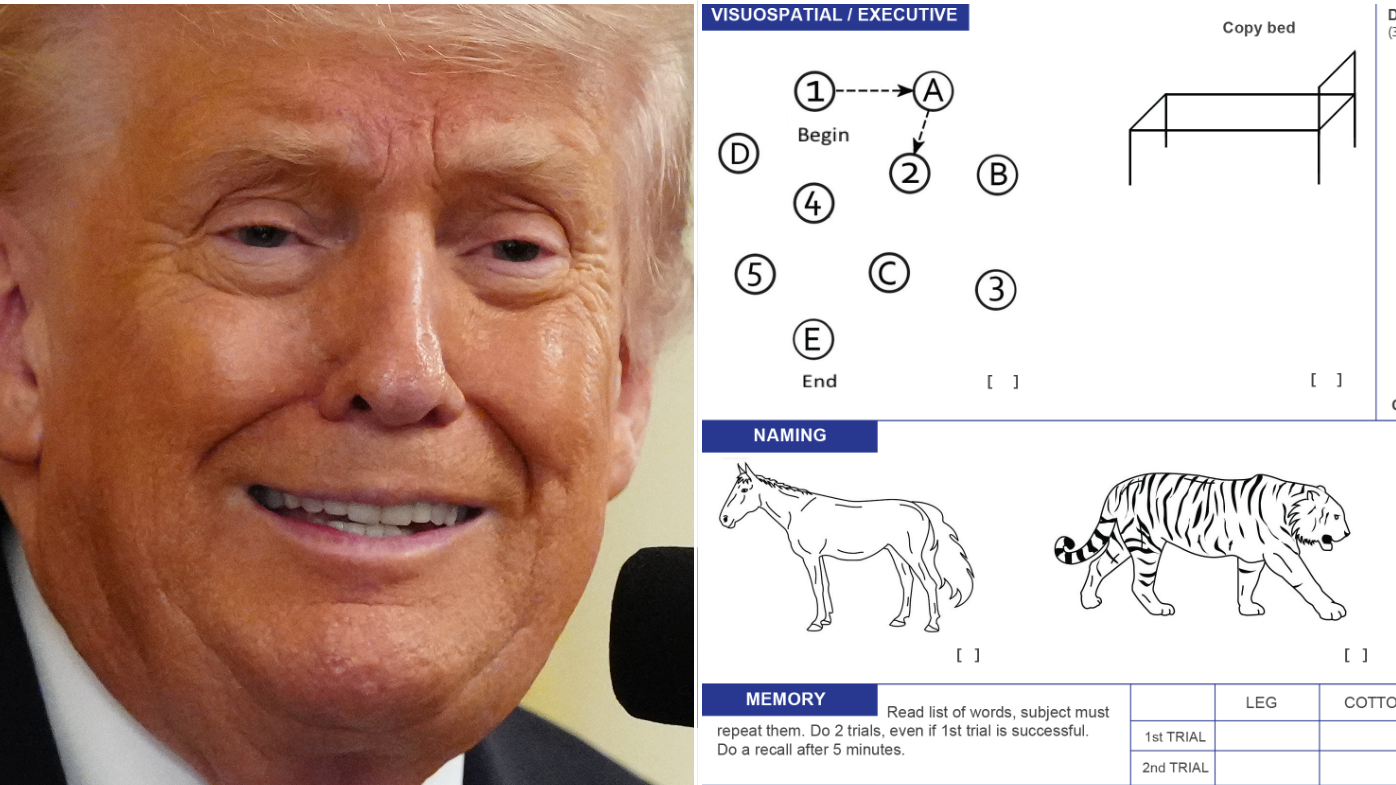
The Montreal Cognitive Assessment (MoCA) was never meant to measure brilliance. It was designed to detect failure. Specifically, the failure of the human brain to perform basic executive functions due to Alzheimer’s, Parkinson’s, or vascular dementia. When a political figure stands before a microphone and touts a "perfect score" on this test as evidence of a high IQ or mental superiority, they aren't just misrepresenting the data. They are fundamentally misunderstanding the floor of human intelligence.
For a veteran neurologist, watching a public figure brag about passing a MoCA is like watching a professional athlete brag about passing a basic vision test. Yes, you can see the letters on the wall, but that doesn't mean you can play the game. The test is a screening tool, a tripwire meant to catch early signs of cognitive decline before they become catastrophic. It is not, and has never been, a trophy for the gifted.
The Mechanics of the MoCA
To understand why these boasts fall flat, you have to look at what the test actually asks of a patient. It is a 30-point, ten-minute exercise. It involves drawing a clock, identifying an animal like a lion or a camel, and repeating a short list of words.
The "hard" part—the section often cited as a feat of memory—usually involves repeating five words like "velvet, daisy, church, red, face" after a brief delay. For a healthy adult, this is a baseline expectation. For someone in the early stages of neurodegenerative disease, the connections required to hold those unrelated concepts in short-term memory are beginning to fray. When a doctor sees a patient score a 30 out of 30, they don't see a genius. They see someone who is, for the moment, "cognitively intact."
The Intelligence Fallacy
Intelligence is a multifaceted construction of logic, verbal fluency, spatial reasoning, and emotional regulation. A standard IQ test takes hours, administered by a psychologist who measures how you solve novel problems. The MoCA measures whether you know what day it is and if you can subtract seven from 100 five times in a row.
The danger in conflating these two things is more than just a matter of semantics. When we allow the narrative to shift from "is this person healthy?" to "is this person a genius because they know what a rhinoceros looks like?", we lower the bar for leadership to a frightening depth. We are no longer debating policy or temperament; we are debating whether the person in charge has the basic neurological equipment to function in society.
Why the "Perfect Score" is a Red Flag
In a clinical setting, a perfect score is the starting point. Doctors use it to rule out gross impairment. However, researchers have long known that the MoCA has a "ceiling effect." This means that for high-functioning individuals—people with advanced degrees, CEOs, or high-ranking officials—the test might not be sensitive enough to catch subtle decline.
A "super-ager" or a highly educated professional might have enough "cognitive reserve" to mask the early stages of decline. They might score a 28 or a 30 even while their family notices they are becoming more impulsive, irritable, or forgetful in complex situations. This is why neurologists rarely rely on the MoCA alone. They look at the "how" behind the answers. Did the patient struggle with the clock drawing but eventually get it right? Was there a delay in word retrieval?
When a politician uses the score as a shield, they are utilizing a clinical tool as a political weapon. It ignores the reality that high-stakes decision-making requires far more than the ability to distinguish a camel from a hippopotamus. It requires judgment, and judgment is often the first thing to go, long before you forget the word "velvet."
The Politics of the Pen
There is a specific irony in the public's fixation on these tests. The more a leader insists on their mental fitness, the more they invite scrutiny into the very lapses they seek to hide. The MoCA was designed by Dr. Ziad Nasreddine in 1996 as a way to provide a more rigorous alternative to the Mini-Mental State Examination (MMSE). It was meant to be harder because the MMSE was too easy.
By boasting about passing the MoCA, politicians are essentially celebrating that they haven't slipped below a threshold that would require medical intervention or assisted living. It is a defensive posture disguised as an offensive one.
The Hidden Baseline of Executive Function
The most telling parts of the MoCA are the sections on executive function. This includes "trail making," where the subject connects letters and numbers in sequence (1-A, 2-B, and so on). This requires the brain to switch between two different mental sets. It tests the prefrontal cortex—the CEO of the brain.
http://googleusercontent.com/image_content/223
If the prefrontal cortex is damaged, a person might become socially inappropriate, lose the ability to plan for the future, or become unable to grasp the consequences of their actions. These are the traits we should be evaluating in leaders. Yet, the MoCA only tells us if the hardware is still plugged in. It tells us nothing about the software running on it.
The Medicalization of Political Fitness
We have entered an era where medical records are treated like opposition research. This shift has forced doctors into the uncomfortable position of seeing their diagnostic tools turned into soundbites. Dr. Nasreddine himself has had to repeatedly clarify that his test is not an IQ test and should not be used as one.
The reality of aging in the public eye is that every stutter, every missed name, and every confused anecdote is magnified. In response, the "perfect cognitive test" has become a modern security blanket. But for those who understand the science, the blanket is transparent.
The standard for the most powerful office in the world shouldn't be "not demented." If the baseline for leadership is simply avoiding a clinical diagnosis of cognitive impairment, the threshold for competence has moved from the realm of achievement into the realm of basic biology.
We are looking for a pilot who can navigate a storm, but we are being told to celebrate because the pilot knows where the cockpit is. The MoCA can tell you if the pilot's eyes work, but it can't tell you if they know how to fly the plane when the engines fail.
Demand more than a passing grade on a screening tool. A score of 30 doesn't mean a leader is sharp; it just means they aren't lost yet. The distinction is everything.