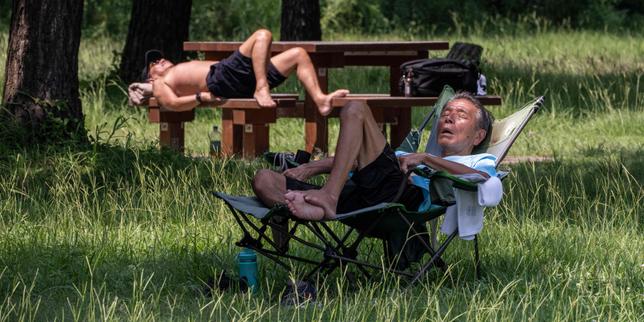
Japan is formalizing a chilling reality in its meteorological lexicon as temperatures routinely breach forty degrees Celsius. The emergence of the term Kokushobi—translating literally to "cruelly hot days"—marks a grim milestone in East Asia's climate emergency. Where the Japan Meteorological Agency once treated temperatures above thirty-five degrees as rare anomalies worthy of the top tier label Moshobi, recurring surges past forty degrees have rendered the old classification system obsolete. The country is not merely updating its vocabulary; it is scrambling to adapt its urban infrastructure, public health systems, and labor laws to keep citizens alive.
Language reflects survival. For decades, Japanese weather broadcasts relied on a predictable hierarchy of summer tiers: Natsubi for days reaching twenty-five degrees, Manatsubi for thirty degrees, and Moshobi for intense heat exceeding thirty-five degrees. When the Japan Weather Association introduced Moshobi in 2007, municipal officials assumed it covered the absolute ceiling of atmospheric extremity. That assumption proved dangerously naive. Within a decade, city centers like Kumagaya, Sano, and Isesaki began recording temperatures reaching forty point eight degrees, shattering century-old national records and leaving emergency services overwhelmed.
When mercury crosses the forty-degree threshold, human physiology undergoes rapid, devastating stress. Thermoregulation breaks down. Sweat stops evaporating effectively in coastal urban humidity, pushing internal core temperatures into lethal zones within thirty minutes of direct exposure. This is not uncomfortable summer weather. It is a hazardous biological environment.
The official recognition of Kokushobi is less about linguistic precision and more about triggering emergency public health protocols.
+-----------------------------------------------------------------------+
|                 JAPAN METEOROLOGICAL HEAT TIER SYSTEM                 |
+-------------------+-------------------+-------------------------------+
| Term              | Threshold         | Primary Public Health Threat  |
+-------------------+-------------------+-------------------------------+
| Natsubi           | >= 25°C (77°F)    | Mild discomfort, dehydration  |
| Manatsubi         | >= 30°C (86°F)    | Moderate exertion fatigue     |
| Moshobi           | >= 35°C (95°F)    | High heatstroke risk          |
| Kokushobi         | >= 40°C (104°F)   | Fatal organ strain, system collapse
+-------------------+-------------------+-------------------------------+
The demographic vulnerability of Japan compounds the crisis in ways western nations rarely calculate. More than twenty-nine percent of the population is over the age of sixty-five. The human body loses its ability to sense ambient temperature shifts as it ages, meaning thousands of senior citizens sit quietly inside stifling rooms without realizing they are drifting into severe hyperthermia.
Every July and August, hospital emergency rooms in Tokyo, Osaka, and Nagoya fill with victims of Netsuchusho—heatstroke—transported directly from their own living rooms. A deep cultural aversion to electricity waste, ingrained during post-war austerity and reinforced after the 2011 Fukushima nuclear disaster, convinces many elderly residents to leave air conditioners powered off even as indoor temperatures climb past thirty-eight degrees.
Emergency calls spike exponentially on Kokushobi days. Paramedics operate at maximum capacity, sometimes taking hours to find an available hospital bed as emergency departments reach total saturation.
The economic fallout stretches far beyond healthcare capacity. Industrial productivity collapses under forty-degree conditions. Construction firms across Kantō and Kansai have been forced to rewrite operational schedules, shifting heavy manual labor to late evening or pre-dawn shifts. Yet even night-time temperatures rarely drop below twenty-eight degrees, creating persistent Nettaiya—tropical nights—that prevent body cooling and lead to chronic sleep deprivation among outdoor workers.
Japan's Ministry of Health, Labour and Welfare faces mounting pressure from labor unions to mandate immediate work stoppages when wet-bulb globe temperature indices reach critical thresholds. Historically, Japanese corporate culture relies on voluntary compliance rather than hard statutory limits. That soft approach is proving deadly. Field reports from infrastructure sites show a surge in workplace accidents directly tied to cognitive decline caused by extreme heat stress.
Consider the physical reality of urban space.
Tokyo is a mega-structure built of heat-retaining concrete, steel, and asphalt. During a Kokushobi event, surface temperatures on asphalt streets can surpass sixty degrees Celsius, creating a suffocating layer of radiant heat that radiates upward precisely at human height. Glass skyscrapers reflect solar energy downward into narrow street canyons, trapping stagnant air and raising local microclimates several degrees above surrounding rural areas.
City planners have attempted localized interventions. Municipalities have sprayed millions of liters of treated wastewater onto streets in traditional Uchimizu rituals, painted miles of bus lanes with solar-reflective thermal coatings, and installed high-pressure misting stations outside train stations.
These efforts are localized band-aids on a systemic wound.
Reflective coatings degrade under heavy traffic within two years. Misting systems increase local humidity, which can actually hinder sweat evaporation when atmospheric humidity is already high. The stark reality is that Japanese cities were engineered for a temperate climate that no longer exists.
The power grid represents another catastrophic single point of failure.
When tens of millions of air conditioning units kick on simultaneously during a Kokushobi peak at two in the afternoon, the national electrical grid faces severe strain. Japan's energy supply relies heavily on imported fossil fuels following the widespread shutdown of nuclear reactors over the past decade. Energy grid operators frequently issue mandatory power conservation alerts during heatwaves, asking citizens to turn off unnecessary lights and moderate air conditioning usage—a directive that directly conflicts with life-saving public health messaging.
If a major earthquake or typhoon were to trigger a regional blackout during a forty-degree heatwave, the death toll from thermal exposure could outpace the immediate casualties of the natural disaster itself. Disaster response planners in Tokyo are quietly preparing for this exact compound disaster scenario, though few publicly acknowledge the extreme difficulty of evacuation under such conditions.
Agriculture tells an equally alarming story.
The prized rice paddies of Niigata and Ibaraki require precise water temperatures to yield high-quality grains. Prolonged exposure to temperatures exceeding thirty-five degrees during the critical flowering stage causes chalky rice grains, reducing commercial value and threatening domestic food security. Livestock operations report plummeting milk production and high mortality rates in poultry farms lacking advanced mechanical cooling.
The economic burden filters down to small businesses and municipal budgets. Local governments are converting public libraries, sports centers, and community halls into designated climate shelters. These spaces offer filtered air conditioning for vulnerable residents who cannot afford soaring electricity bills. Yet rural towns with shrinking tax bases struggle to fund these cooling hubs, creating a geographic divide in survival infrastructure between wealthy urban centers and dying provincial villages.
Legal frameworks remain dangerously behind atmospheric realities.
While Japan's revised Climate Change Adaptation Act created designated heatstroke prevention alerts, it stops short of granting local authorities the legal power to shut down private businesses, close commercial districts, or halt public transport during Kokushobi events. Authority remains decentralized, leaving school boards, factory managers, and transport operators to make haphazard decisions based on internal risk tolerance rather than unified scientific mandates.
Schools highlight this administrative paralysis. While most public school classrooms now have basic air conditioning, athletic fields and gymnasiums frequently do not. Tragic incidents of heat-induced collapse during mandatory afternoon sports practices continue to make national headlines, exposing a institutional failure to adapt legacy routines to extreme thermal environments.
The global implications of Japan's struggles are immediate.
Nations across temperate zones in Europe and North America look at Japan as an early-warning system for rapid urban thermal adaptation. If a technologically advanced, highly organized society with world-class public infrastructure struggles to protect its population from forty-degree heatwaves, less prepared regions face catastrophic vulnerability.
The creation of the term Kokushobi is not a stylistic linguistic update. It is a formal admission that the climate baseline has fundamentally shifted. The challenge facing Japan is no longer preparing for an occasional hot summer; it is rebuilding the physical, legal, and social architecture of an entire nation to withstand an era of relentless heat.
Adapting to this environment demands massive structural investment: hardening the energy grid with resilient renewable microgrids, overhauling building codes to mandate passive cooling, enforcing strict legal caps on outdoor labor, and culturally dismantling the dangerous ideal of enduring discomfort through sheer willpower.
Japan's survival in a forty-degree world depends on treating heat not as an inconvenient weather event, but as a silent disaster.