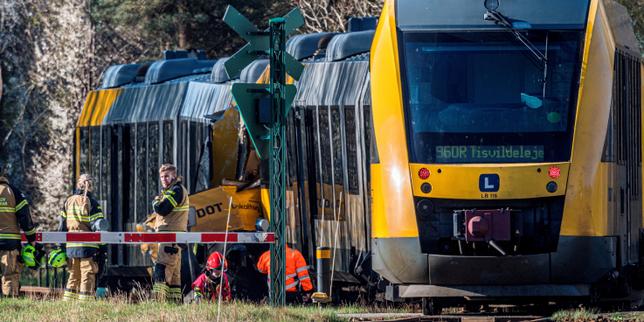
Modern rail reporting is a masterclass in missing the point. The headlines currently bleeding across European feeds focus on a single collision in Denmark: seventeen injured, five critical. The narrative is predictable. It centers on "tragedy," "failure," and the inevitable call for more expensive, redundant safety layers that slow down progress and hike up ticket prices.
This isn't about being heartless. It's about being honest.
If we keep chasing the phantom of "zero accidents," we will eventually regulate rail into a museum exhibit. The real scandal isn't that trains occasionally hit each other. The real scandal is how safe rail actually is compared to the alternatives we force people into when we make trains too expensive or too slow to use.
The Safety Paradox of European Infrastructure
Mainstream media views an accident as a systemic breakdown. I view it as a statistical certainty within an incredibly high-performing system.
When you look at the data from the European Union Agency for Railways (ERA), the numbers are staggering. Rail is roughly 20 to 30 times safer than traveling by car. Yet, when a car crash happens, it’s a local traffic update. When a train collision occurs, it’s a national crisis that halts infrastructure planning.
This hyper-fixation on rare rail failures creates a perverse incentive for regulators. They demand more "failsafes" that add friction to the network. Every minute added to a commute or every Euro added to a fare by over-engineered safety protocols pushes travelers back into the most dangerous place they can be: the driver's seat of a car.
By obsessing over the seventeen people injured in Denmark, we ignore the thousands who will die on European highways this year because the rail system wasn't efficient enough to win their business.
The High Cost of the Moral High Ground
Imagine a scenario where we spend €500 million to implement a new signaling layer that prevents exactly one low-speed collision every decade. On paper, it's a win. In reality, it’s a catastrophic misallocation of capital.
That same €500 million could have been used to expand high-speed lines, automate freight, or reduce the cost of entry for suburban commuters. I have seen transit authorities incinerate budgets on marginal safety gains while their core infrastructure rots. They do it because "safety" is a shield against political criticism. No one gets fired for overspending on a safety system, even if it makes the train twice as slow. They get fired when a headline says "Collision."
We are currently suffering from a "safety at any price" mentality that is actively killing the industry's competitiveness. If we want to save lives, we need more trains running, not more reasons to keep them in the station for "inspection."
The Myth of the Human Error Boogeyman
The competitor articles love to hunt for a villain. Was it a distracted driver? A signaling glitch? A maintenance oversight?
This line of questioning is fundamentally flawed. In any complex system involving thousands of tons of steel moving at high speeds, "human error" is a constant, not a variable. The goal shouldn't be to eliminate the error—that’s impossible—but to build a system that absorbs the error without a total collapse.
However, we have reached a point of diminishing returns. The European Rail Traffic Management System (ERTMS) is a brilliant piece of engineering, but it isn't a magic wand. There is a baseline risk to moving humans across a continent. If we refuse to accept that baseline, we are lying to ourselves.
The Danish incident will likely lead to a "review" of protocols. What that actually means is more paperwork, more bureaucracy, and more delays for the average passenger. It’s a performative dance designed to appease a public that doesn't understand the trade-offs of modern engineering.
Why We Need More Risk, Not Less
This is the part where the "industry experts" start clutching their pearls. But the truth is simple: an aggressive, slightly more risky rail network is better for society than a stagnant, "perfectly safe" one.
Look at the history of industrial progress. Shipping, aviation, and energy all scaled by accepting a managed level of risk and iterating quickly. When we treat a rail accident as a moral failing rather than a technical data point, we freeze the technology in time.
The obsession with the "critical state" of five passengers is a distraction from the critical state of the European economy. We need a transport backbone that is fast, cheap, and ubiquitous. You cannot achieve that if you treat every fender-bender on the tracks like a nuclear meltdown.
Stop Asking "How Did This Happen?"
The "People Also Ask" sections are filled with questions like "How safe are Danish trains?" or "What caused the collision?" These are the wrong questions.
The right question is: "What is the opportunity cost of the reaction to this accident?"
If the reaction is a six-month delay on network upgrades or a hike in regional taxes to pay for new sensors, the cost is too high. We are prioritizing the emotional satisfaction of "doing something" over the cold, hard reality of transport logistics.
I’ve spent years in boardrooms where "safety first" was used as a code word for "we are too afraid to innovate." It’s a comfortable lie. It allows mediocre managers to hide behind compliance checklists while the world moves past them.
The Uncomfortable Truth About "State of the Art"
We like to think our modern systems are infallible. They aren't. They are just complicated. Complexity often breeds new, unpredictable types of failure.
A collision in 2026 isn't a sign that we’re regressing. It’s a sign that we are operating a massive, high-pressure system at scale. The fact that these incidents are so rare that they make international news is actually proof of the system's success, not its failure.
But instead of celebrating that success, we use these moments to tighten the noose around the industry's neck. We demand "answers" that satisfy a 24-hour news cycle but ignore the physics of the problem.
Rail is a volume business. To make it work, you need speed and frequency. Safety protocols that hinder speed and frequency are, by definition, anti-rail. They are an existential threat to the mode of transport that is supposed to save us from our carbon-heavy, car-choked reality.
The Hard Choice
We can have a rail system that is 100% safe, 0% efficient, and 1000% more expensive. Or we can accept that occasionally, things go wrong.
The seventeen people in Denmark are a statistic in a system that protects millions of others every day. If we let their injuries dictate the future of infrastructure policy, we aren't being compassionate. We are being irrational.
The next time you see a headline about a train accident, don't ask for more regulations. Ask why we aren't building more tracks. Ask why we aren't making trains faster. Ask why we are so afraid of a risk that is already lower than almost anything else we do in our daily lives.
Stop pretending that "safety" is a neutral goal. It’s a trade-off. And right now, we are trading away our future for the illusion of total security.
Accept the crash. Build the next line anyway.