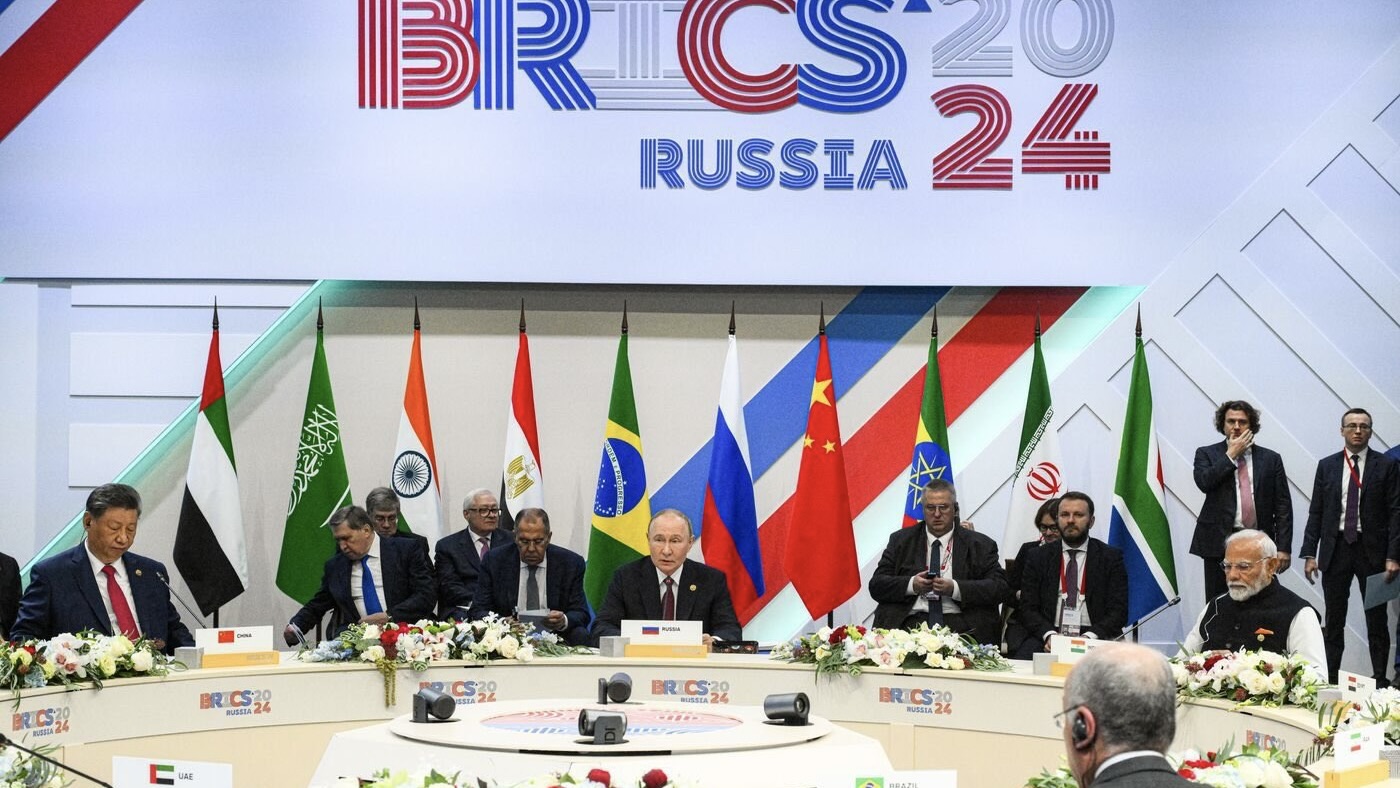
Every major media outlet swallowed the talking point wholesale. World leaders packed their bags and left New Delhi following the 18th BRICS Summit, and the headlines breathlessly announced an impending revolution in global finance. They told you the dollar's monopoly is finished. They told you a unified currency is right around the corner, backed by gold, ready to dethrone Washington and rewrite the rules of international trade.
It is a fairy tale for politicians who need a domestic win and commentators who do not understand balance sheets. Recently making headlines in this space: The Locked Door in Vienna That Could Decide the Fate of Nations.
I spent two decades advising sovereign debt desks and watching state-directed capital evaporate into thin air. I have seen central banks panic when their liquidity dries up, and I can tell you with absolute certainty that BRICS is not an economic bloc. It is an awkward geopolitical speed-dating group trapped in a room with incompatible interests, conflicting currency controls, and a profound lack of mutual trust.
Let us start with the core delusion: the grand de-dollarization push. Further insights into this topic are explored by Reuters.
The lazy consensus claims that because China, Russia, India, Brazil, and South Africa are trading in local currencies—like settling oil transactions in yuan or rupees—the dollar is bleeding out. Look at the mechanics. When India buys discounted Russian crude, it pays in rupees. Now, what does the Russian central bank do with billions of rupees sitting in Indian commercial banks? India maintains strict capital controls. Russia cannot easily buy Western assets, cannot freely convert those rupees into other major currencies without steep transaction friction, and faces a massive trade imbalance because Russia buys very little from India. Moscow is essentially hoarding currency it cannot spend on global markets. That is not a challenge to the greenback. That is barter with extra steps.
A currency is only as strong as the institutional credibility and liquidity of the issuer. To replace the dollar, you need deep, open capital markets, rule of law, predictable central banking, and an asset class safe enough for global pension funds to park trillions of dollars. None of these prerequisites exist within the BRICS framework.
China runs a closed capital account. Beijing tightly manages the yuan to protect its domestic manufacturing base and prevent capital flight. You cannot have a global reserve currency if the issuing government can freeze, devalue, or restrict outflows at a moment's notice to manage a local property crisis. Brazil and South Africa deal with persistent fiscal deficits and political volatility. India fiercely guards its economic sovereignty and views Chinese hegemony with deep, justified suspicion. New Delhi and Beijing have spent decades staring each other down across a disputed Himalayan border. Expecting them to lock arms in monetary policy is historical illiteracy.
Proponents of the bloc love to point out that BRICS now commands a massive chunk of global GDP and controls critical supply chains. True. They produce raw materials, manufacture goods, and house a vast percentage of the world's population. But control over supply does not equal monetary supremacy. Saudi Arabia joined the expanded club on paper, but Riyadh still prices its oil in dollars because its currency is pegged to the dollar and its national security depends on a Western security umbrella.
The structural flaw of the bloc lies in the asymmetry of ambition. Beijing wants a yuan-centric trade zone where it acts as the central banker to the developing world, swapping local debts for long-term geopolitical leverage through the Belt and Road initiative. India wants strategic autonomy, keeping its options open with both the West and the Global South. Russia wants a sanctions-evasion bypass. South Africa and Brazil want better terms of trade from multilateral lenders like the International Monetary Fund and the World Bank.
These goals pull in opposing directions. You cannot build a coherent monetary union when one member is actively weaponizing its economic policy to dodge international sanctions while another is trying to integrate deeper into Western capital markets to fund its tech sector.
Listen to the rhetoric coming out of these summits. It is always high on ambition and completely devoid of institutional architecture. There is no independent central bank. There is no treaty on fiscal transfers. There is no agreement on how to handle a liquidity crisis when a member state defaults on its sovereign obligations. The New Development Bank—touted as an alternative to the World Bank—lends a fraction of what traditional multilateral institutions disburse, and it still relies heavily on Western capital markets to fund its operations by issuing bonds denominated in dollars and euros.
When you strip away the photo ops and the communiques drafted by diplomats who know better, the New Delhi summit achieved what every other summit achieves: a polite agreement to disagree while pursuing unilateral national interests.
The dollar will not fall because a collection of geopolitical rivals held a conference. It will only fall if the United States continues to mismanage its fiscal house, weaponize its payment rails past the point of no return, and destroy the institutional trust that underpins its debt markets. That is a threat generated in Washington, not New Delhi, Beijing, or Moscow.
Stop looking for shortcuts to a multipolar financial system. Real power is built on transparent property rights, deep liquid debt markets, and the rule of law. Until the members of BRICS are willing to surrender their monetary sovereignty and domestic financial controls to a truly independent multinational authority—an outcome roughly as likely as winter in the Sahara—the greenback remains the only game in town.