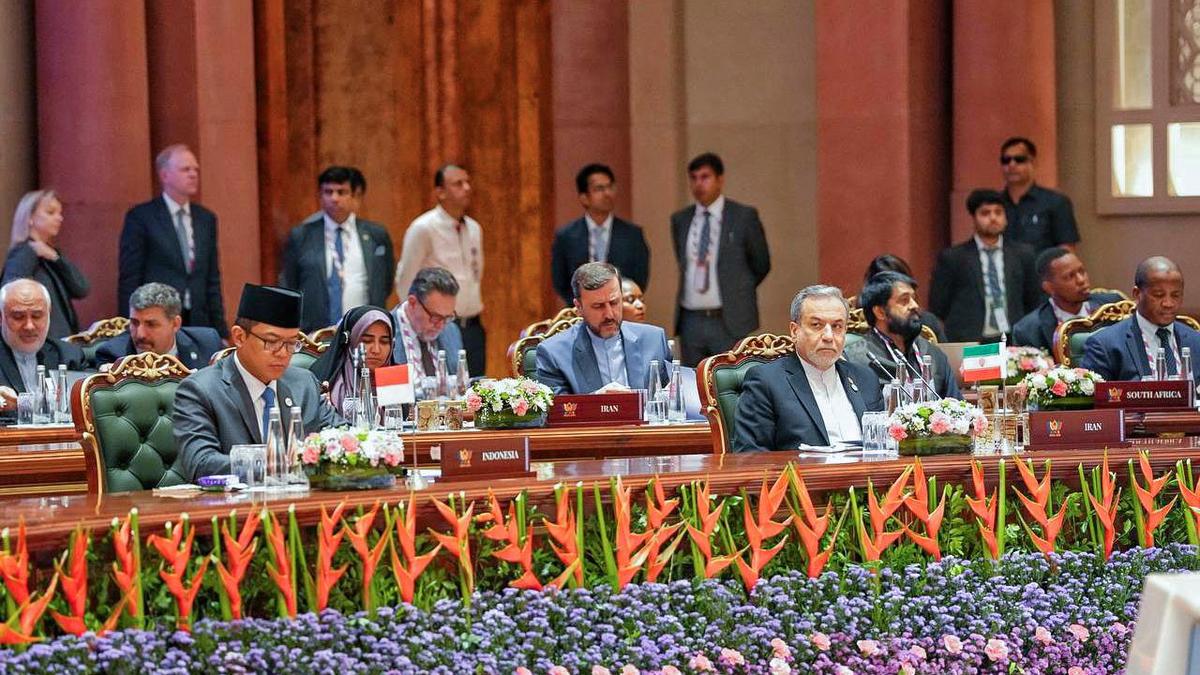
The media loves a schoolyard scrap. When Iran and the UAE traded barbs at the recent BRICS foreign ministers' gathering, the headlines practically wrote themselves. "Tensions Flare," "Diplomatic Deadlock," "The Future of BRICS in Jeopardy." It is the same tired script written by people who view geopolitics through the lens of a 1990s Model UN conference. They see friction and assume failure. They see a heated debate over three islands in the Persian Gulf and conclude that the bloc is a house of cards.
They are dead wrong.
What the mainstream analysis misses is that friction is not a bug of the new multipolar order; it is the primary feature. The spat between Tehran and Abu Dhabi over the Greater Tunb, Lesser Tunb, and Abu Musa islands is a localized territorial dispute that has existed since 1971. Bringing that baggage into the BRICS boardroom doesn't signal the end of the alliance. It signals that BRICS has finally become the only room in the world where real power is actually brokered.
The Myth of the Monolithic Bloc
Western observers are obsessed with the idea that for an international organization to function, everyone must like each other. They look at the G7—a group of nations that largely march in lockstep under a single security umbrella—and use it as the gold standard for "success."
That is a fundamental misunderstanding of how the rest of the world operates.
BRICS was never intended to be a mutual admiration society. It is a clearinghouse for national interests. The fact that Iran and the UAE can remain in the same room while fundamentally disagreeing on sovereign territory is a testament to the bloc's utility, not its fragility. If you want a group where everyone nods in agreement, go to a country club. If you want to reshape the global financial architecture, you need the people who actually control the taps and the transit routes, regardless of whether they want to share a meal.
Sovereignty is the New Currency
The "lazy consensus" suggests that these diplomatic flare-ups will paralyze decision-making on things like the BRICS Pay system or de-dollarization. This ignores the cold, hard logic of the petrodollar’s decline.
Both Iran and the UAE are playing a long game that transcends a few rocky outcroppings in the Gulf. They are looking at a world where the U.S. Treasury can flip a switch and delete a nation’s reserves. Iran has lived through that nightmare. The UAE, despite its current alignment with Western financial systems, is smart enough to see the writing on the wall.
When UAE Foreign Minister Sheikh Abdullah bin Zayed Al Nahyan or his Iranian counterpart talk "clash," they are performing for their domestic audiences. Behind the scenes, the mechanics of trade continue. The UAE remains one of Iran's most vital trading partners. In 2023, non-oil trade between the two surpassed $20 billion. Do you think a disagreement over the Tunbs is going to stop the flow of re-exported goods through Dubai?
I have watched boards of directors scream at each other for six hours and then vote unanimously on a merger because the math demanded it. Geopolitics is no different. The math of the 21st century demands an alternative to the SWIFT system, and both Tehran and Abu Dhabi know they can't build it alone.
Stop Asking if BRICS is Unified
It is the wrong question. It’s a distraction. The question you should be asking is: "Does BRICS need to be unified to be effective?"
The answer is no.
The strength of BRICS lies in its transactionalism. Unlike the EU, which requires an exhausting level of legal and social integration, BRICS is a "plug-and-play" model for sovereign states. You don't have to adopt a specific ideology. You don't have to change your human rights record. You just have to have something the others want—oil, minerals, or a strategic coastline.
The Iran-UAE friction proves that the bloc is "conflict-tolerant." This is a massive competitive advantage. It allows the group to expand into the Middle East and Africa without waiting for centuries-old blood feuds to resolve. While the West waits for "stability," the Rest is busy building infrastructure.
The Real Power Move: Commodity Multipolarity
Let's look at the data the pundits ignore. The expanded BRICS+ now controls roughly 43% of global oil production. When Iran and the UAE sit at the same table, they aren't just discussing islands. They are discussing the pricing of energy outside the reach of the New York Mercantile Exchange.
If you think a diplomatic "clash" matters more than the collective control of the Strait of Hormuz and the Bab el-Mandeb, you are playing checkers while they are playing 4D chess. The UAE is positioning itself as the world’s premier "neutral" hub—the Singapore of the West—while Iran is the "fortress" economy that has proven it can survive total isolation. Combined, they offer a blueprint for how mid-tier powers can bypass the traditional gatekeepers of the global economy.
Why Your Portfolio Should Ignore the Headlines
Investors and analysts who get spooked by these diplomatic rows are the ones who always miss the rally. The volatility is the noise; the institutionalization of the bloc is the signal.
We are seeing the birth of a secondary global economy. It’s messy. It’s loud. It’s full of regional rivals who would love to see the other fail. But they are all bound by a singular, overriding reality: the Western-led "Rules-Based Order" no longer offers them the growth or security they require.
The UAE is not going to leave BRICS because Iran hurt its feelings. Iran is not going to stop its pivot to the East because of an Emirati statement at a press conference. They are stuck with each other, and they know it.
The Inevitability of Friction
Expect more of this. Expect Egypt and Ethiopia to argue over the Nile while voting for a BRICS currency. Expect China and India to have border skirmishes while their trade volumes hit record highs.
This isn't a sign of weakness. It is the sound of a new world being built. The old world was defined by "with us or against us." The new world is defined by "with us on some things, against us on others, and trading with us on everything."
The Iran-UAE "clash" is just the first of many. If you're looking for a peaceful, unified front, stick to watching old G7 reruns. If you want to understand where the power is shifting, watch the people who hate each other sit down and do business anyway.
The islands aren't moving. But the money is.

:max_bytes(150000):strip_icc():focal(819x186:821x188)/Murdaugh-Family-e90854a716884d608fb6fd925e18d840.jpg)
