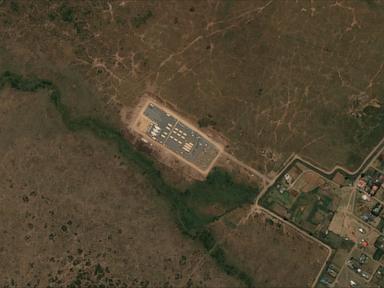
The rain in central Kenya does not fall; it drops like lead. On the tarmac of Laikipia Air Base, the water hits the canvas of military-grade tents with a rhythmic, deafening thud. Inside one of these tents, seven Americans are sitting on green canvas army cots. They are not sick. They are not allowed to leave.
They are the first residents of a geopolitical anomaly: a fifty-bed bio-isolation compound built by Washington on foreign soil, designed specifically to ensure that the realities of a distant viral outbreak never cross the Atlantic Ocean.
For months, these seven people—members of the evangelical disaster response group Samaritan’s Purse—were working in the dense, exhausting heat of the Democratic Republic of Congo. They were managing the fallout of a terrifying spike in the Bundibugyo strain of the Ebola virus. Some were doctors who looked through fogged plastic visors into the bleeding eyes of the dying; others were construction workers who built the wooden frames for treatment wards. Now, because of a sudden shift in American travel policy, they are stranded in a legal and diplomatic no-man’s-land.
Washington’s mandate is absolute: any American citizen returning from the Ebola zone must spend twenty-one days in a third country before they are permitted to touch down on American soil.
The logic from the State Department is cold, clinical, and protective. We cannot risk it. But out on the runway in Laikipia, that logic feels entirely different. It feels like a cage built out of a sovereign nation’s backyard.
The Geography of Fear
To understand how seven healthy aid workers ended up on cots in a Kenyan military zone, you have to look at the math of viral incubation. Ebola does not announce itself immediately. It bides its time. For three weeks, a person can carry the pathogen while feeling completely normal. Then comes the fever. Then the vomiting. Then the systemic collapse.
Because an American doctor contracted the virus earlier this month and had to be evacuated to Germany in a high-stakes biocontainment flight, the political tolerance for risk in Washington evaporated overnight. The solution was the Laikipia facility.
The US government envisioned it as a premium, state-of-the-art holding station—a place where American clinicians can watch American bodies under American supervision.
But Kenya is not a blank space on a map. It is a nation with its own memories of epidemics, its own fragile medical infrastructure, and its own intense pride.
Imagine living in Nanyuki, just outside the air base gates. You watch transport planes land, carrying the citizens of the wealthiest nation on earth, men and women who may or may not be harboring one of the deadliest pathogens known to science. You are told this is a partnership. But to many locals, it looks like something else entirely. It looks like the world’s superpower offloading its biological hazards onto an African landscape because its own domestic populace is too squeamish to house its own heroes.
The tension quickly spilled over into the streets. Protests erupted outside the gates. Tear gas mixed with the afternoon dust. Tragically, during one demonstration, a protester was shot dead.
The Kenyan High Court stepped in, issuing a fierce injunction to halt construction, citing the blatant disregard for local health security. The country’s health minister was even found guilty of contempt of court for allowing work to proceed.
Yet, if you look at the latest satellite imagery, the tents are there. The cots are occupied. The global machinery of American defense moves forward, regardless of local judges or local grief.
The Unseen Exposure
Isolation does strange things to the mind. The seven aid workers are trapped in a profound paradox. They went to Central Africa to save lives, driven by a deep, sacrificial faith. Now, they are treated as if they are the threat.
They are monitored constantly by US Public Health Service clinicians. Every spike in body temperature, every morning headache, every scratch in the throat is a moment of existential terror.
Most of the group had low-risk roles, but according to sources close to the facility, there is at least one individual among them with a known, high-risk exposure.
That single detail changes the air inside the tents. It turns twenty-one days into an agonizingly slow countdown. If one person breaks out in a sweat, the entire facility changes from a precautionary camp into an active hot zone.
The Kenyan government has made its boundaries starkly clear: these seven Americans are not permitted to step one foot outside the base. They cannot visit a shop in Nairobi; they cannot walk the red dirt roads of Laikipia. They are technically within Kenya, but they are entirely excised from it.
Franklin Graham, the head of Samaritan’s Purse, has publicly defended the facility, calling it "state-of-the-art" and arguing that if his people are going to get sick, this is where they should be. It is an attempt to find comfort in a bleak situation. But no amount of high-grade plastic sheeting or military logistics can obscure the profound loneliness of being quarantined on the edge of a runway, thousands of miles from home, because your own country closed its doors to you until you can prove you are clean.
Global health policy often looks pristine on paper. It is written in clean, black ink by people sitting in air-conditioned offices in Washington and Geneva. They talk about "abundance of caution" and "precautionary monitoring." They draw circles on maps to indicate containment zones.
But when those policies materialize in the real world, they look like an armed perimeter on a Kenyan airstrip. They look like local citizens wondering why their sovereign laws can be bypassed by foreign construction crews. And they look like seven exhausted human beings, listening to the rain beat against the canvas, waiting for the thermometer to tell them whether they are safe, or whether they are the next casualty.


.png?width=1200&auto=webp&trim=0%2C0%2C0%2C0)
