A man shivers on an island where the wind tastes like frozen salt. It is December 9, 1985. The place is James Ross Island, a jagged, ice-choked scrap of land off the tip of the Antarctic Peninsula. The man is Mike Thomson, a British geologist who spends his days mapping rock layers that do not want to be mapped. His fingers are stiff, blue-rimmed, and clumsy inside thick gloves. He is looking for ancient marine life, clues to date the stone beneath his heavy boots.
Instead, he finds a rock that looks slightly like an old potato.
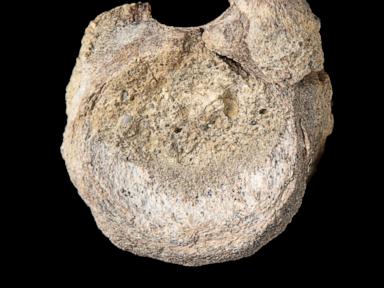
It is ten centimeters wide. It has a curious, heavy density. Thomson brushes away the dark Antarctic grit, pulls out a field notebook with weather-beaten pages, and sharpens his pencil. He draws a tiny, neat sketch of the object. Beside it, he writes four words: vertebra of large reptile.
He does not jump up and down. He does not celebrate. In the context of 1985, Antarctica is a vault of marine fossils—sharks, ancient clams, swimming reptiles that ruled the black Cretaceous seas. Thomson packages the bone, boxes it with thousands of other geological samples, and ships it back to the United Kingdom.
There, it goes into a wooden cabinet. The drawer slides shut. The latch clicks.
Silence follows for forty years.
The Geography of Forgetting
We tend to think of museums and scientific archives as grand cathedrals of immediate discovery. We imagine white-coated researchers instantly recognizing a treasure the moment it clears the dirt. The reality is far more human, cluttered, and quiet. Science moves at the speed of funding, personnel, and patience.
For nearly four decades, Thomson’s rock sat in the geology collections of the British Antarctic Survey in Cambridge. It was surrounded by an ocean of other rocks, a massive backlog of frozen history waiting for its moment in the light. To anyone passing by, the drawer held nothing but cold storage.
Consider what happens next when an archive outlives its collector. Mike Thomson passed away in 2020. He died believing he had found a piece of a marine reptile—a significant find, certainly, but a familiar one. He never knew that his freezing day on James Ross Island had actually rewritten natural history.
The awakening happened because someone decided to look closer at the routine. Dr. Mark Evans, a paleontologist and collections manager, was sorting through the archived Antarctic material. He wasn't looking for a miracle. He was doing the methodical, often tedious work of stewardship.
He opened the drawer. He picked up the ten-centimeter potato of stone.
Evans noticed a shape that did not fit the profile of a sea monster. Marine reptiles have flat, disk-like vertebrae designed to cut through water resistance. This bone had a hollow on one end and a distinct, rounded bump on the other. It was a ball-and-socket joint. It was built to support massive, rhythmic weight on land.
He called Paul Barrett, a dinosaur specialist at the Natural History Museum in London. Barrett looked at the unique combination of features. The diagnosis was instant.
It was a titanosaur. A land-dwelling, long-necked, plant-eating giant.
The Continent of Forests
The revelation is jarring because of the sheer geography of it. This was not just a dinosaur bone; it was the first dinosaur bone ever collected on the Antarctic continent. It had simply been waiting in plain sight for forty years for someone with the right eyes to open the right drawer.
But the real mystery lies in how a massive, leaf-eating creature could survive in a place that is currently defined by sub-zero desolation.
Eighty-two million years ago, the global climate was running a fever. Antarctica sat far south, just as it does now, but it was completely unrecognizable. There were no transantarctic ice sheets. There were no endless deserts of white.
Metaphorically speaking, if you traveled back to the Late Cretaceous, you would need a raincoat, not a parka.
The continent was wrapped in lush, green, temperate forests. Rivers cut through dense woodlands, and wetlands stretched across plains capable of growing enough vegetation to feed an animal that measured 23 feet from snout to tail.
The specimen found in Thomson's drawer was actually small for its family. Titanosaurs include the largest land animals to ever walk the Earth—colossal beasts that could stretch over 100 feet and weigh 60 tons. This Antarctic traveler was a modest seven meters long. Scientists still debate whether it was a juvenile that died young, or a member of a unique dwarf species that adapted to the seasonal darkness of the southern polar circle.
We know it died near the ancient coast. Its body likely bloated, floated out into the marine shallows, and sank into the soft seafloor sediment, fossilizing alongside the ammonites and marine shells that Thomson was originally hunting for.
The Unbroken Line
Every fossil found in Antarctica is a hard-won victory. The ice sheets cover roughly 98 percent of the continent, hiding the rock record beneath miles of frozen water. Fieldwork is a high-stakes gamble against blizzards, logistical failures, and brief summer windows.
Because the physical landscape is so difficult to access, the collection drawers in research stations and museums become the real frontiers of discovery. The modern toolkit—high-resolution CT scanners and digital 3D modeling—allows today's researchers to peer inside bones that were collected with pickaxes and preserved in newspaper decades ago.
This single vertebra changes how we map the ancient world. Before this discovery was confirmed, the fossil record for titanosaurs in the Southern Hemisphere was a jigsaw puzzle with missing pieces. South America was teeming with them. Australia had none. New Zealand had only a few fragments.
The presence of this titanosaur confirms a grander migration. The Antarctic Peninsula was not an isolated island; it was a vital, green land bridge. These massive herbivores literally marched across the bottom of the world, moving from South America through Antarctica to populate New Zealand, bypassing the Australian landmass entirely.
It is a profound image: a line of long-necked giants silhouetted against a polar sunset, walking through a forest where glaciers now grind toward the sea.
Mike Thomson’s family and colleagues noted that he would have been delighted to know the truth of what he picked up that December afternoon. He didn't have the tools or the context in 1985 to see the dinosaur hiding inside the reptile label. But he did the one thing that mattered most. He saved it. He drew it. He put it in a safe place.
The true value of an archive is that it holds answers to questions we haven't yet figured out how to ask. The history of our planet is not just buried under miles of Antarctic ice. Sometimes, it is simply waiting for a hand to pull open a heavy wooden drawer.