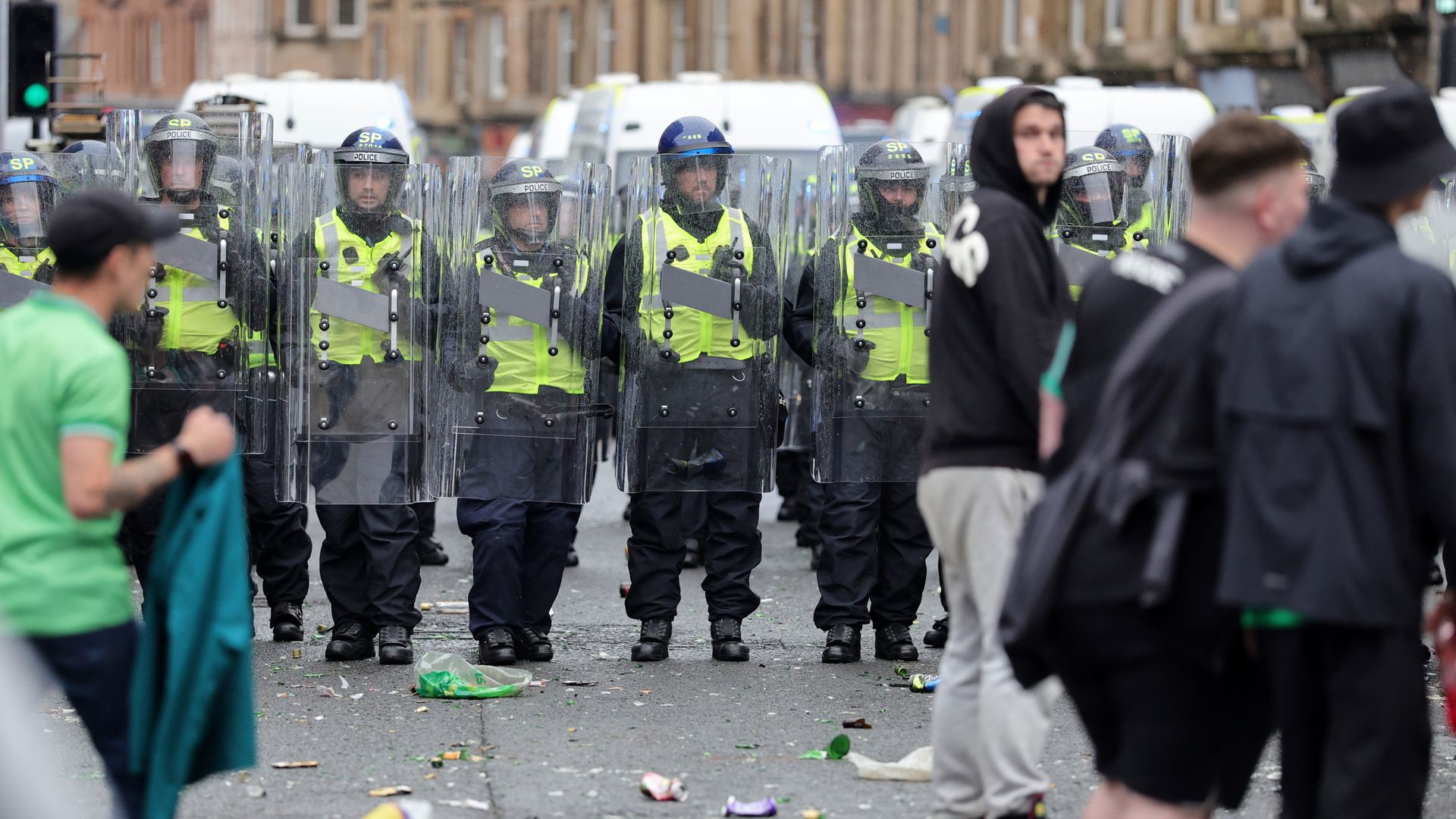
The siren does not sound like a celebration. It cuts through the thick, beer-soaked air of Glasgow with a mechanical screech, a sharp contrast to the primal roars that echoed through Celtic Park just hours earlier.
To the untrained eye, the scene is one of pure triumph. Green and white scarves litter the asphalt like discarded confetti. A football club has just clinched the league title, adding another silver trophy to a cabinet already groaning under the weight of history. For the fans, this is the pinnacle. It is the release of nine months of anxiety, tribal warfare, and breathless anticipation. Meanwhile, you can find similar stories here: Ronda Rousey 15-Second Victory is the Worst Thing That Ever Happened to Women MMA.
But look closer. Step away from the stadium lights and move into the city center, where the celebration curdles into something dark, volatile, and deeply human.
Here, the narrative changes. The story is no longer about tactical genius, top-tier athleticism, or sporting legacy. It is about a twenty-four-year-old public order officer, his uniform stiff with sweat and cheap lager thrown from the crowd, standing behind a polycarbonate shield as a brick flies toward his face. To explore the bigger picture, check out the recent analysis by Sky Sports.
Football is beautiful. Until the glass breaks.
The Chemistry of the Crowd
Sociologists talk about "collective effervescence," a grand term for the intoxicating high that happens when thousands of people share the exact same emotion at the exact same time. When your team wins, your brain floods with dopamine. You are part of a tribe. You are invincible.
But dopamine is a volatile chemical. Mix it with twelve hours of heavy drinking, historical sectarian tensions, and the anonymity of a dense crowd, and the euphoria shifts. The boundary between joy and aggression dissolves.
Consider what happens next: a chant turns into a roar. A roar turns into a surge. Suddenly, the celebration is no longer about supporting a team; it is about occupying space, claiming dominance, and pushing against any boundary put in front of it.
The police officers deployed to George Square or the Merchant City do not see the beautiful game. They see a logistical nightmare wrapped in a security crisis. They stand in thin blue lines, watching the transformation happen in real-time. A young man who would likely apologize if he bumped into you in a grocery store is suddenly screaming profanities, his face distorted by a tribal rage that he cannot fully explain.
The statistics from these weekends are often published as dry tallies in the Monday morning papers. Nineteen arrests. Ten injuries. Property damage.
Those numbers are bloodless. They fail to capture the sensory reality of a riot in the name of recreation. They don't mention the smell of pyrotechnics burning the back of your throat, or the sickening thud of a heavy boot hitting a riot shield. They hide the human cost behind a veil of bureaucratic language.
The Invisible Stakes Behind the Shield
We tend to view police officers as institutional monoliths. We see the armor, the helmets, the batons, and we forget that there is a person inside the gear.
Think about the reality of a "serious disorder" call. These officers have families. They have hobbies. They have lives that have absolutely nothing to do with the ancient rivalry between green and blue. Yet, they are the ones who must absorb the impact when celebration morphs into chaos.
An officer stands on the tarmac, knees aching from hours of immobility, watching a firework arc through the gray Scottish sky. It isn't aimed upward. It is aimed directly at them. In that split second, the grand narrative of a football championship vanishes. The tactical formations of the manager mean nothing. The only thing that matters is the survival instinct.
When an officer is injured during these post-match disorders, the ripples extend far beyond the immediate pain of a broken bone or a lacerated face.
The real damage is psychological. It is the realization that a sporting event—a game played with a leather ball on a patch of grass—has become a valid justification for violence. It is the cynicism that creeps in when you realize the people throwing the bottles are the same people you are sworn to protect on Tuesday morning.
The club will release a statement. They always do. They will condemn the "small minority" of fans who tarnished the club’s reputation. They will express gratitude to the emergency services. The words will be polished, vetted by public relations experts, and utterly hollow.
Because by Tuesday, the city will have washed the streets. The broken glass will be swept away. The graffiti will be scrubbed from the historic stone buildings. The trophy will sit safely behind glass in the boardroom, gleaming and pristine, completely disconnected from the chaos that paid for its arrival.
The Culture of the Blind Eye
The problem is not unique to Glasgow, nor is it unique to Celtic. This is the dark underbelly of hyper-commercialized, identity-driven sport globally. We have built an industry that monetizes obsession, and then we act shocked when that obsession overflows into the streets.
For decades, there has been a tacit agreement between football culture and wider society. We tolerate a level of antisocial behavior around matchdays that would result in immediate arrest anywhere else. We accept the public urination, the casual vandalism, the aggressive intimidation of bystanders as "part of the atmosphere."
We call it passion.
But passion does not require a paramedic.
When we classify violence as a mere byproduct of a sporting victory, we become complicit. We create a landscape where the thrill of the win is inextricably linked to the thrill of transgression. The fan who throws a flare into a crowd of families isn’t acting in a vacuum; he is operating within a culture that has consistently lowered the bar for acceptable human behavior in the name of team loyalty.
The true cost of the title win is not found in the millions spent on player transfers or the price of a season ticket. It is found in the quiet hospital rooms where officers wait for X-ray results, their families sitting anxiously in plastic chairs, wondering how a football match became a battlefield.
The sun sets over the Clyde, casting long shadows across a city that is slowly sobering up. The euphoria of the win is fading, replaced by the grim reality of a Monday morning hangover and a mounting bill for repairs.
Somewhere in a terraced house on the outskirts of the city, a police officer sits at a kitchen table, carefully peeling back a bandage to check the stitches across his brow. He looks at his reflection in the dark window. Outside, the city is quiet again. The celebration is over. The trophy has been won. But as he touches the tender skin above his eye, the victory feels incredibly distant, and entirely meaningless.



,webp/007/704/893/2560x1440.7.webp)