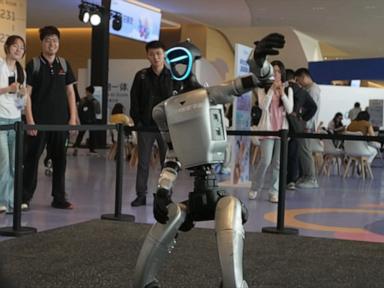
The physical threshold of human bipedal sprint mechanics has remained anchored to Usain Bolt's peak velocity of 10.44 meters per second, achieved during his 100-meter world record split. When a robotic system is publicly evaluated against this benchmark, popular media frames the achievement as a simple conversion of motor torque into linear displacement. This perspective ignores the governing constraints of ground reaction forces, actuator thermal dissipation, and dynamic stability control loops. Outrunning a human sprinter is not an exercise in raw top-end speed generation; it is a complex problem of high-frequency state estimation and instantaneous force application within milliseconds of foot-strike.
Evaluating the mechanical reality of high-velocity humanoid platforms requires deconstructing the engineering trade-offs between explosive power density and structural compliance. Human sprinters store and release elastic energy through the Achilles tendon, utilizing passive stiffness to minimize metabolic cost while maximizing stride length. Robotic systems attempting equivalent velocities must replicate this energy return artificially or substitute it with over-dimensioned actuators that exponentially increase mass. This creates a fundamental physical paradox: heavier limbs demand higher actuator torque to accelerate, but higher torque requires heavier motors and denser power sources, compounding the kinetic energy that must be dissipated during deceleration and turning maneuvers.
The Kinematic Bottleneck of High-Velocity Bipedalism
Achieving velocities exceeding ten meters per second on two legs demands a stride frequency and ground contact time that pushes mechanical actuators to their operational limits. During a human sprint, the foot remains in contact with the ground for approximately 80 to 90 milliseconds. Within this brief window, the leg must absorb up to four times the runner's body weight in vertical ground reaction force while simultaneously redirecting horizontal momentum forward.
Translating this dynamic to a robotic chassis exposes three distinct engineering barriers:
- Actuator Bandwidth: Electric motors rely on electromagnetic induction, where torque response is fundamentally limited by electrical time constants and inductance. Hydraulic and pneumatic alternatives offer higher power-to-weight ratios and natural compliance, but introduce sealing complexities, fluid compressibility issues, and vulnerability to contamination at high operational cycles.
- Sensor Latency: State estimation algorithms must process inertial measurement unit data, joint encoders, and foot-force sensors within sub-millisecond windows. A delay of even five milliseconds in closed-loop feedback at high velocities results in catastrophic divergence from the desired trajectory, causing immediate structural collapse or uncontrolled tipping.
- Thermal Dissipation: Continuous peak-current delivery to joint actuators generates severe Joule heating in the stator windings. Without aggressive active cooling mechanisms that add dead weight to the limbs, high-output sprinting phases are restricted to brief demonstrations rather than sustained operational states.
These constraints explain why theoretical peak speed calculations differ drastically from real-world utility. A robot capable of a brief linear sprint across a controlled, flat laboratory floor operates under conditions vastly different from those required for real-world navigation.
The Power-Mass Trade-Off in Robotic Locomotion
The energy required to propel a bipedal robot forward scales non-linearly with mass. While wheeled or tracked platforms distribute weight evenly across a continuous contact patch, a humanoid robot concentrates its entire mass onto two point-like or small-area end-effectors during single-support phases.
When velocity increases, the kinetic energy formula dictates that doubling the speed quadruples the kinetic energy the system possesses. If a robotic platform suffers an unexpected perturbation or a localized sensor failure at high velocity, the resulting crash involves massive impact forces capable of shearing structural titanium components and shattering carbon-fiber composites. Consequently, engineers must build safety margins into the structural chassis, adding mass that subsequently demands more powerful actuators to move.
This dynamic creates a diminishing return on investment for top-end speed in commercial humanoid design. While high-speed mobility attracts public attention, industrial and logistical environments prioritize energy efficiency, payload capacity, and mean time between failures. Sustained high-speed sprinting burns through onboard battery reserves at a rate that renders autonomous deployment economically unviable for extended operational shifts.
Addressing the Control Architecture Deficit
Traditional model predictive control frameworks often struggle with the hybrid dynamics of running, where the system alternates between continuous flight phases and discrete impact events. During the flight phase, the robot is a ballistic projectile governed strictly by gravity and angular momentum conservation. The instant the foot touches the ground, the system transitions instantaneously to a constrained multibody system with high impact impulses.
To bridge this gap, modern high-speed robotics research increasingly relies on reinforcement learning trained in physics simulation environments before transfer to hardware. This approach allows the control policy to discover non-intuitive gait patterns that manage ground reaction forces more effectively than rigid, analytically derived trajectories. However, the sim-to-real gap remains a persistent hurdle. Unmodeled actuator backlash, friction variations in harmonic drives, and ground surface compliance cause simulated policies to degrade when deployed on physical hardware under high-stress conditions.
Deploying high-velocity bipedal systems outside tightly controlled laboratory environments requires a shift in how engineers balance structural rigidity with compliance. Rather than striving to match biological sprint records through brute-force motor sizing, the development trajectory will likely pivot toward hybrid locomotion modes, intelligent energy capture systems, and distributed sensor arrays that anticipate terrain variations before impact occurs. The metric of success for advanced robotics is transitioning away from peak momentary velocity and toward reliable, energy-efficient operational endurance under unpredictable physical conditions.