Mainstream space coverage loves a clean victory lap. A press release drops, a rendering of two pristine spacecraft hovering over a cratered grey sphere hits the wire, and suddenly every science desk on the planet runs the exact same breathless headline. Mercury gets its first visitor in years as a pair of spacecraft loop into orbit.
Pop the champagne. Cue the inspiring orchestral swell. Ignore the math. If you found value in this post, you should read: this related article.
If you actually look at the orbital mechanics behind the European Space Agency and Japan Aerospace Exploration Agency joint mission known as BepiColombo, calling this a triumphant arrival misses the brutal reality of deep space navigation. Reaching the innermost planet is not an upward climb against gravity. It is a controlled fall into the Sun's massive gravitational well, and BepiColombo spent over eight years slamming on the brakes just to avoid getting incinerated or flung into the void.
I have watched aerospace teams burn through hundreds of millions of dollars designing propulsion architectures that look brilliant on a whiteboard in Darmstadt or Tsukuba, only to watch reality shred their timelines when thermal loads and thruster degradation enter the chat. The lazy consensus treats orbital insertion as a finish line. In truth, slipping into Mercury orbit is the absolute bare minimum required to stop a multi-billion-dollar hardware stack from becoming an expensive meteor. For another perspective on this event, refer to the latest update from MIT Technology Review.
The Gravity Well Trap Nobody Explains
To understand why the celebratory coverage is so misleading, you have to understand delta-v. In orbital mechanics, delta-v represents the total change in velocity required to execute a maneuver. Most people assume that because Mercury is relatively close to Earth compared to Jupiter or Saturn, getting there must be easy.
Wrong. Dead wrong.
Getting to Pluto requires less energy than stopping at Mercury. When a spacecraft leaves Earth, it inherits Earth's orbital velocity around the Sun—roughly 30 kilometers per second. To drop inward toward Mercury, you have to shed massive amounts of that angular momentum. As the spacecraft falls closer to the Sun, solar gravity accelerates it relentlessly. By the time you cross Mercury's orbit, your spacecraft is screaming past the planet at speeds that make chemical rocket braking virtually impossible. If you tried to pack enough conventional chemical propellant to slow down at Mercury, the fuel tank would be so massive that no rocket on Earth could lift it off the pad.
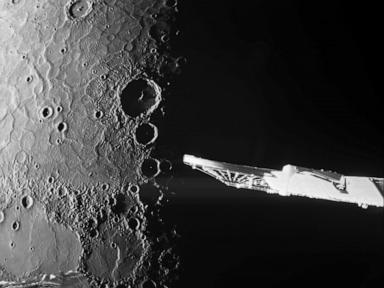
This is why BepiColombo had to execute nine planetary flybys—one at Earth, two at Venus, and six at Mercury itself—just to bleed off enough energy to be captured. The mission launched in October 2018. It took until late 2026 just to enter orbit. That is eight years of threading a needle across the inner solar system while solar radiation baked the spacecraft at temperatures exceeding 350 degrees Celsius.
Even then, things did not go according to the glossy brochure. In 2024, engineers discovered that electrical current anomalies in the Mercury Transfer Module prevented the solar electric propulsion thrusters from operating at full thrust. Think about that. Halfway through the longest braking maneuver in planetary science history, the primary braking system lost peak power. Flight dynamics teams at ESOC had to completely redesign the trajectory on the fly, trading precious arrival time for survival and pushing the orbital insertion back by nearly a year.
Calling this a routine "loop into orbit" insults the sheer desperation and brilliance required to keep the mission alive when the hardware started fighting back.
Why Sending Two Orbiters at Once Is a Calculated Gamble
The BepiColombo stack is actually three separate spacecraft bolted together for the cruise phase:
- The Mercury Transfer Module (MTM): Built by ESA, housing the solar electric ion thrusters and massive solar arrays that did the heavy lifting across the inner solar system.
- The Mercury Planetary Orbiter (MPO): Also built by ESA, packed with eleven instruments designed to map the surface, measure gravity fields, and analyze the exosphere from a low, nearly circular polar orbit.
- The Mercury Magnetospheric Orbiter (Mio): Built by JAXA, a spin-stabilized spacecraft designed to sit in a high, elliptical orbit to study the magnetic field and solar wind interactions.
During the cruise, Mio sat inside a protective sunshield because its delicate instruments could not survive direct solar exposure without spinning—and it could not spin while bolted to the transfer module. Now that the stack has reached Mercury, the MTM is jettisoned, and the two science orbiters separate to do their jobs.
On paper, dual-orbiter architecture solves the biggest headache in planetary science. When NASA's MESSENGER mission orbited Mercury from 2011 to 2015, it had to make compromises. Because MESSENGER was a single spacecraft in a highly elliptical orbit, scientists could never tell if a sudden spike in magnetic readings was caused by the planet's internal dynamo changing or by a burst of solar wind slamming into the magnetosphere at that exact second. You cannot be in two places at once.
By placing Mio high in the magnetosphere and MPO low over the crust, scientists finally get simultaneous two-point measurements. Mio watches the solar wind hit the outer boundary; MPO watches how the surface and inner field react.
Here is the catch that mission cheerleaders gloss over: stacking two completely different spacecraft from two different space agencies onto one propulsion bus multiplies failure modes exponentially. Every interface, every separation mechanism, every thermal blanket had to account for the parasitic heat radiating off the other modules. Mercury does not just cook you from above with sunlight ten times more intense than what hits Earth. The planet's dark, airless surface absorbs solar energy and re-radiates it upward as brutal infrared heat.
MPO has to fly within 480 kilometers of that glowing skillet. To survive, ESA had to invent entirely new high-temperature multi-layer insulation, specialized ceramic coatings, and radiator designs that bounce infrared heat sideways rather than absorbing it. If a single thermal louver jams or a coating degrades faster than modeled under relentless UV bombardment, the electronics inside cook within hours.
Dismantling the Lazy Questions About Mercury
Whenever a mission reaches Mercury, search engines flood with the exact same surface-level questions. Most of them rest on completely flawed premises.
Is Mercury actually the hottest planet in the solar system?
No. Venus is hotter, sitting at a crushing 465 degrees Celsius day and night because of its runaway carbon dioxide greenhouse effect. Mercury has almost no atmosphere to trap heat. While its sunlit side hits 430 degrees Celsius, its night side plummets to minus 180 degrees Celsius. That 600-degree thermal swing is far worse for spacecraft engineering than a steady oven. Metal expands, contracts, fatigues, and cracks. Designing a spacecraft for Mercury is less like building a furnace and more like building a bridge that has to survive an earthquake every few hours.
Why bother studying a dead rock when Mars or Europa might have life?
This is the ultimate astrobiology bias, and it blinds people to how planetary formation actually works. Mercury should not exist in its current form. Its iron core accounts for roughly 85 percent of the planet's radius, leaving only a thin veneer of silicate rock on the outside. By comparison, Earth's core is about 55 percent of its radius.
Something catastrophic happened to Mercury early in the solar system's history. Either a massive protoplanet slammed into it and stripped away its outer mantle, or the young Sun vaporized its silicate crust before it could finish forming. Furthermore, MESSENGER found volatile elements like potassium, sulfur, and chlorine on the surface—elements that should have boiled away billions of years ago if Mercury formed close to the Sun.
Mercury is a forensic crime scene. If we cannot explain how an iron cannonball with volatile chemicals ended up right next to our star, our models of how rocky exoplanets form around other stars are fundamentally broken. Every time the James Webb Space Telescope spots a rocky world hugging a distant star, astronomers use Mercury as their baseline. Right now, that baseline is full of holes.
Did BepiColombo find anything new yet?
Not from orbit, because the science phase barely just started, though its six gravity-assist flybys already grabbed unprecedented close-up data of Mercury's southern hemisphere and magnetospheric boundaries. Anyone claiming major orbital discoveries today is recycling flyby press releases from 2021 through 2025. The real grind begins now, and it takes months of instrument calibration before a single peer-reviewed dataset drops.
The Uncomfortable Truth About International Megaprojects
Let us talk about the elephant in the cleanroom: cost and cadence.
BepiColombo was approved by ESA back in 2000. It took eighteen years to build and launch, and another eight years to arrive. That is twenty-six years from concept to orbital science. By the time MPO and Mio finish their primary mission in 2028, engineers who drew the first CAD models will be retired, and the onboard processors will be running on radiation-hardened architecture from the early 2000s.
Imagine trying to run modern data science on a computer designed during the George W. Bush administration, parked next to a thermonuclear furnace, communicating across 100 million kilometers of space via a narrow radio beam.
This is the inherent flaw of flagship-class planetary missions. When you bundle twenty instruments onto two orbiters across two continents, the political cost of failure becomes zero-tolerance. Nobody can afford to lose a multi-billion-euro asset. So teams test, re-test, add redundancy, bloat the mass, delay the launch, and stretch the timeline across a quarter-century.
To be fair, the alternative—cheap, fast, commercial-style smallsats—would be vaporized before crossing the orbit of Venus. You cannot slap off-the-shelf CubeSat components together and send them into a 400-degree radiation bath. Deep space thermal and propulsion physics do not care about Silicon Valley "move fast and break things" slogans. High-reliability engineering takes time and absurd amounts of money.
Still, celebrating the arrival without acknowledging the agonizingly slow, fragile, twenty-six-year gauntlet it took to get there creates a false impression that deep space exploration is a smooth, inevitable march forward. It is not. It is a knife-edge survival game where a single thruster glitch in 2024 nearly turned a quarter-century of human effort into a drifting piece of space junk.
What Actually Matters Over the Next Twelve Months
Forget the pretty animations of two spacecraft dancing in formation. If you want to track whether BepiColombo actually delivers on its promise, watch three specific metrics over the coming year:
- Thermal Degradation Rates: Watch the telemetry reports from ESA's flight control team regarding MPO's radiator efficiency. Mercury's infrared albedo is brutal, and how well the coatings hold up over the first two Mercury years (176 Earth days) will determine whether the mission gets extended into the 2030s or dies early from heat stroke.
- The Core Dynamo Resolution: Look for data from the Mercury Magnetometer (MERMAG) and the BepiColombo Laser Altimeter (BELA). MESSENGER discovered that Mercury's magnetic field is offset northward by nearly 20 percent of the planet's radius. Nobody knows why. Simultaneous measurements from MPO and Mio will finally separate internal core currents from external solar wind compression.
- Water Ice in Permanent Shadows: Despite sitting next to the Sun, Mercury's axial tilt is almost zero—less than 0.03 degrees. That means the floors of deep craters at the north and south poles never see sunlight. Radar data from Earth and neutron spectroscopy from MESSENGER confirmed massive deposits of water ice trapped under dark organic-rich layers. MPO's spectrometers will map the exact chemical composition of those organics, telling us whether comets delivered the building blocks of life directly to the inner solar system.
Space agencies love to sell exploration as a neat, linear triumph. It makes for great television and easy budget approvals. But the real story of BepiColombo is not that two spacecraft effortlessly looped into orbit. The real story is that human beings threw a fragile machine into the gravitational teeth of a star, watched its engines falter mid-flight, rewrote the laws of their trajectory on the fly, and barely caught the planet before flying past it forever.
Stop applauding the press release and start watching the telemetry. The hardest part of surviving Mercury starts today.