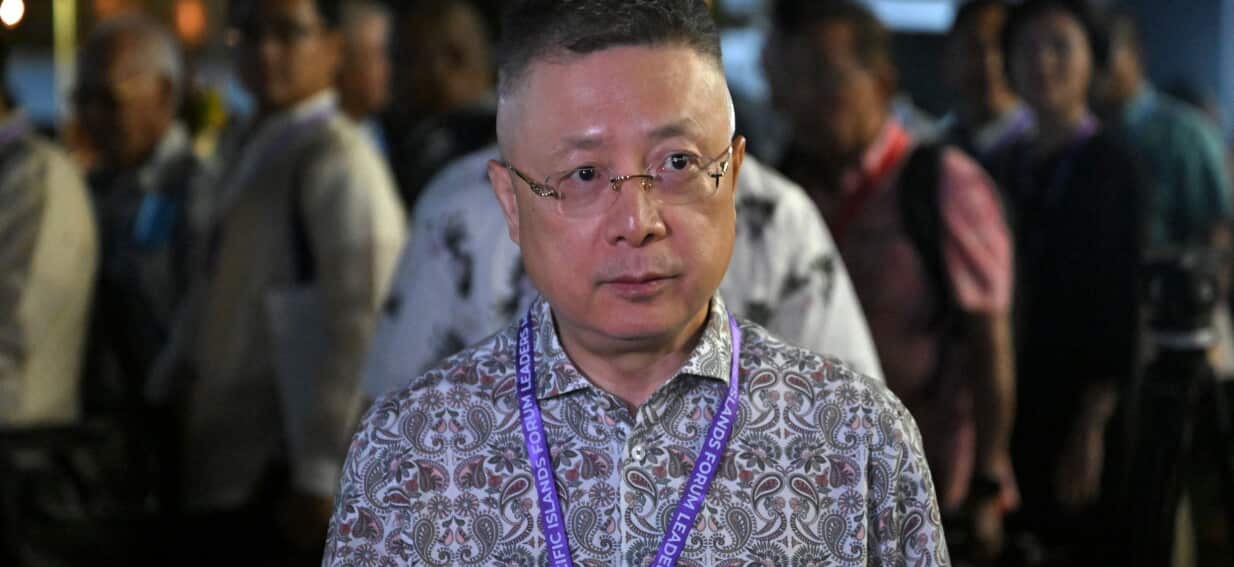
The headlines are playing the standard, lazy script. Beijing issues a stern warning over Taiwan sneaking into a Pacific Islands Forum side event, diplomats furrow brows, and pundits chatter about rising regional tension. Everyone treats this as another predictable chess move in the great Pacific theater.
They are missing the entire plot.
This isn't about Beijing flexing its muscle over a breakaway province. This is about panic. When an economic superpower starts throwing tantrums because a few low-elevation atolls with micro-economies let a Taiwanese official walk into a hotel ballroom, you are not watching strength. You are watching a superpower realize its soft-power checkbook just bounced.
I have spent the better part of a decade watching foreign ministries misread Oceania. Analysts look at the Pacific Islands through a cold, transactional lens of debt-trap diplomacy, port leases, and naval positioning. They assume Beijing buys loyalty and Taipei buys token recognition, treating these island states as passive pawns on a Beijing-Washington-Taipei board.
That framework is garbage.
The Pacific Islands are not passive real estate. They are sovereign actors with acute existential crises, primarily centered on climate collapse and maritime resource protection. They take money from Beijing, they take grants from Canberra, and they take diplomatic presence from Taipei because they are playing a multi-lateral arbitrage game that leaves traditional diplomats dizzy. When Taiwan shows up at a Pacific summit, it is not a protocol violation. It is a masterclass in asymmetric diplomacy that exposes the brittle fragility of Beijing's billion-dollar charm offensive.
The Myth of the Monolithic Island Bloc
Western coverage loves to treat Oceania as a uniform block that can be swayed by a single high-level bribe or infrastructure project. That lazy framing collapses the moment you look at the sub-regions: Melanesia, Micronesia, and Polynesia.
Take the Republic of Palau or the Marshall Islands. They maintain official diplomatic ties with Taipei, ignoring Beijing's threats for decades because their security compacts with Washington run deep and their democratic governance structures make autocratic pressure a tough sell. Meanwhile, countries like Solomon Islands flipped recognition to Beijing in 2019, leading to internal political convulsions that proved foreign influence is never a free lunch.
Beijing's reaction to Taiwan's low-key presence at these summits reveals a deep institutional insecurity. If a rising global hegemon were truly winning the battle for hearts and minds across the Blue Continent, it would ignore a minor Taiwanese delegation. You do not scream about a mosquito when you own the ranch. By issuing formal diplomatic warnings and threatening consequences, Beijing validates Taiwan's status as a legitimate regional stakeholder. It draws a massive neon sign pointing directly to the fact that Taipei offers something Beijing cannot buy: decentralized, non-threatening partnership that does not demand signing away maritime sovereignty.
The Economics of Invisibility
Let us talk about the money, because that is what everyone obsesses over. The conventional wisdom states that Beijing's deep pockets will inevitably squeeze Taiwan out of the Pacific entirely.
The math fails when you examine the local ground truth. Mega-infrastructure projects financed by foreign loans often come with labor strings attached, environmental degradation, and long-term debt liabilities that local populations detest. I have walked through Pacific capitals where gleaming government complexes sit half-empty while local water grids fail.
Taiwan's aid model, by contrast, focuses on localized agriculture, renewable micro-grids, medical missions, and educational exchanges. It is quiet, highly targeted, and remarkably resilient against corruption because it bypasses bloated central bureaucracies. When Pacific leaders fight to keep Taiwan at the table, they are protecting a specialized aid channel that directly serves rural communities, something massive loans for convention centers rarely accomplish.
Beijing wants absolute obedience. Oceania wants functional survival. Those two goals are fundamentally incompatible, which is why every regional forum turns into a high-stakes diplomatic knife fight over attendance rosters.
The Flawed Logic of Beijing's Red Lines
The diplomatic playbook from Beijing relies on a simple premise: isolate Taiwan globally until it surrenders. In Europe or Latin America, this strategy yields mixed results. In the Pacific, it is backfiring spectacularly.
When you tell a prime minister of a sovereign Pacific nation who they can and cannot invite to their own backyard, you trigger a deep-seated post-colonial allergy to foreign dictation. These are nations that spent the mid-to-late 20th century violently or laboriously shaking off British, French, German, Australian, and New Zealand control. They did not trade centuries of colonial oversight just to take orders from a new capital in East Asia.
Every time Beijing issues a warning over Taiwan's presence, local leaders quietly chalk it up as arrogant overreach. It alienates the exact political class Beijing needs to cultivate.
+---------------------------+-----------------------------------+-----------------------------------+
| Metric                    | Beijing's Regional Approach       | Taiwan's Regional Approach        |
+---------------------------+-----------------------------------+-----------------------------------+
| Primary Tool              | Mega-loans, state infrastructure  | Technical aid, health, education  |
| Political Cost            | High debt, sovereignty erosion    | Low-friction diplomatic presence  |
| Local Perception          | Transactional, heavy-handed       | Community-focused, peer-level     |
| Vulnerability             | Elite pushback, debt backlash     | Geopolitical isolation pressure   |
+---------------------------+-----------------------------------+-----------------------------------+
Look closely at the table above. Beijing wins on raw capital deployment but loses heavily on relational equity. Taiwan wins on localized trust but loses the numbers game in formal recognition. But in a regional forum where consensus rules and small states punch far above their weight, relational equity matters more than a balance sheet.
The Real Threat to Regional Stability
The media frames Taiwan's participation as a provocation that threatens stability. That flips reality on its head. The threat to stability is not a small delegation of Taiwanese officials discussing climate resilience or fisheries management. The threat is an aggressive diplomatic architecture that demands Pacific nations surrender their agency to appease a foreign power's domestic political insecurities.
If you want to understand where the Pacific is heading, stop listening to foreign ministry spokespeople in Beijing, Washington, or Canberra. Watch the local delegations. Watch how the Federated States of Micronesia or Tuvalu quietly carve out space for alternative partners despite the immense pressure bearing down on them. They are not victims waiting to be rescued by a larger power. They are ruthless pragmatists running the most sophisticated diplomatic hedging strategy on the planet.
Beijing is not warning about consequences because they hold all the cards. They are warning because they can see those cards slipping from their grip.



