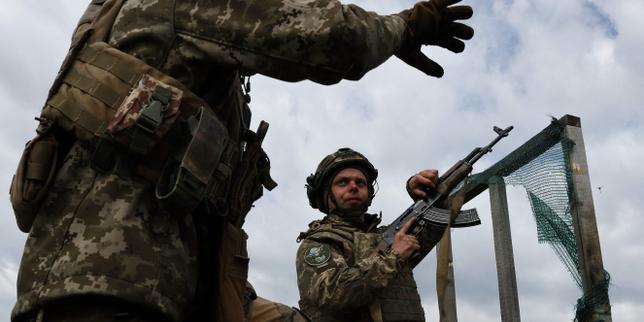
Ukrainian special forces have retaken full control of Stepnohirsk, halting a month-long Russian push toward the strategic hub of Zaporizhzhia. Led by the Artan special unit of Ukraine's military intelligence, the assault expelled Russian forces from fortified positions within the urban center, securing the critical E105 highway. While Moscow intended to bring the regional capital within tube artillery range, the collapse of their assault units under intense drone and urban warfare has exposed deep structural weaknesses in Russia's southern grouping. Ukraine now holds the initiative on this axis, shifting the calculus of the entire southern campaign.
The operational reality of this counter-offensive goes far beyond a routine border clash or a standard symbolic village rescue.
Stepnohirsk is a gateway. Sited just thirty kilometers south of Zaporizhzhia, the town sits directly astride the E105 highway, the primary north-south logistical artery leading toward the heart of Ukraine’s industrial powerhouse. Had the Russian forces secured this ground, they would have gained a permanent platform to rain conventional 152mm artillery shells directly onto a city of half a million people, rendering its massive industrial infrastructure unusable.
Instead, the Kremlin's strategy ran into a meat grinder. Military assessments from the frontline, including reports from the 128th Separate Zakarpattia Mountain Assault Brigade, revealed that the lifespan of newly mobilized Russian soldiers thrown into the urban environment of Stepnohirsk dropped to mere minutes.
The mechanism of this Ukrainian victory relied on a tight, integrated loop of aerial reconnaissance and precision fire. Combat footage released by military intelligence shows the Artan unit advancing under heavy threat, including the direct interception of specialized Russian waiting drones designed to ambushed assault vehicles.
The Attrition Calculus
The tactical execution inside Stepnohirsk illustrates how modern urban defense has changed. Russian infantry groups attempted to infiltrate the town through a slow creeping process from nearby Kamianske, utilizing basements and ruined concrete structures to establish fortified pockets.
Ukraine responded by turning the town into a digital panopticon. Every building was systematically monitored by thermal drones before specialized assault teams moved in to clear the structures. The high-risk nature of the operation meant that heavy armor was largely kept back, used primarily for rapid extraction or high-speed transit along the exposed crossroads of the E105, while infantry fire teams did the dangerous work of close-quarters clearing.
Russia’s failure here points to an acute shortage of properly trained assault infantry. Rather than utilizing cohesive, elite units for complex urban maneuvers, the Russian command repeatedly committed fragmented groups of poorly integrated personnel. When these initial waves were broken by Ukrainian precision fire, the remaining forces were forced to rely on heavy artillery and drone strikes from a distance, attempting to mask a full operational retreat with the appearance of ongoing combat activity.
Shifts in Southern Logistics
The victory at Stepnohirsk does not mean the Zaporizhzhia front is suddenly safe. The Russian military is already shifting its attention toward alternative axes, looking for softer targets near Lukianivka and Pavlivka to outflank the newly established Ukrainian defensive line.
However, the wider strategic picture favors Kyiv. For the first time in several operational cycles, Ukrainian forces are reclaiming significant territory faster than Russia can fortify its gains. This localized success comes at a time when Ukraine is expanding its battlefield interdiction campaign, utilizing new domestically produced guided glide bombs to strike Russian logistical centers and assembly points well behind the immediate frontline.
By forcing Russia to abandon its push toward the regional capital, Ukraine has secured its industrial rear and disrupted the Kremlin's broader campaign goals for the summer. The defensive lines running through Mali Shcherbaky, Stepove, and Stepnohirsk now form a hardened barrier that Moscow cannot easily bypass without committing scarce strategic reserves.