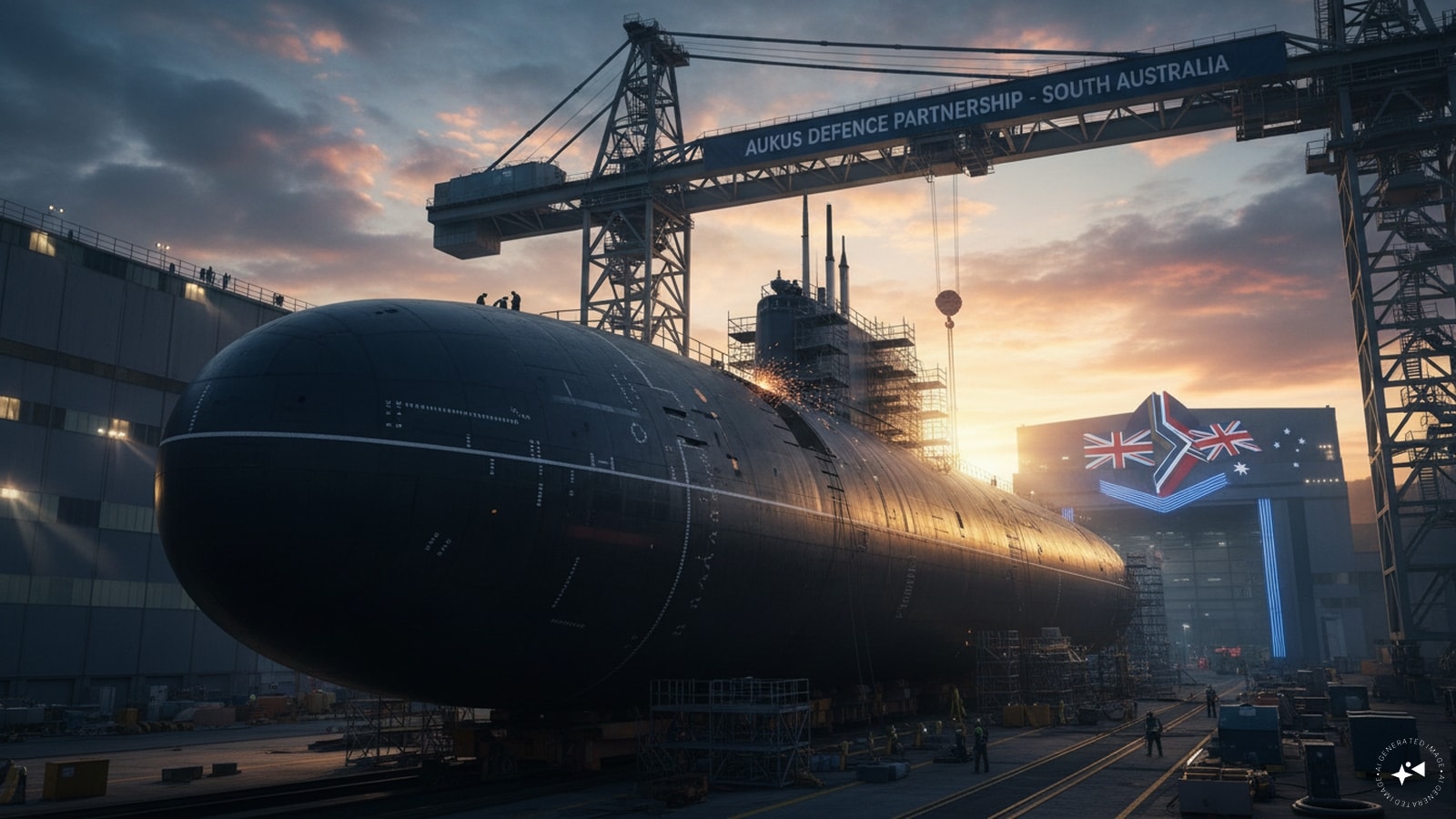
The Three-Billion-Dollar Illusion of Maritime Sovereignty
Australia just flushed another $3.2 billion down the defense procurement drain.
The political class will tell you this is a necessary down payment on national security, a crucial pillar of the AUKUS agreement, and a demonstration of ironclad solidarity with Washington and London. They want you to believe that dropping billions on nuclear-powered submarines guarantees deterrence in the Indo-Pacific. Meanwhile, you can read related stories here: The Whispered War and the Silent Split in Washington.
They are lying to themselves, and they are burning public capital to buy an illusion.
I have spent years watching defense bureaucracies burn cash on platform-centric vanity projects. The strategy is always the same: take a massive check, hand it to defense contractors, call it "strategic posture," and hope no one looks too closely at the operational reality. To see the complete picture, we recommend the excellent article by The New York Times.
Australia’s submarine purchase is not a strategic masterstroke. It is a slow-motion industrial failure wrapped in a geopolitical security blanket.
The Math Behind the AUKUS Money Pit
Let us break down what Australia is actually getting for its billions, because the mainstream defense reporting completely misses the logistical absurdity of this agreement.
The core promise of AUKUS relies on a simple premise: Australia gives capital to US and UK shipyards to expand production capacity, and in return, Australia receives nuclear attack submarines (SSNs) decades down the line.
Here is the inconvenient truth about the US shipyards receiving this cash:
- The Virginia-class Backlog: Electric Boat and Newport News Shipbuilding are already struggling to build 1.2 to 1.3 Virginia-class submarines per year for the US Navy. The US Navy’s own requirement is two per year.
- Maintenance Bottlenecks: Nearly 40% of the US attack submarine fleet is currently sidelined in maintenance backlogs or waiting for overhaul slots.
- Workforce Deficits: You cannot solve a shortage of thousands of specialized nuclear engineers and master welders by simply handing a shipyard a bigger check.
Imagine a scenario where you order a custom supercar from a boutique factory that has a ten-year waiting list and can only produce half the cars its current customers ordered. Adding $3 billion to their bank account today does not magically spawn skilled labor tomorrow. It just makes you a very expensive preferred creditor waiting in a line that isn't moving.
Australia is paying top dollar to subsidize the industrial base of foreign powers while inheriting all the execution risks.
The Acoustic Tracking Reality: Why SSNs Aren't Invincible
The media loves the word "stealth." They treat nuclear submarines like invisible underwater spaceships that can roam the oceans undetected indefinitely.
That narrative is decades out of date.
Nuclear submarines are fast, and they can stay submerged for months because they do not rely on diesel fuel. But they are not silent, and they are not unlocatable.
+--------------------------+-----------------------------------+------------------------------------+
| Feature                  | Conventional Diesel-Electric / AIP | Nuclear-Powered Attack Sub (SSN)   |
+--------------------------+-----------------------------------+------------------------------------+
| Primary Stealth Mode     | Ultra-quiet on battery power      | Continuous cooling pump noise      |
| Endurance                | Days to weeks (AIP dependent)     | Months (limited only by food)      |
| Choke-Point Defense      | Superior in shallow waters        | Inferior in shallow waters         |
| Cost Per Unit            | $500M - $1B                       | $3B - $4.5B                        |
+--------------------------+-----------------------------------+------------------------------------+
Nuclear reactors require continuous cooling loop pumps. While modern technology muffles this machinery significantly, it creates an undeniable thermal and acoustic signature. In shallow littoral waters—like the key maritime choke points of Southeast Asia—a modern, ultra-quiet diesel-electric submarine operating on battery or Air-Independent Propulsion (AIP) is vastly harder to detect than a massive 7,800-ton nuclear-powered vessel.
We are entering an era of absolute ocean transparency:
- Distributed Sensor Networks: Low-cost, autonomous underwater gliders equipped with passive sonar array grids are turning target waters into tripwire zones.
- Satellite Synthetic Aperture Radar (SAR): Orbiting sensors can now detect minute surface wake anomalies caused by large submerged hulls moving at speed.
- Machine-Learning Processing: AI models can isolate quiet acoustic signatures from ambient ocean noise in real time, neutering traditional stealth tactics.
While Australia spends $360 billion over the lifetime of the AUKUS program to field a handful of massive targets, potential adversaries are deploying thousands of low-cost, expendable drone swarms that will turn shallow choke points into suicide traps for multi-billion-dollar crewed vessels.
The Sovereign Capability Paradox
The most disingenuous aspect of the AUKUS narrative is the idea that this money buys Australia an independent strategic capability.
It does the exact opposite. It seals a total, irreversible surrender of strategic autonomy.
A nuclear submarine is not a standalone weapon; it is an ultra-complex ecosystem. Australia does not have a domestic civil nuclear industry. It does not enrich uranium. It does not produce naval reactors. It does not possess the native workforce required to perform high-level reactor maintenance.
The Sovereign Trap: If a defense platform cannot be maintained, repaired, or modified without the explicit operational and technical sign-off of a foreign power, you do not own that platform. You are leasing a capability that operates purely at the discretion of your partner's domestic political cycle.
If Washington experiences a political shift toward isolationism in ten years, Australia’s operational readiness drops to zero. If the US Congress decides to restrict exports of technical components during an emergency, the Australian fleet becomes multi-billion-dollar harbor ornaments.
You do not build true sovereignty by renting another nation's defense industrial base. You build it by designing capabilities you can manufacture, scale, and maintain yourself.
What Australia Should Have Done Instead
Critics will ask: what is the alternative? Does Australia simply sit back and leave its trade routes unprotected?
No. The alternative is abandoning the vanity of force projection in favor of asymmetric, cost-effective, real-world defense.
For the price of the AUKUS program, Australia could construct an impassable maritime denial zone:
- 100+ Advanced AIP Diesel-Electric Submarines: For the price of five to eight nuclear submarines, Australia could field a massive fleet of modern conventional submarines tailored specifically for littoral defense and choke-point denial.
- Massive Autonomous Drone Fleets: Thousands of uncrewed surface and subsurface vessels creating an impenetrable persistent surveillance network across the northern approaches.
- Integrated Land-Based Anti-Ship Missile Systems: Long-range precision strike networks dispersed across northern Australia, making any foreign naval approach statistically suicidal.
That is how you secure a nation's borders in the 21st century. You do not do it by buying a tiny number of exquisite platforms that will take thirty years to arrive and five minutes to target once ocean transparency renders them visible.
Australia is paying a astronomical fee to enter a club it will never control, buying weapons it cannot maintain, to project power it cannot sustain.
It is time to stop confusing massive expenditure with strategic security. The money is gone, the delivery dates will slip, and the ocean is only getting clearer.


