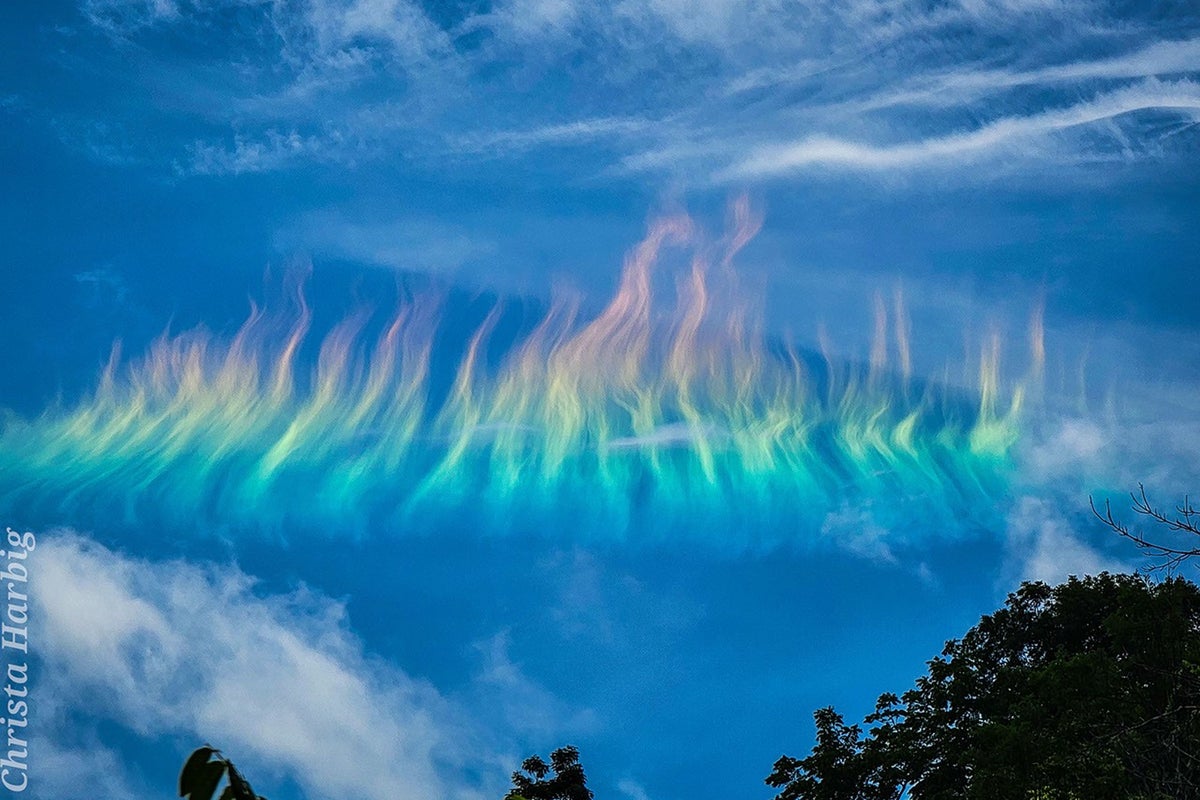
Rare atmospheric phenomena frequently trigger widespread public misidentification, turning routine optical physics into viral anomalies. When observers across West Virginia recently reported a brilliant, multicolored band stretching horizontally across the sky, casual descriptions labeled the sight a fire rainbow. This terminology is entirely incorrect. The event was a circumhorizontal arc, an optical phenomenon governed by precise angles of solar elevation, hexagonal ice crystal geometry, and total internal reflection within cirrus clouds. Understanding the mechanics of this display requires stripping away folk taxonomy and examining the precise optical variables that produce such chromatic separation.
The Optical Architecture of Halo Phenomena
Atmospheric halos require three distinct variables to align simultaneously: a specific ice crystal morphology, a precise orientation of those crystals relative to the observer, and a narrow window of solar elevation. Unlike rainbows, which rely on refraction and reflection inside liquid water droplets, circumhorizontal arcs are ice halo variants driven exclusively through solid-state refraction.
The medium responsible for this light bending consists of microscopic, plate-shaped hexagonal ice crystals suspended within high-altitude cirrus clouds. For a circumhorizontal arc to form, these plate crystals must drift horizontally, acting as miniature, parallel prisms. Light enters through a vertical side face of the hexagonal plate and exits through the horizontal bottom base face. This specific entry-and-exit pathway creates a minimum deviation angle of approximately 68 degrees for red light, scaling upward to roughly 73 degrees for violet light.
This angular variance accounts for the distinct, sweeping separation of colors. Because the minimum deviation angle for red is smaller than that for violet, the red band appears on the upper edge of the arc, with violet structured at the bottom. The band spans a considerable horizontal angle because these plate crystals can catch sunlight across an expansive azimuth, provided the sun sits high enough in the sky to supply the requisite geometry.
The Solar Elevation Constraint
The single most restrictive variable governing the appearance of a circumhorizontal arc is the altitude of the sun. The sun must be positioned very high in the sky, specifically between 58 and 68 degrees above the horizon.
When the solar elevation drops below 58 degrees, the light entering the vertical side face of a horizontal plate crystal hits the internal interface at an angle exceeding the critical angle for total internal reflection. Instead of refracting out through the bottom base face, the light reflects internally, destroying the directional chromatic sorting required to project an arc. Conversely, when the sun climbs above 68 degrees, the geometry shifts again, causing the exiting light rays to compress or fade out of the viewer's usable field of vision.
This narrow operational window explains why circumhorizontal arcs are entirely absent in polar regions, where the sun never reaches the necessary vertical altitude. They are similarly restricted in deep winter across mid-latitudes. They manifest primarily during late spring and midsummer months around solar noon, and only when observers are situated at latitudes between roughly 55 degrees North and 55 degrees South. The West Virginia sighting occurred during a period where local solar angles transiently crossed this narrow operational threshold while high-altitude cirrus decks drifted overhead.
Structural Comparison Against Rainbows and Iridescence
Casual observers frequently confuse circumhorizontal arcs with standard primary rainbows or cloud iridescence due to the shared presence of spectral colors. However, the physical drivers of these phenomena diverge entirely.
A primary rainbow forms when sunlight enters a falling spherical raindrop, refracts, reflects off the internal back wall of the drop, and refracts again upon exiting. This projects a circular arc centered on the antisolar point, meaning an observer must stand with their back to the sun to view it. The angular radius of a primary rainbow is fixed at approximately 42 degrees.
Cloud iridescence, or mother-of-pearl clouds, involves optical diffraction rather than pure refraction. When a cloud consists of extremely uniform, microscopic water droplets or ice crystals of nearly identical dimensions, light waves diffract around the particles, creating pastel patches of color that cling closely to the edges of the cloud boundary without forming coherent, large-scale geometric arcs.
A circumhorizontal arc, by contrast, is centered on the horizon directly beneath the sun, requiring the observer to face toward the solar meridian rather than away from it. It spans vast swaths of the sky, sometimes stretching across seventy degrees of the horizon, dwarfing the angular span of standard cloud iridescence.
Atmospheric Prerequisites and Meteorological Context
Producing a visible circumhorizontal arc requires a tightly coupled sequence of meteorological events. The upper troposphere must maintain a persistent layer of thin cirrus or cirrostratus nebulosus clouds. These clouds are composed entirely of ice crystals rather than supercooled water droplets.
The stability of the air mass is equally critical. If wind shear or severe turbulence disrupts the horizontal orientation of the hexagonal plate crystals, causing them to tumble randomly, the directional refraction collapses. The light scatters haphazardly, yielding a uniform white glare instead of distinct spectral bands. For a vivid arc to materialize, the cirrus layer must remain undisturbed, allowing millions of falling plate crystals to act in synchronized optical alignment like an enormous, fractured diffraction grating spread across the heavens.
The presence of haze, low-level cumulus clouds, or thick stratocumulus decks will completely obscure the phenomenon from ground-level view. The West Virginia sighting depended heavily on a temporary localized clearing of lower atmospheric particulate matter coinciding perfectly with the upper-level presence of an undisturbed, ice-saturated cirrus deck.
Practical Identification Protocols for Observers
When documenting or analyzing anomalous atmospheric displays, systematic classification prevents misattribution. Observers should record three mandatory metrics before labeling any optical event:
The solar angle must be measured to confirm whether the sun is elevated within the 58 to 68 degree band. If the sun is low on the horizon, the display is physically precluded from being a circumhorizontal arc and is likely a sun dog, a tangent arc, or a conventional rainbow.
The spatial orientation relative to the sun must be verified. Circumhorizontal arcs run parallel to the horizon at a considerable angular distance below the sun, typically 46 degrees or more. They never form complete circles around the sky, nor do they appear opposite the solar disk.
The cloud substrate must be examined for crystalline texture. The presence of fibrous, translucent cirrus formations confirms the necessary solid-state medium, whereas dense, billowing vertical cloud structures point toward liquid-phase optical phenomena.
Rigorous adherence to these physical parameters eliminates ambiguity, transforming a fleeting visual anomaly into a predictable consequence of atmospheric thermodynamics and optical geometry.


