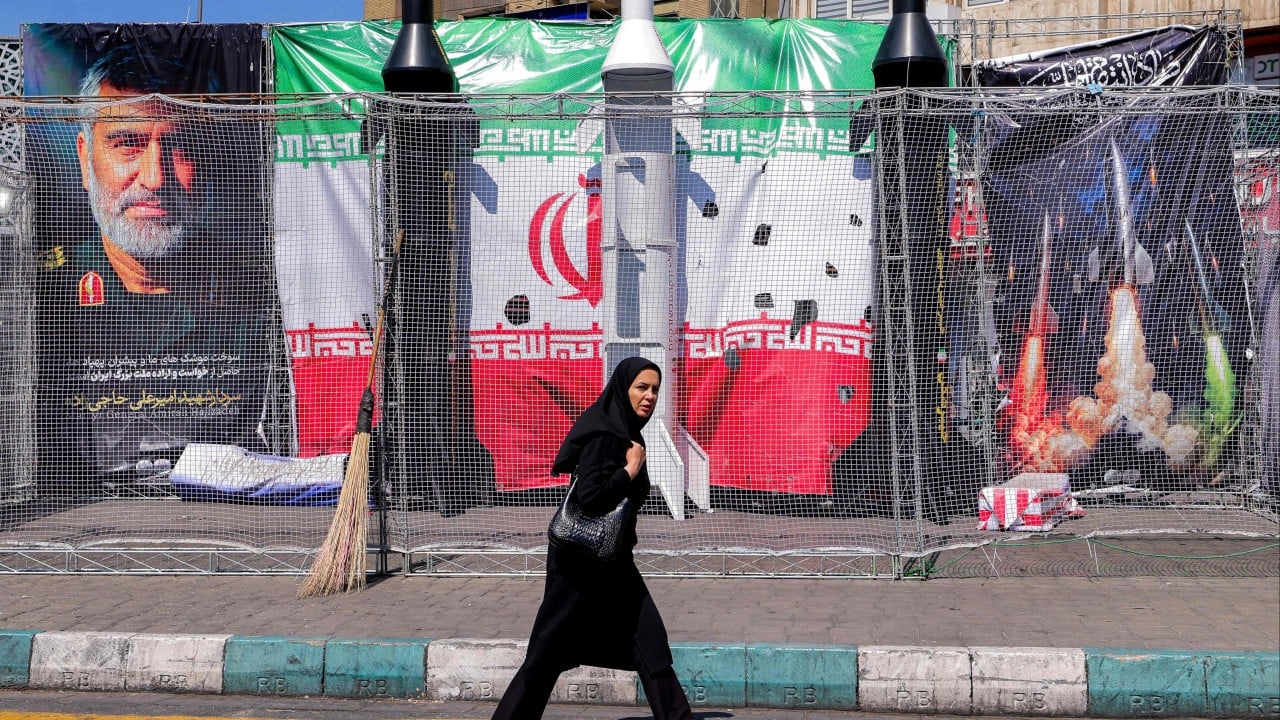
The mobilization of civilian populations to form "human chains" around Iranian nuclear and power facilities represents a calculated shift from kinetic defense to a cognitive and legalistic deterrent strategy. This maneuver functions as a forced escalation of the cost-benefit analysis for any state actor considering a preemptive strike. By integrating non-combatants into the physical security perimeter of high-value infrastructure, the Iranian state transitions its defense posture from a traditional military hardening model to an asymmetric "Optics-Driven Attrition" framework.
The Triad of Deterrence: Kinetic, Legal, and Cognitive
To understand the strategic utility of human chains, one must decompose the Iranian defensive posture into three distinct operational pillars.
1. Kinetic Mitigation and Target Ambiguity
While a human chain offers zero protection against a precision-guided munition (PGM) or a high-yield kinetic penetrator, its primary physical function is to introduce a "Non-Combatant Variable" into the targeting algorithm. In modern warfare, specifically under the Rules of Engagement (ROE) governing Western militaries, the presence of civilians necessitates a Collateral Damage Estimation (CDE) process.
The CDE process requires analysts to quantify the potential for civilian casualties. If the predicted "non-combatant cutoff value" is exceeded, the strike is legally or politically neutralized without a single shot being fired. The human chain effectively forces the attacker to choose between abandoning the mission or accepting the status of a war criminal under international law.
2. International Legal Constraints and the Principle of Proportionality
Under the Geneva Conventions, specifically Article 51 of Protocol I, the presence of the civilian population shall not be used to render certain points or areas immune from military operations. However, the "Principle of Proportionality" mandates that an attack is prohibited if the incidental loss of civilian life is excessive in relation to the concrete and direct military advantage anticipated.
The Iranian strategy leverages this ambiguity. By encircling a power plant, they transform a legitimate military target into a site where any strike automatically triggers a proportionality violation. This creates a "Legal Deadlock," where the strategic value of destroying a reactor is outweighed by the diplomatic and legal blowback of a mass-casualty event broadcast in real-time.
3. Cognitive Warfare and Global Narrative Control
In the current information environment, the speed of imagery dissemination outpaces the speed of military justification. A human chain serves as a "Live-Streamed Deterrent." The presence of civilians creates a high-stakes psychological barrier for the pilots and operators tasked with executing the strike. It shifts the narrative from a surgical strike against a rogue nuclear program to a massacre of unarmed civilians protecting their national sovereignty.
Structural Vulnerabilities in the Energy Grid
The call for human chains highlights the critical fragility of the Iranian power sector. The Iranian energy grid is characterized by a high degree of centralization, making it susceptible to "Systemic Cascading Failure."
- Generation Concentration: A significant percentage of Iran’s baseload power is generated by a handful of massive thermal and nuclear sites.
- Transmission Bottlenecks: The distance between generation hubs and urban load centers (like Tehran) creates vulnerable nodes in the high-voltage transmission lines.
- Cyber-Physical Overlap: The SCADA (Supervisory Control and Data Acquisition) systems managing these plants are legacy infrastructures often integrated with newer, internet-facing protocols, providing a vector for non-kinetic strikes.
Protecting these sites with human shields is a recognition that the physical hardening (concrete bunkers, S-300 surface-to-air missiles) may be insufficient against contemporary bunker-busting technology like the GBU-57 Massive Ordnance Penetrator (MOP).
The Cost Function of Civilian Mobilization
The decision to deploy human chains is not without internal risk. The state must balance the deterrent value against the potential for domestic blowback. This can be viewed through a "Risk-Transfer Equation."
$$R_{total} = (P_{strike} \times L_{infrastructure}) - (P_{deterrence} \times V_{political_capital})$$
Where:
- $R_{total}$ is the residual risk to the regime.
- $P_{strike}$ is the probability of a US/Israeli strike.
- $L_{infrastructure}$ is the loss of power generation capacity.
- $P_{deterrence}$ is the effectiveness of the human chain.
- $V_{political_capital}$ is the domestic cost of putting citizens in harm's way.
If the state perceives the threat of a strike to be imminent (as suggested by the "US deadline" rhetoric), the value of $P_{strike}$ rises so high that the regime is willing to burn $V_{political_capital}$ to achieve a marginal increase in $P_{deterrence}$.
Strategic Limitations of Asymmetric Human Shields
The human chain strategy suffers from several critical failure points that a sophisticated adversary can exploit.
Non-Kinetic Neutralization
Human shields are only effective against weapons that cause physical destruction. They provide no defense against cyber-attacks designed to induce a "Logical Meltdown." If a virus like a Stuxnet successor disables the cooling systems or turbines from within, the human chain becomes a witness to a silent failure rather than a shield against a loud one.
The "Shield-to-Target" Decoupling
An adversary can choose to ignore the primary generation sites and focus instead on the "Intermediate Infrastructure." By destroying substations and transmission towers located in remote, unpopulated areas, an attacker can achieve the same result—de-energizing the nation—without ever engaging the human shields at the power plants.
Sustained Mobilization Fatigue
The logistics of maintaining a human chain are immense. Providing food, water, and sanitation for thousands of people in high-security zones creates a massive internal strain. If the "deadline" passes without a strike, the state faces the "Crying Wolf" effect, where subsequent mobilizations will see diminishing participation and increased resentment.
The Geopolitical Endgame
The Iranian call for human chains is a signal of "Escalation Dominance." By signaling that they are willing to weaponize their own population's safety, Iran is forcing the United States and its allies into a "Zero-Sum Moral Game."
For the US, the deadline represents a diplomatic tool; for Iran, it is a trigger for total national mobilization. The transition from military defense to civilian-centric deterrence suggests that the Iranian leadership views the current threat environment as existential. This is no longer a localized dispute over enrichment percentages; it is a fundamental test of whether international norms regarding civilian protection can be used as a hard-power asset in a regional conflict.
The strategic play for an attacking force in this scenario is to bypass the "Shielded Nodes" entirely. A multi-vector approach involving electronic warfare to spoof sensor data, targeted cyber-disruption of the grid's load-balancing software, and the physical destruction of unmanned transmission infrastructure renders the human chain an obsolete defense. The Iranian state is preparing for a 20th-century siege in a 21st-century theater of operations.