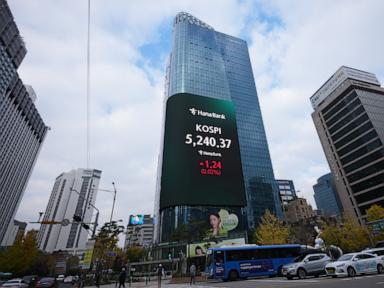
Asian shares slipped today because the region's semiconductor giants carry a disproportionate, structural exposure to Nvidia’s hardware bottlenecks and export restrictions that broader US indices can easily shrug off. While Wall Street rallied on diversified consumer strength, software margins, and interest rate optimism, Tokyo, Seoul, and Taipei took a direct hit. The divergence comes down to a simple reality of global finance. American markets own the high-margin software and brand equity of artificial intelligence, while Asian markets own the capital-intensive factories that actually build the silicon. When Nvidia sneezes, the S&P 500 catches a mild cold, and the KOSPI ends up in the emergency room.
To understand why a single California chip designer can dictate the daily fortunes of trillions of dollars in Asian market capitalization, you have to look past the ticker symbols and examine the physical assembly line. Most retail investors still view the AI boom as a monolithic wave lifting all boats. On trading desks from Hong Kong to Singapore, however, institutional money managers treat the sector as a rigid hierarchy of risk.
The Structural Illusion of the Wall Street Rally
Wall Street has a luxury that Asian exchanges simply do not possess. Diversification. When the Dow Jones Industrial Average or the S&P 500 climbs, the gains are routinely cushioned by healthcare conglomerates, legacy banks, retail giants, and enterprise software firms. Even when Nvidia faces scrutiny over supply chain delays, margin compression, or regulatory pushback, American investors can rotate capital into companies that merely use artificial intelligence rather than those that manufacture its physical guts.
Asian benchmarks are constructed differently. They are heavily weighted toward export-driven industrial manufacturing and foundational hardware.
Consider the sheer concentration of risk in East Asia's premier indices. In Taiwan, a single company—Taiwan Semiconductor Manufacturing Company (TSMC)—accounts for roughly a third of the entire Taiex index. In South Korea, Samsung Electronics and SK Hynix dominate the KOSPI to a degree that would make American antitrust regulators dizzy. When Nvidia encounters friction, whether from architectural redesigns, thermal management issues in next-generation server racks, or tightening geopolitical trade controls, the shockwave does not dissipate across dozens of sectors. It slams directly into the balance sheets of the companies fabricating the wafers, packaging the chips, and supplying the high-bandwidth memory.
The disconnect between New York and Tokyo is not an anomaly. It is the natural result of an asymmetric supply chain. Wall Street prices the dream of AI productivity; Asia prices the brutal capital expenditure required to make that dream physically possible.
Inside the Nvidia Supply Chain Bottleneck
Nvidia does not own a single fabrication plant. It is a fabless designer that relies entirely on an intricate, fragile web of Asian partners to turn architectural blueprints into physical silicon. This business model is the secret behind Nvidia's staggering gross margins, which routinely hover above 70 percent. By offloading the multi-billion-dollar cost of building and maintaining foundries onto Asian partners, Nvidia insulates itself from fixed-cost nightmares.
The companies on the receiving end of those contracts do not enjoy that insulation.
The High-Bandwidth Memory Trap
Take the market for High-Bandwidth Memory (HBM), the specialized, stacked DRAM chips essential for feeding data to AI processors. SK Hynix and Samsung have poured tens of billions of dollars into expanding HBM production lines to meet Nvidia's insatiable demand. These facilities require cleanrooms, extreme ultraviolet lithography machines, and years of calibration before a single profitable wafer rolls off the line.
When Nvidia faces delays in rolling out a new chip architecture—or when hyperscalers like Microsoft, Alphabet, and Meta pause to digest their existing server inventory—the memory makers are left holding the bag. They cannot simply pivot those specialized HBM production lines to make standard smartphone memory overnight. The fixed costs remain astronomical, depreciation schedules keep ticking, and inventory begins to pile up. Equity analysts in Seoul know this math intimately. The moment Nvidia hints at a deceleration in growth or a hiccup in product rollouts, institutional traders immediately sell off Korean memory stocks to front-run the inevitable margin squeeze.
Advanced Packaging and CoWoS Constraints
The bottleneck extends beyond memory into the realm of advanced packaging. Modern AI chips are no longer single pieces of silicon; they are complex multi-chip modules stitched together using techniques like TSMC’s Chip-on-Wafer-on-Substrate (CoWoS).
If a design flaw or a thermal dissipation problem forces Nvidia to tweak a chip's layout late in the production cycle, the entire packaging line stalls. Equipment suppliers in Japan—companies like Tokyo Electron and Advantest—suddenly face pushed-out delivery schedules for testing and wafer-handling gear. A minor engineering delay in Santa Clara translates into a quarterly revenue miss in Yokohama and Hsinchu.
Geopolitics and the Export Control Squeeze
Financial media often treats trade restrictions as background noise until a major ban hits the front page. In reality, regulatory friction is a constant, grinding tax on Asian tech valuations.
Washington’s escalating export controls aimed at curbing China’s access to advanced semiconductors have placed Nvidia in a perpetual state of compliance gymnastics. Every time the US Department of Commerce tightens the rules on compute density or interconnect speeds, Nvidia has to go back to the drawing board to engineer stripped-down, compliant chips for the Chinese market.
For Nvidia, losing a slice of the Chinese data center market is an annoyance easily offset by insatiable demand from American cloud providers. For Asian suppliers, the collateral damage is far more severe.
- Lost Volume: Japanese lithography and chemical suppliers rely heavily on mid-tier Chinese fabs for steady, predictable cash flow. Restrictions on servicing those clients directly erode their baseline revenue.
- Compliance Costs: Taiwanese and Korean firms must navigate a minefield of overlapping US, European, and domestic regulations, slowing down cross-border shipments and increasing legal overhead.
- Domestic Substitution: Every new US sanction accelerates Beijing's state-backed push for semiconductor self-sufficiency. While Chinese domestic chips still lag behind Nvidia's flagship offerings, they are rapidly capturing market share in legacy nodes and lower-tier AI inference workloads—markets that Korean and Taiwanese firms used to dominate unchallenged.
When Wall Street traders bid up US stocks, they are largely ignoring the slow-motion decoupling of the global tech supply chain. Asian investors cannot afford that blind spot because the decoupling is happening in their own backyard.
The Currency and Macro Crosswinds
Equity markets do not trade in a vacuum, and currency dynamics frequently amplify the pain in Asian tech. The relationship between the US dollar, the Japanese yen, and the Korean won plays a massive, often misunderstood role in how global funds allocate capital.
When US economic data comes in strong enough to fuel a Wall Street rally, it often pushes out expectations for aggressive Federal Reserve interest rate cuts. Higher-for-longer US rates keep the dollar strong and Treasury yields attractive. For global institutional investors, a strong dollar acts like a giant vacuum cleaner, sucking liquidity out of emerging markets and Asian equities and pulling it back into US assets.
In theory, a weaker yen or won should help Asian exporters by making their goods cheaper abroad. In practice, modern semiconductor manufacturing relies heavily on imported raw materials, foreign intellectual property, and dollar-denominated energy. A weak local currency inflates the cost of running a massive foundry. Furthermore, foreign institutional investors—who account for a massive portion of daily trading volume in Seoul, Taipei, and Tokyo—suffer currency losses when local currencies slide. When Nvidia stumbles and triggers a tech sell-off, foreign funds hit the sell button not just to exit the stock, but to get out of the currency before their returns evaporate.
Capital Expenditure Fatigue Is Setting In
For the past two years, the market rewarded any company willing to spend billions on AI infrastructure. If a tech giant announced a massive hike in capital expenditure (CapEx), its stock went up. That honeymoon phase is dying a slow death.
Institutional investors are starting to ask uncomfortable questions about return on invested capital (ROIC). Hyperscalers have spent hundreds of billions of dollars buying Nvidia GPUs, building data centers, and securing power grids. Yet, the actual enterprise software revenue generated by generative AI applications remains a fraction of that hardware outlay.
Consider a hypothetical example to see how this math breaks down. Imagine a major cloud provider spends $10 billion on next-generation server racks to train a new foundation model. To justify that expenditure over a standard four-year server depreciation cycle, the cloud provider needs to generate roughly $2.5 billion to $3 billion in high-margin annual software revenue just to break even on the hardware, electricity, and cooling costs. If enterprise customers hesitate to pay $30 per user per month for AI copilots, the cloud provider has no choice but to slow down its hardware orders in the following year.
Wall Street is beginning to price in this digestion period, but it is doing so selectively. Investors are rotating out of pure-play hardware and into software companies that might benefit from cheaper compute costs down the road. Asia, having no major domestic software ecosystems to absorb that rotated capital, simply bleeds out. When the CapEx cycle turns, the pick-and-shovel makers are always the first ones laid off.
The Hidden Fragility of Index Concentration
Veteran market watchers have seen this movie before. During the dot-com bubble of 1999 and 2000, telecommunications equipment makers like Cisco, Nortel, and Lucent were treated as infallible monopolies. Their valuations detached from reality because investors assumed internet traffic would grow infinitely without a single pause in infrastructure spending. When telecom carriers finally ran out of financing and halted fiber-optic buildouts, the equipment suppliers collapsed by 80 to 90 percent.
Today's AI hardware boom is backed by much stronger balance sheets than the debt-fueled telecom bubble of the late nineties. Microsoft, Google, and Meta are funding their AI buildouts with massive free cash flow, not junk bonds. That fundamental strength prevents a total systemic collapse.
However, the concentration risk inside Asian equity indices has reached a dangerous extreme. Passive investing—the relentless flow of money into index funds and ETFs—has mechanically forced capital into the largest stocks in every market. Because TSMC, Samsung, and Tokyo Electron sit at the top of their respective indices, passive inflows artificially inflated their valuations during the good times.
Now, the exact same mechanism works in reverse. When active hedge funds short semiconductor ETFs to hedge against Nvidia's volatility, authorized participants are forced to sell the underlying Asian stocks indiscriminately. Good companies with solid balance sheets get liquidated right alongside over-leveraged speculators simply because they share the same index weighting.
What Traders Are Actually Watching Now
Smart money in Asia is no longer taking its cues from overnight closing prices in New York. The correlation between the Nasdaq and Asian tech benchmarks has fractured because the underlying fundamentals have diverged.
Instead of watching Wall Street headlines, institutional desks in Hong Kong and Singapore are tracking granular supply chain metrics. They are watching spot prices for DDR5 memory, monthly revenue disclosures from Taiwanese ODM server assemblers like Quanta and Foxconn, and utilization rates at second-tier foundries like UMC and GlobalFoundries. These operational numbers tell the real story long before it shows up in an American earnings call.
If utilization rates at packaging plants start to dip, or if lead times for server components shrink from forty weeks down to twelve, it signals that the supply crunch is easing. In the semiconductor industry, an easing supply crunch is almost always a precursor to pricing pressure and margin compression.
The divergence between a rallying Wall Street and slipping Asian shares is not a pricing error waiting to be corrected by arbitrageurs. It is a rational market repricing the brutal reality of hardware economics. Software scales at near-zero marginal cost, allowing American tech giants to weather hardware hiccups with their margins intact. Silicon requires endless billions in concrete, lithography, and electricity, leaving Asian manufacturers permanently exposed to the slightest tremor in Nvidia's demand curve. Until the global AI trade proves it can generate sustainable software profits without endless hardware subsidies, every rally on Wall Street will remain a fragile illusion for the factories in the East.