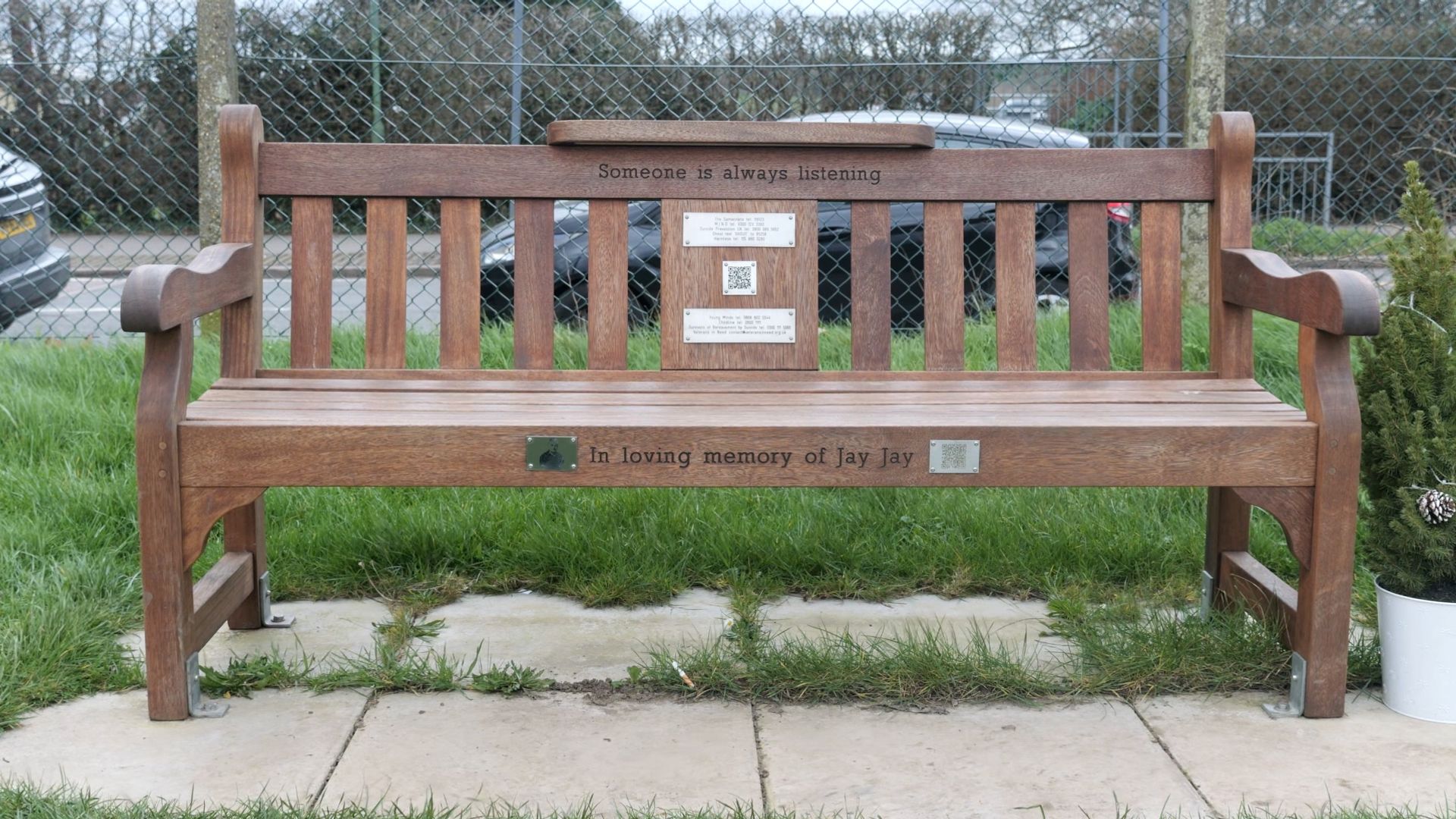
Public health outcomes are fundamentally dictated by the friction between an individual in crisis and the accessibility of a support node. In the context of the "mental health bench" movement—a decentralized network of designated seating areas intended to facilitate spontaneous peer support—the primary objective is to lower the activation energy required for a help-seeking event. This is not a matter of sentiment; it is a structural optimization of urban space to address the failure of traditional, high-barrier clinical pathways. By designating a specific physical coordinate as a "safe zone" for dialogue, the intervention attempts to solve the coordination problem inherent in social isolation.
The Tri-Factor Model of Low-Threshold Support
To understand why a simple piece of street furniture can function as a psychological intervention, one must decompose the interaction into three distinct operational layers.
1. The Signal-to-Noise Ratio in Urban Environments
Urban spaces are traditionally designed for transit, not stasis. A standard park bench carries an ambiguous social script; sitting there might signal a desire for solitude, rest, or observation. The "Friendship Bench" or "Chat Bench" removes this ambiguity through explicit labeling. This reduces the cognitive load on both the distressed individual (the signal-taker) and the potential helper (the signal-provider). When the intent of the space is codified, the social risk of "intruding" on a stranger is neutralized.
2. Temporal Proximity and Crisis Mitigation
Clinical mental health services operate on a lag. Between the onset of acute distress and an intake appointment, there is a dangerous window of vulnerability. Social infrastructure acts as a real-time buffer. While it does not replace psychiatric care, it functions as a "stop-gap" that can de-escalate emotional volatility through immediate human synchronization.
3. The Decentralization of Care
Centralized healthcare systems are prone to bottlenecks. By moving the point of contact from a hospital or clinic to a neighborhood sidewalk, the system shifts from a Reactive Model (waiting for a patient to present at a facility) to a Proactive Proximity Model. This bypasses barriers such as transportation costs, bureaucratic intake forms, and the social stigma associated with entering a psychiatric ward.
Technical Constraints and The Risk of Implementation Failure
The efficacy of these benches is not intrinsic to the wood or metal used in their construction; it is dependent on the ecological context of their placement. A bench placed in a high-noise, high-traffic intersection fails because the environment prevents the auditory and emotional privacy required for vulnerability.
- Acoustic Isolation: For a micro-intervention to succeed, the ambient noise level must be low enough to allow for a natural speaking volume. High decibel environments trigger a physiological "fight or flight" response, which is counter-productive to de-escalation.
- The Bystander Effect Paradox: In highly crowded areas, the probability of an individual stopping to help actually decreases as the "responsibility" is perceived to be diffused among the crowd. Optimal placement occurs in "medium-density" zones—areas with enough foot traffic to ensure the bench is seen, but low enough density that an individual feels a personal social obligation to engage.
- Maintenance of Symbolism: If a designated bench falls into disrepair or becomes associated with anti-social behavior, the "safety signal" is corrupted. The physical state of the infrastructure directly correlates to the perceived safety of the mental space it represents.
The Economic Logic of Peer-Led Intervention
From a macro-economic perspective, mental health benches represent a high-leverage investment with a near-zero marginal cost after installation.
- Reduction in Emergency Room Overload: A significant percentage of ER visits involve non-clinical psychological distress. If 5% of these individuals find sufficient de-escalation on a community bench, the cost savings to the public health system are exponential compared to the $500–$2,000 cost of a single bench.
- Labor Arbitrage: Professional psychological labor is scarce and expensive. Peer-to-peer support utilizes the "latent capacity" of the community—ordinary citizens who are willing to listen but lack a formal venue to do so. This is an efficient allocation of social capital.
- Prevention of Workforce Attrition: Early-stage intervention prevents the slide from "manageable stress" to "clinical burnout," keeping individuals active in the labor market and reducing the strain on long-term disability systems.
Identifying the "Dark Place" Bottleneck
The competitor narrative focuses on the bench as a place for "dark times." In analytical terms, this "dark place" is a state of informational isolation. The individual feels their internal state is unobservable and unfixable. The bench functions as a transceiver. It allows the individual to broadcast a "low-battery" signal in a format that the community is pre-authorized to receive.
However, we must acknowledge the limitations. A bench cannot prescribe medication. It cannot provide Cognitive Behavioral Therapy (CBT). It cannot manage severe psychosis. The danger of this model is "intervention creep," where local governments might use low-cost social furniture as a justification for defunding professional psychiatric services. The bench is a portal, not a destination.
Structural Requirements for a Scalable Network
For a municipality or organization to move beyond "symbolic" benches toward a functional support network, the following variables must be optimized:
- Integration with Rapid Response: Each bench should feature a non-obtrusive QR code or NFC tag linking directly to 24/7 crisis hotlines. This bridges the gap between peer support and professional intervention.
- Volunteer Density: A bench is useless if no one ever sits on it to listen. Successful programs (like the original Friendship Bench in Zimbabwe) train "grandmothers" or community elders to occupy these spaces during peak hours. This ensures the "supply" of empathy meets the "demand" of the distressed.
- Data Feedback Loops: To measure success, organizers must track qualitative metrics—not just how many benches exist, but the frequency of "high-value interactions." This requires anonymized reporting mechanisms where participants can log a successful connection.
The Strategic Shift from Clinical to Communal
The transition toward "mental health benches" signals a broader shift in the philosophy of care. We are moving away from the "Clinical Silo" model toward an "Integrated Social Fabric" model. The objective is to bake mental health resilience into the physical geography of our lives.
The most effective strategy for implementing this infrastructure is not a blanket rollout of 1,000 benches. Instead, it is a Targeted Geospatial Deployment. Identify areas with high social isolation indices—senior living clusters, student housing, and transit hubs—and install benches as part of a "Social Safety Grid."
The final strategic move for any entity looking to replicate this success is to move beyond the bench as a product and treat it as a protocol. The wood and paint are irrelevant; the protocol is the public permission to be human in a space that usually demands productivity. Stop treating mental health as a private medical secret and start treating it as a public utility that requires physical infrastructure. Deploy the benches not as "kindness projects," but as high-ROI urban components designed to reduce the systemic cost of isolation.


