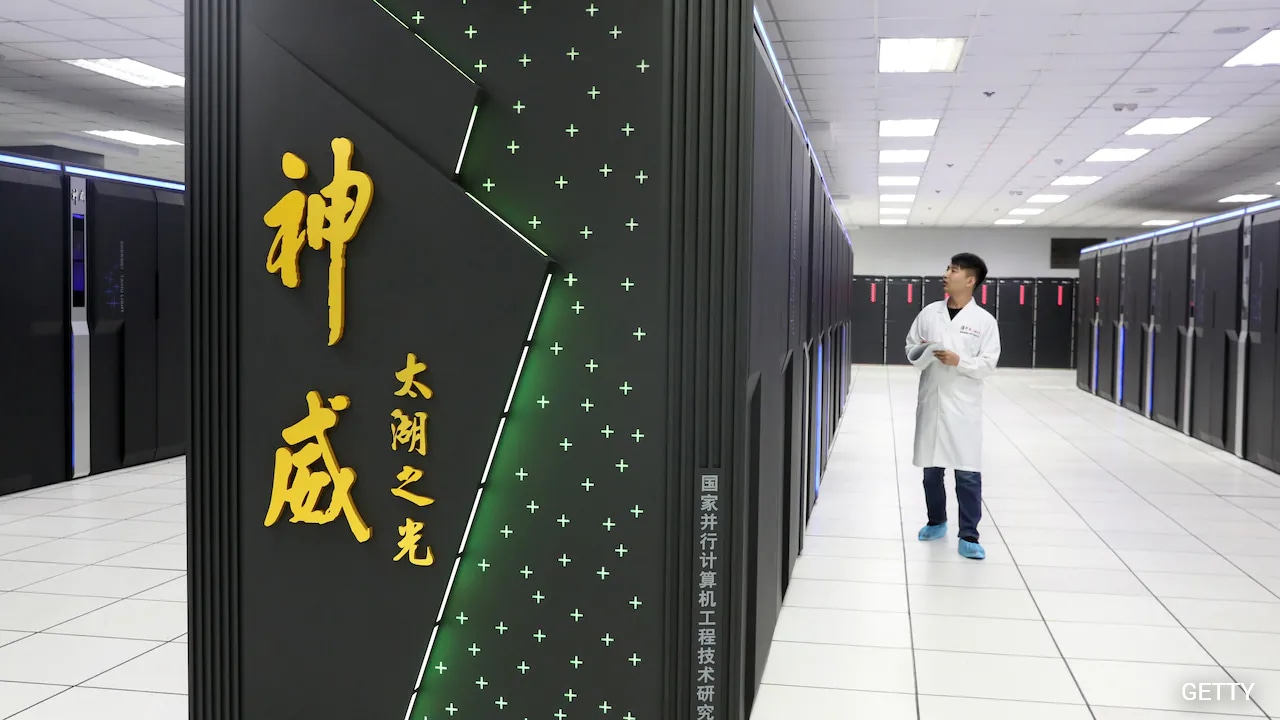
Sustained double-precision compute capability is an incomplete proxy for strategic technological dominance. While the displacement of the United States from the summit of the TOP500 supercomputer rankings signals a milestone in hardware assembly, evaluating national computing power solely through High-Performance Linpack (HPL) metrics obscures the operational trade-offs of modern workloads. The June 2026 debut of the LineShine supercomputer at the National Supercomputing Centre in Shenzhen establishes a new baseline for raw arithmetic throughput, yet a structural decomposition of its architecture reveals a clear divergence between traditional scientific simulation capability and actual frontier artificial intelligence readiness.
The Architectural Bifurcation: Core Count vs. Mixed Precision
The LineShine system achieves a verified HPL score of 2.198 exaflops, surpassing the United States Department of Energy’s El Capitan system at Lawrence Livermore National Laboratory by approximately 20 percent. This milestone marks the first time a Chinese installation has officially topped the list since the Sunway TaihuLight in 2017. However, the fundamental engineering choices underlying LineShine expose the distinct geopolitical constraints governing its development.
The machine's computational engine is the homegrown, custom LingKun platform, utilizing 304-core Huawei LX2 processors built on the Armv9 instruction set architecture. Total system scale encompasses 13,789,440 processor cores housed across 90 cabinets. The defining technical characteristic of LineShine is its total reliance on conventional Central Processing Units (CPUs) rather than the heterogenous CPU-GPU (Graphics Processing Unit) hybrid architectures that characterize its contemporary exascale peers, such as El Capitan, Frontier, and Aurora.
This structural divergence becomes highly apparent when analyzing performance data across distinct benchmarking matrices.
- High-Performance Linpack (HPL): LineShine delivers 2.198 exaflops sustained against a theoretical peak of 2.736 exaflops. This represents an exceptionally high linear execution efficiency of 80.3 percent for dense linear systems, a direct result of tightly coupled, homogeneous CPU scaling and a proprietary low-latency LingQi interconnect.
- High-Performance Conjugate Gradients (HPCG): On workloads mimicking real-world, memory-bandwidth-bound scientific applications, LineShine leads the field at 22.00 HPCG-petaflops. This confirms superior performance in traditional partial differential equation solvers, climate modeling, and structural engineering mechanics.
- HPL-MxP (Mixed-Precision): On the benchmark specifically designed to measure lower-precision (FP16/BF16) arithmetic utilized in training large-scale deep learning models, LineShine drops to fourth place globally, achieving only 7.92 exaflops.
The mixed-precision metric uncovers a stark performance asymmetry. El Capitan demonstrates an HPL-MxP score of 16.7 exaflops—a 9.2-times acceleration over its standard double-precision baseline, driven by the specialized matrix math cores embedded within its AMD Instinct MI300A accelerators. LineShine yields a modest 3.6-times speedup under the same parameters. The absence of dedicated tensor-style acceleration units within its CPU-heavy architecture creates a functional ceiling on its deep learning throughput per unit of hardware footprint.
The Cost Function of Sanction Evaded Infrastructures
The decision to execute an exascale deployment using a CPU-only topology is driven primarily by supply chain architecture rather than unconstrained algorithmic choice. United States export controls initiated in late 2022 and expanded through subsequent unilateral restrictions structurally targeted the transfer of high-density, specialized accelerators to Chinese entities. By restricting access to discrete enterprise GPUs, the regulatory framework created a specific hardware deficit.
LineShine represents an optimization strategy built to bypass this specific constraint. General-purpose CPUs running custom instruction set extensions for vector math operate under a different regulatory classification than advanced accelerators. While this strategy successfully bypasses target restrictions, it introduces a significant penalty across the thermodynamic and fiscal cost functions of the datacenter.
The thermal and electrical reality of this infrastructure presents a steep trade-off. LineShine demands a sustained electrical draw of approximately 42.2 megawatts to maintain its peak operating state. This translates to an energy efficiency rating of 52.07 gigaflops per watt. In comparison, the top tier of the Green500 efficiency rankings—dominated by systems built around tightly integrated CPU-GPU architectures such as the Nvidia Grace Hopper and Blackwell platforms—routinely deliver efficiencies exceeding 70 gigaflops per watt.
The architectural penalty of scaling via raw core volume manifests as:
- Shedding Density: Attaining exascale thresholds using 13.79 million CPU cores requires vast physical footprints, exponentially complex cabling matrices, and higher long-term failure rates across structural nodes due to the sheer quantity of individual components.
- Interconnect Saturation: Managing cache coherency and data routing across millions of discrete general-purpose elements places an extraordinary burden on the networking fabric. The custom LingQi interconnect must dedicate substantial bandwidth merely to synchronize state changes across nodes, creating an inherent efficiency decay curve if scaled further.
- Capital Expenditure Allocation: Shifting from highly concentrated accelerator modules to massive arrays of customized multi-core CPUs drastically alters the silicon wafer consumption per exaflop, inflating manufacturing overhead even if subsidized outside standard commercial markets.
Evaluating Ecosystem Capacity: The Hyperscale Dark Matter
Relying exclusively on the TOP500 ledger to evaluate a nation's absolute computational readiness introduces a profound selection bias. The ranking operates as a voluntary registry; it requires public or academic institutions to execute specific LINPACK tests and submit the verified logs for review. Consequently, the list increasingly fails to capture the largest aggregate pools of computing power deployed globally.
The actual center of mass for enterprise computational capacity has shifted from sovereign national laboratories to commercial cloud hyperscalers. Infrastructure investments by Western conglomerates—including Microsoft, Amazon Web Services, Google, and Meta, alongside specialized private infrastructure deployments such as xAI’s Colossus cluster—are conspicuously absent from the TOP500 rankings. These corporate entities do not pause multi-billion-dollar commercial operations to execute static linear algebra benchmarks for public ledger recognition.
Industry assessments indicate that single commercial hyper-clusters housing hundreds of thousands of interconnected advanced accelerators possess aggregate low-precision AI throughput that dwarfs the combined capacity of the entire public TOP500 registry. The tactical focus of these private infrastructures is entirely optimized for token generation, transformer model training, and massive vector search execution.
By prioritizing traditional double-precision scientific compute, public rankings reward systems optimized for simulating physical realities—such as fluid dynamics, nuclear stockpile stewardship, and molecular modeling. They structurally under-represent platforms engineered to process massive associative data arrays. Therefore, while China's milestone proves deep structural competency in sovereign chip fabrication and complex system integration under intense trade pressures, it does not imply a parallel leapfrog in industrial AI training capacity.
The operational reality is an equilibrium of distinct specializations. The United States maintains a decisive lead in aggregate lower-precision silicon volume and commercial cloud hyperscale architecture. China has demonstrated an elite capability to architect highly customized, sovereign, sanction-resistant architectures optimized for specific institutional workloads.
The strategic imperative for institutional operators is clear: evaluate infrastructure investments not through the singular prism of peak floating-point operations, but through the strict multi-variable optimization of memory bandwidth, precision-targeted instruction sets, and localized supply chain redundancy. The country that masters the complete lifecycle of chip design, high-bandwidth memory integration, and energy-insulated datacenter logistics will dictate the actual limits of computational authority, irrespective of changing positions on a public leaderboard.