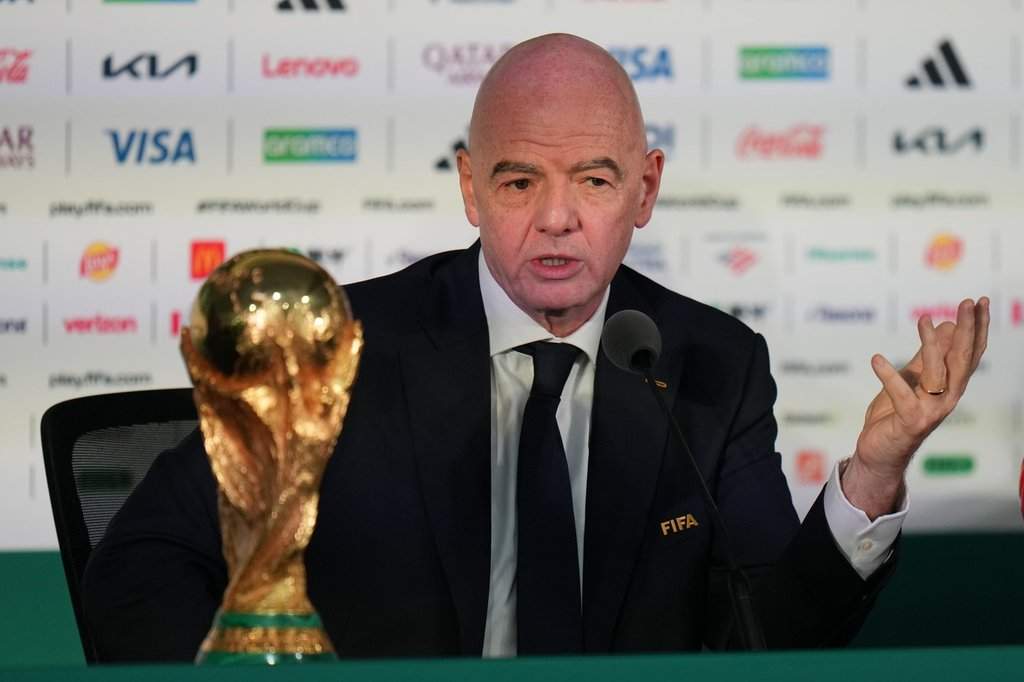
The recent proposal to establish FIFA Forward Enterprise (FFE) represents a fundamental shift in the economics of global sports governance. By attempting to separate commercial delivery from institutional oversight, FIFA President Gianni Infantino has initiated a high-stakes financial maneuver that threatens to alienate the sport’s foundational stakeholders. Understanding this move requires moving past the rhetoric of "selling the soul of football" to examine the underlying mechanisms of asset securitization, control, and governance risk.
The Mechanism of Commercial Spin-offs
The core of the FFE proposal involves segregating the commercial and operational activities of FIFA’s major tournaments—specifically the men's and women's World Cups and the Club World Cup—into a dedicated subsidiary. This is a classic move in institutional finance: moving a high-performing, cash-flow-generative asset into a distinct entity to facilitate capital raising through equity stakes or private investment.
From an institutional perspective, the stated goal is to professionalize commercial operations and increase liquidity. If successful, this would theoretically allow FIFA to redistribute capital more aggressively to member associations. However, the structural flaw lies in the alignment of incentives between FIFA’s internal governance and the external investors. Once an entity like FFE is capitalized by private equity, its primary fiduciary obligation shifts toward maximizing yield for its shareholders. The board of a commercial subsidiary will inevitably pressure the governing body to increase the frequency of tournaments, expand market access to high-revenue regions, and prioritize commercial metrics over sporting integrity.
Governance Disintermediation and Risk
The internal revolt led by FIFA’s Chief Operating Officer, Kevin Lamour, and the resignation of senior advisor Carlos Cordeiro highlight a critical breakdown in internal decision-making. The lack of transparency in the planning process effectively bypassed established governance committees, creating a "black box" scenario where major stakeholders—including confederations like UEFA, CONCACAF, and AFC—found themselves uninformed regarding a structural change that affects the value of their own participation.
This creates a governance bottleneck. If FIFA persists in decoupling commercial operations from the broader membership, it risks institutionalizing a two-tier system:
- The Commercial Layer: An autonomous subsidiary focused on high-growth extraction and investor returns.
- The Political Layer: A traditional governing body increasingly decoupled from the revenue streams it nominally manages.
This bifurcation diminishes the leverage of member associations, as their influence over the sport’s commercial direction is functionally outsourced to private investors. The unified 55-0 vote by UEFA against the project is not merely a moral objection; it is a defensive strike against the dilution of their collective bargaining power.
The Cost Function of Private Investment
The involvement of external investors, such as those led by Thrive Capital, introduces an external pressure component that FIFA has not previously navigated. When private equity enters the capital structure of a governing body, the "cost of capital" is not just the interest rate or the equity share sold; it is the loss of operational autonomy.
The $20 billion valuation ascribed to this venture assumes a trajectory of exponential growth. To meet these targets, FFE would likely require:
- Frequency Compression: Shifting from a four-year World Cup cycle to a more condensed interval to accelerate return on investment.
- Market Prioritization: Focusing host selection on markets with higher per-capita commercial yields, potentially marginalizing smaller or developing football nations despite their contribution to the global base of the sport.
- Content Expansion: Increasing the number of matches to inflate broadcasting rights fees, creating a potential "saturation point" where the product quality declines due to player fatigue and over-exposure.
Institutional Trust and the Credibility Gap
The current backlash demonstrates the catastrophic failure of the "top-down" implementation strategy. Even if the project were mathematically sound, the lack of due process has triggered a crisis of trust. Institutional entities, particularly sports confederations, operate on a consensus-based model. By bypassing this, the executive leadership has forced a confrontation that may lead to long-term fragmentation.
The resignation of Carlos Cordeiro—a figure with significant institutional credibility in finance and sports administration—serves as a warning sign to potential investors. If senior personnel with banking expertise publicly characterize the deal as detrimental to the asset's long-term health, it increases the "due diligence" risk for any private equity firm. Investors are unlikely to proceed if the project faces active, high-level opposition that could lead to protracted legal battles, litigation over TV rights, or total boycotts.
Strategic Outlook and Structural Reality
The path forward for FIFA’s leadership requires immediate mitigation of the current structural friction. To resolve the present stalemate, the following steps are likely necessary:
- Governance Re-integration: The proposed subsidiary must be brought back under the direct oversight of a reconstituted finance and compliance committee that includes representatives from all major confederations.
- Transparency Protocols: All investment term sheets and external commercial agreements must be subject to an independent, non-partisan audit and a transparent vote by the FIFA Council.
- Institutional Veto Rights: The member associations must be granted explicit veto rights over any future commercial changes that involve the sale of equity or long-term operational control of the World Cup.
If FIFA continues to move forward without these safeguards, the sport faces a fractured landscape. A formal boycott by major confederations, while unprecedented, is now a quantified risk. The leadership must pivot from an "asset liquidation" framework toward one that emphasizes transparent, consensus-driven commercial development. The strategic play is to abandon the current FFE structure in favor of a joint-venture model that retains ownership and control within the existing federated structure, ensuring that the commercialization of the sport remains tethered to its long-term health rather than short-term capital extraction.