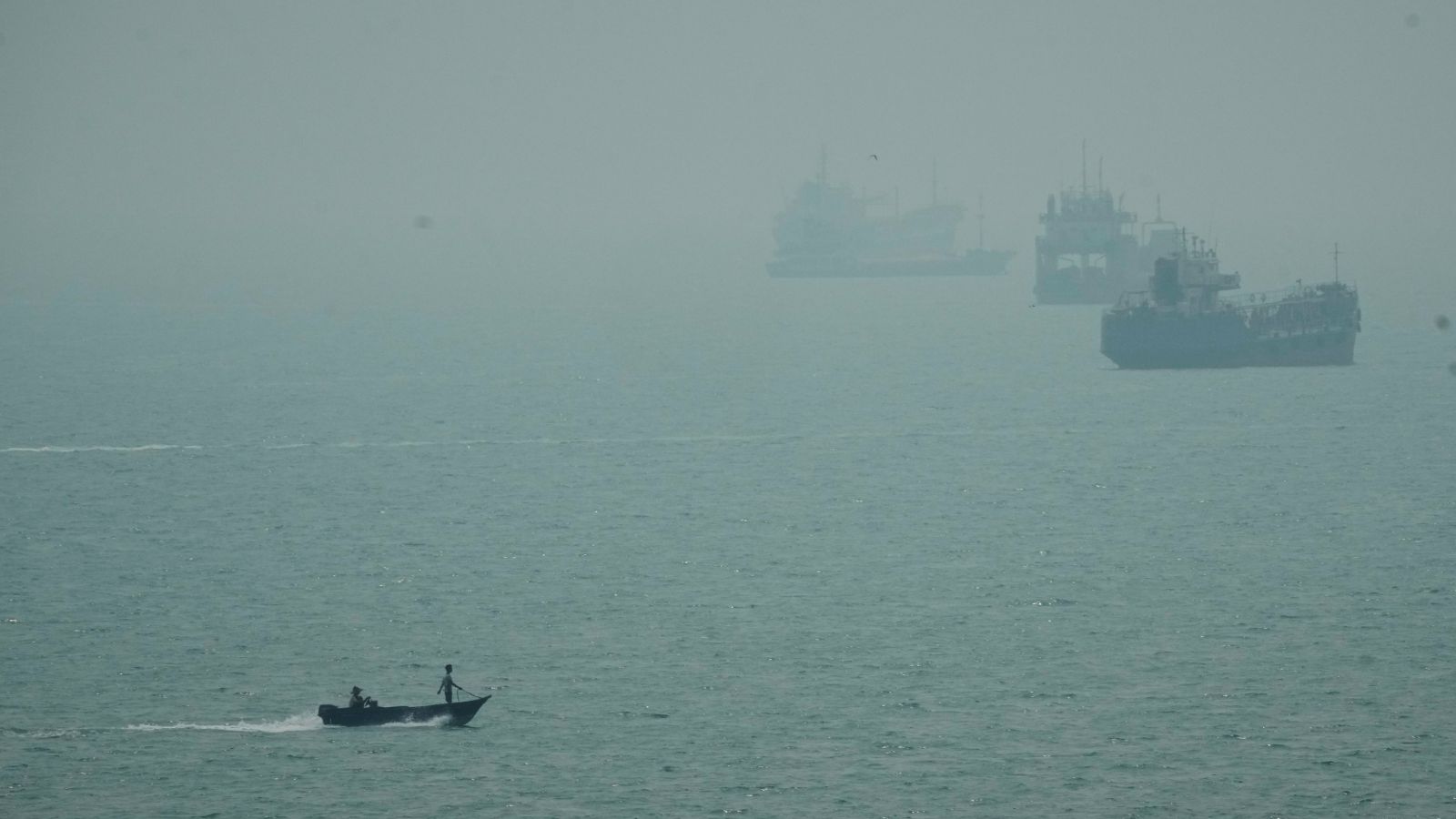
The kinetic escalation in the Middle East following the outbreak of hostilities between Washington and Tehran introduced an immediate, catastrophic supply-side constriction to global petroleum markets. The effective closure of the Strait of Hormuz choked off millions of daily barrels of crude, creating a theoretical shortage capable of driving nominal benchmark prices far beyond historical peaks. That the global economy avoided a catastrophic energy shock is not the result of spontaneous market equilibrium or coordinated Western diplomatic intervention. Instead, systemic price containment traces back directly to Beijing's multi-year accumulation of strategic crude inventories, executed under the banner of national self-reliance.
Understanding this dynamic requires dissecting the mechanics of global oil pricing under duress. When a vital maritime chokepoint like the Strait of Hormuz experiences severe disruption, physical supply scarcity forces immediate spot-market competition. Refiners scramble for uncommitted barrels, bidding up prices in a zero-sum scramble to maintain facility operations. The initial economic models predicted that a major confrontation involving Iranian production and regional transit lanes would trigger an inflationary spiral, transmitting high fuel costs across international manufacturing and logistics networks.
Beijing disrupted this theoretical trajectory through accumulated inventory deployment. Over the preceding decade, China systematically constructed one of the largest strategic petroleum reserve networks in modern economic history. While Western commentary frequently frames this buildup through the lens of military contingency planning—specifically preparation for potential naval blockades or amphibious operations regarding Taiwan—the commercial byproduct of these massive stockpiles altered global market structures during the Persian Gulf crisis.
When physical imports tightened, rather than entering the spot market with aggressive, price-insensitive bids that would have supercharged international crude benchmarks, state-owned and independent Chinese refiners utilized domestic reserves to bridge the deficit. This tactical withdrawal of demand pressure from global spot markets acted as an invisible shock absorber. By absorbing the localized deficit through pre-positioned national storage rather than competing for dwindling maritime cargoes, China suppressed the upward velocity of oil prices.
The economic calculus governing this behavior is rooted in export exposure and macro-level dependency. China operates as a massive net importer of crude oil, anchoring an industrial export machine deeply integrated with Western consumer markets. A parabolic spike in global energy costs functions as a dual-edged systemic threat. While domestic refiners might capture localized margins, the macroeconomic feedback loop—higher manufacturing costs, depressed consumer demand in export destinations, and global recessionary impulses—destroys aggregate demand for Chinese manufactured goods. Xi Jinping’s emphasis on supply-chain security and energy self-reliance anticipated external shocks, but the operational execution of drawing down these reserves served as a public good for the wider global economy, protecting international trade from an unmitigated price dislocation.
The structural reality of these inventory buffers, however, introduces a finite horizon for market stability. Strategic reserves are, by definition, exhaustible assets. As the conflict in the Middle East extends across successive quarters, the capacity of domestic stockpiles to continuously offset missing maritime volumes diminishes. The mathematical relationship between inventory depletion rates and sustained production losses in the Persian Gulf dictates that price suppression is a temporary condition rather than a permanent structural floor.
Market participants tracking the trajectory of energy costs frequently misinterpret the relationship between Washington and Beijing during this crisis. Public diplomatic friction over trade enforcement and geopolitical alignment obscures a quiet commercial interdependence. Washington demands that Beijing apply pressure on Tehran to cease regional disruptions, while simultaneously recognizing that unilateral Western naval operations lack the capacity to fully secure maritime transit lanes without severe economic friction. Beijing absorbs the immediate shock by rationing its accumulated reserves, shielding its domestic industrial base while inadvertently keeping Western inflation metrics from breaching terminal thresholds.
This dynamic highlights a fundamental transformation in commodity market governance. Traditional supply-side economics relied upon spare production capacity managed by coordinated cartels like OPEC to smooth out price volatility. In an era defined by state-directed economic nationalism and fragmented geopolitical blocs, national strategic reserves function as the primary marginal balancing mechanism. When traditional supply channels fracture, the depth of a nation's sovereign stockpile determines its ability to insulate domestic output from international pricing chaos.
The forward-looking risk profile centers on the depletion threshold of these reserves. As state-controlled storage facilities approach critical minimum operating levels, refiners will inevitably re-enter international markets to replenish physical stocks. If Persian Gulf export infrastructure remains constrained or impaired, this structural shift from inventory draw-down to inventory rebuilding will unleash pent-up bidding pressure. The temporary reprieve engineered by Beijing's defensive architecture will evaporate, exposing consuming economies to the deferred cost of the regional conflict. Strategic planning for industrial consumers must therefore treat current price stability as an artificial plateau, preparing operational supply chains for a secondary price adjustment when sovereign inventory buffers reach their operational limits.