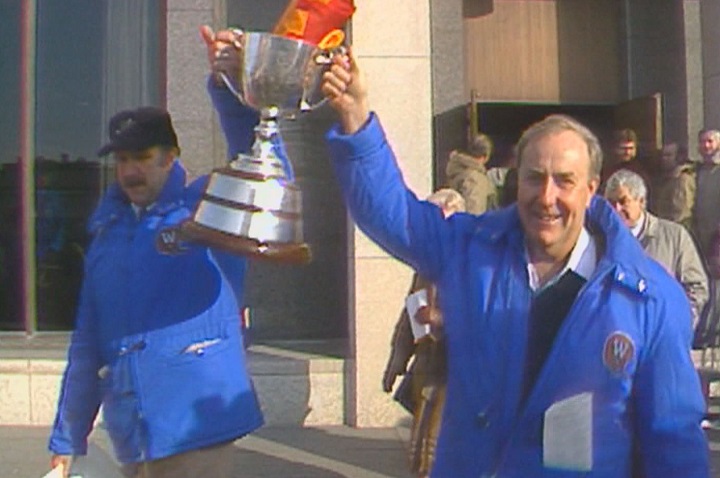
The wind in Winnipeg doesn’t just blow. It carves. Anyone who has stood on the sidelines at regular season's end knows the specific brand of chill that rolls off the prairie, cutting through layers of heavy wool and down jackets until it finds bone. It is an unforgiving environment. To build something that lasts in this place, you cannot rely on flash or fleeting brilliance. You need a foundation forged from iron, stubbornness, and an unyielding belief in the collective will.
For more than a decade, that foundation wore a headset and a scowl. His name was Cal Murphy.
When a football club announces that a name is being etched into its Ring of Honour, the modern sports fan often greets the news with a polite nod and a scroll through their social media feed. It becomes another line item in a franchise's marketing schedule, a halftime ceremony designed to sell hot dogs and nostalgic caps. But names on a stadium facade aren't just decorations. They are ghosts. They are the structural pillars holding up the identity of a community.
To understand why adding Cal Murphy to the Winnipeg Blue Bombers Ring of Honour matters, you have to look past the cold text of the press release. You have to travel back to an era when the franchise wasn't a powerhouse, but an afterthought, and look at the man who literally gave his own heart to keep it alive.
The Concrete Echoes of 1983
Imagine walking into the old stadium on Empress Street in the early autumn of 1983. The concrete is gray, the sky is grayer, and a generation of fans has grown up believing that success belongs exclusively to other cities. The Blue Bombers had spent over twenty years wandering through a championship desert. The glory days of Bud Grant were a fading memory, black-and-white photographs yellowing in the basement of local legions.
Enter a man with an abrupt manner and a gaze that could melt ice.
Cal Murphy did not arrive in Manitoba to make friends. He arrived to win. He took over a team that had lost its way and immediately began demanding something the city hadn't seen in years: absolute, uncompromising accountability. He wasn't a corporate strategist using whiteboard jargon. He was a football philosopher who believed that a team mirrored its city. Winnipeg was blue-collar, tough, and well-acquainted with hardship. Murphy decreed that his football team would be exactly the same.
The transformation wasn't instantaneous, but it felt inevitable once the pieces clicked. He reconstructed the roster not with high-priced prima donnas, but with individuals who had something to prove. He looked for the overlooked. He found players who ran a little harder because they knew what it was like to be cut, who hit a little harder because they understood the precarity of a sports career.
By 1984, the culture had shifted. The dry facts tell us that the Blue Bombers won the Grey Cup that year, ending a twenty-two year drought. But the facts fail to capture the explosion of pure, unadulterated relief that washed over the province. That victory wasn't just a trophy; it was a validation. It told a community that had long felt secondary to the larger media markets out East or the oil-rich booms out West that they were, for at least one freezing Sunday, the best in the land.
The Shadow on the Sideline
True builders are never satisfied with a single monument. Murphy transitioned from the field to the general manager's office, constructing a machine that dominated the Canadian Football League for a decade. He brought in coaches, drafted Canadian talent with uncanny precision, and managed the salary cap like a man protecting his own life savings. Under his watch, the team captured two more titles in 1988 and 1990.
But as the franchise grew stronger, the man who built it was quietly breaking down.
Football is an industry that devours its citizens. The hours are monstrous, the stress is constant, and the diet usually consists of whatever can be eaten out of a styrofoam container at midnight while watching game film. For years, Murphy pushed his body past reasonable limits. His heart was failing.
Consider the terrifying reality of the winter of 1992. While the city was preparing for another season, its football patriarch was confined to a hospital bed in London, Ontario, hooked up to machines, waiting for a stranger to die so that he might live. His heart was drastically enlarged, working at a fraction of its capacity. The tough exterior, the legendary temper, the brilliant football mind—all of it was trapped in a failing biological cage.
The tension in Manitoba during those months was palpable. Sports talk radio wasn't discussing draft picks or defensive schemes; people were calling in to offer prayers for a general manager. It was a rare moment where the artificial world of professional sports dissolved, revealing the deep human connective tissue underneath. We often view these figures as indestructible characters in a weekly drama. Suddenly, the architect of Winnipeg's pride was fragile.
Then came the miracle. A match was found.
The Second Movement
Most people would take a heart transplant as a clear, cosmic sign to buy a rocking chair, move to a warmer climate, and spend their remaining years watching the grass grow.
Cal Murphy was not most people.
Mere months after undergoing one of the most invasive medical procedures known to science, he was back in Winnipeg. He was back in his office. He was back to grumbling about missed blocks and evaluating game film. To those who didn't know him, it looked like madness. To those who did, it was the only logical outcome. The football club wasn't just his job; it was the pacemaker that kept his new heart beating.
His return wasn't a symbolic victory lap. He didn't come back to be a figurehead or a living mascot. He returned to run the operation with the same intensity as before. He coached again. He argued with officials. He built more playoff teams.
Think about the sheer psychological grit required to stand on a frozen sideline in November, breathing in air that feels like broken glass, listening to the roar of thirty thousand people, while carrying the heart of a stranger in your chest. That isn't just dedication to a game. That is a refusal to let mortality dictate the terms of your existence.
Why the Wall Needs His Name
As time passes, names fade from the active memory of a stadium. The fans who pack the modern stands at Princess Auto Stadium look at the Ring of Honour and see a collection of historical signposts. They know the names, but they might not know the sweat. They might not know the cold nights or the backroom battles that kept the lights on when the franchise faced financial ruin in the late nineties.
Murphy’s inclusion in this elite circle corrects a historical omission. He belongs there not just because of his win-loss record, though ninety-eight regular-season victories as a head coach is an astonishing number. He belongs there because he shaped the very DNA of what it means to be a Winnipeg Blue Bomber.
When you see the current iteration of the team—the physical, suffocating defense, the offensive line that prides itself on bruising opponents, the connection between the roster and the blue-collar fan base—you are looking at a house built on Cal's blueprints. He established the standard. He taught a city that it didn't have to apologize for its weather, its geography, or its economic status. He turned those very elements into weapons.
The ceremony will happen, the curtain will drop, and the letters spelling out his name will catch the prairie light. The applause will echo across the stadium, carrying over the suburbs and toward the rivers.
But the true tribute won't be the metal letters on the concrete facade. It will be found in the quiet realization of every fan who looks up at that wall on a freezing night, pulls their jacket a little tighter against the north wind, and remembers that once, there was a man who gave everything he had—down to his very heart—to teach this city how to win.