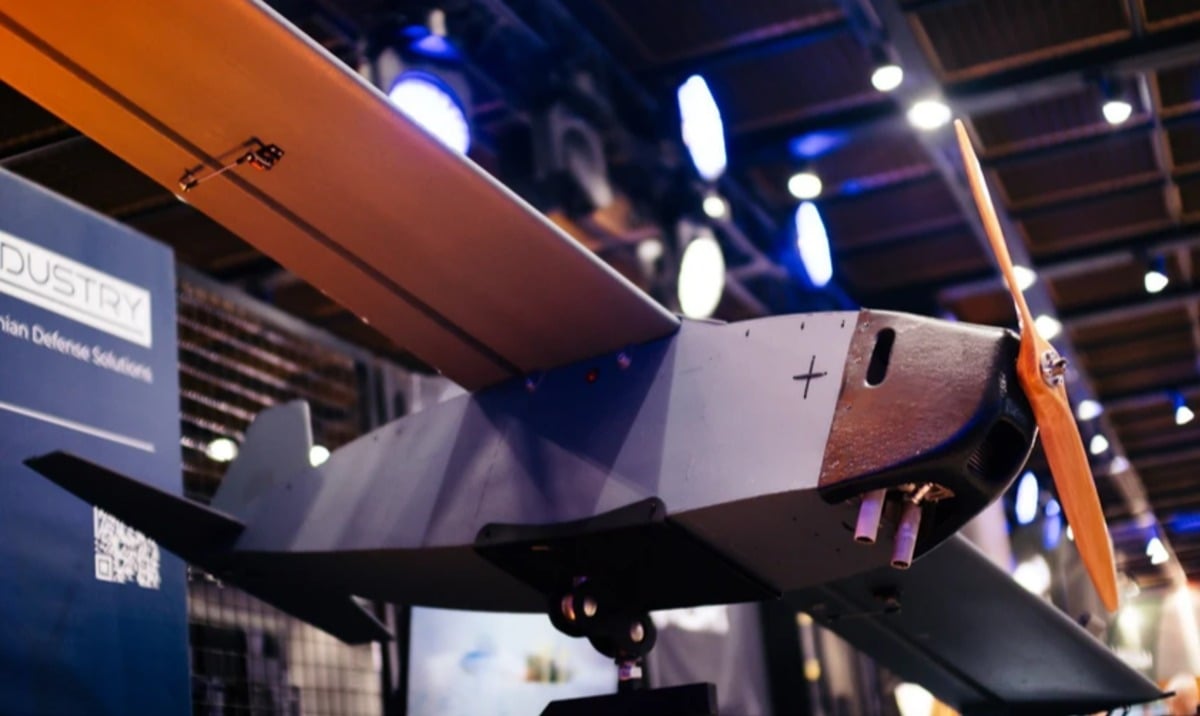
The operational reality of attrition warfare dictates that cost asymmetry supersedes technological complexity. When Ukrainian manufacturer DG Industry weaponized the middle-strike variant of its Shpatel decoy Unmanned Aerial Vehicle (UAV), it executed a structural shift in aerial doctrine rather than a simple field modification. By transforming a $5,000 pneumatic-launched decoy into a strike asset carrying an 8-kilogram warhead with a 250-kilometer range, the system breaks the traditional defense economic equation. It forces adversarial air defense commands to choose between terminal asset saturation or the rapid depletion of multi-million-dollar surface-to-air missile (SAM) inventories.
Understanding this development requires separating the physical modification of the airframe from the systemic logic of the payload-to-cost ratio. This structural breakdown maps how the conversion operates, evaluates its strategic friction points, and analyzes its macroeconomic pressure on defensive networks.
The Dual-Use Architecture Framework
The original utility of the Shpatel platform relied on its signature-generation capability. Operating since 2025 as a dedicated decoy, the baseline airframe features a 420-kilometer range, a nominal one-kilogram self-destruction payload, and passive radar-reflection mechanisms designed to mimic high-threat cruise missiles or long-range strike assets. The transition to a dual-use strike/decoy system relies on three distinct technological pillars.
Kinematic and Structural Allocation
The conversion swaps range for mass without altering the basic aerodynamic envelope of the airframe. The strike variant drops operational range from 420 kilometers to 250 kilometers to accommodate an 8-kilogram high-explosive warhead.
By maintaining a cruise speed of 130 km/h, the airframe retains an identical flight profile to its decoy counterpart. This kinematic homogeneity ensures that radar systems cannot differentiate between the two variants based on velocity, altitude, or Doppler signatures.
Control System Agility
The updated communication architecture changes the drone from a pre-programmed, single-direction asset into a dual-purpose platform. Operable as either an attack drone or an airborne signal relay flying at altitudes exceeding 1 kilometer, the platform creates a localized communications mesh.
Using the strike platform as a high-altitude relay extends the line-of-sight control window for low-flying First-Person View (FPV) drones or sister strike variants. This counters the earth's curvature and terrain masking, which traditionally limit low-altitude electronic control channels.
Catapult Launch Logistics
The reliance on a pneumatic catapult deployment mechanism removes the requirement for established runway infrastructure or high-signature thermal launches. This lowers the launch footprint, allowing highly mobile deployment teams to operate from unprepared positions along the front. This logistical mobility prevents adversarial counter-battery or preemptive strikes on launch sites.
The Strategic Cost Function
The primary impact of weaponizing a $5,000 decoy is the economic strain it places on defensive networks. Traditional military procurement measures a weapon's effectiveness by its probability of destruction ($P_d$). In contrast, asymmetric drone doctrine assesses a platform by its Cost-to-Impose-Cost Ratio ($C_{ic}$). This ratio is defined as the cost of the attacking asset divided by the cost of the intercepting missile.
$$\text{Cost-to-Impose-Cost Ratio} = \frac{\text{Cost of Attacking Asset}}{\text{Cost of Intercepting Missile}}$$
The table below illustrates the economic mismatch generated by low-cost platforms like the Shpatel against standard modern air defense interceptors.
| Intercepting System | Estimated Interceptor Cost | Shpatel Cost | Cost Asymmetry Ratio |
|---|---|---|---|
| S-300 / 48N6 Variant | $1,000,000+ | $5,000 | 1:200 |
| Tor-M2 / 9M338 | $300,000+ | $5,000 | 1:60 |
| Pantsir-S1 / 57E6 | $100,000+ | $5,000 | 1:20 |
When an asset costs roughly $5,000, firing even a short-range, low-cost interceptor like the Pantsir's 57E6 creates a 20-to-1 financial loss for the defender. If the defender uses high-tier tactical systems to protect infrastructure farther back, the ratio degrades to 200-to-1.
The introduction of an actual 8-kilogram warhead into the decoy mix removes the option of passive tracking. When a decoy is unarmed, an air defense commander with good electronic intelligence can theoretically choose to ignore targets heading toward non-critical zones.
However, when the decoy shares an identical radar cross-section (RCS) and flight profile with a strike variant carrying 8 kilograms of high explosives, every incoming signature must be treated as a lethal threat. This forces full combat engagement from defensive batteries, accelerating interceptor depletion.
Operational Constraints and Systemic Vulnerabilities
Despite its financial advantages, the converted Shpatel platform is not an absolute weapon. Its reliance on ultra-low-cost commercial components and structural adaptations introduces specific vulnerabilities that adversarial forces can exploit.
Kinematic Vulnerability to Mobile Gun Architecture
At a cruise speed of 130 km/h and an altitude profile optimized for line-of-sight tracking, the drone is highly vulnerable to mobile anti-aircraft gun systems, such as the Gepard or ZU-23-2 units, when deployed in clean electronic environments. These systems bypass missile economic problems by using optical tracking and low-cost kinetic ammunition.
Electronic Warfare Slew and Link Saturation
The upgraded control system allows for real-time adjustments and relay operations, but it also creates an RF signature. Directed, high-power electronic warfare (EW) jamming targeting command frequencies can break the control link, forcing the drone into automated inertial guidance modes. This dramatically lowers its accuracy over its 250-kilometer range.
Payload Threshold Limitations
An 8-kilogram warhead is effective against unhardened logistical nodes, communications arrays, fuel depots, and parked aircraft, but it cannot breach reinforced concrete fortifications or heavily armored command bunkers. The platform is structurally limited to soft-target interdiction.
Deployment Playbook for Integrated Salvos
To maximize the economic and operational strain on an opponent, deployment doctrine must avoid isolated launches. The platform delivers its highest value when integrated into mixed, multi-tiered strike packages.
Phase I: Radar Saturation and Vector Probing
Launch baseline Shpatel decoy variants via pneumatic catapults along broad vector paths. This forces adversarial early-warning radar installations to activate, exposing their geographic positions, operational frequencies, and engagement boundaries.Phase II: Target Fixation and Relay Establishment
Deploy the modified strike/relay variants directly behind the decoy wave. Position specific units to circle at altitudes above 1 kilometer to establish a continuous, low-latency communication mesh across the advance corridor.Phase III: Kinetic Interdiction and Terminal Slew
As defensive batteries deplete their ready-to-fire interceptors on the decoy wave, the strike variants descend along low-altitude paths toward designated target coordinates. Simultaneously, forward-deployed FPV strike teams utilize the active airborne Shpatel relays to strike localized tactical assets that attempt to reposition.
Military forces facing deep-strike campaigns must pivot away from traditional missile-on-UAV engagement strategies. True defense sustainability requires scaling automated, radar-directed kinetic gun networks and wide-area electronic suppression fields. Until these close-in weapon systems are deployed in high numbers across vulnerable interior sectors, the conversion of modular decoy platforms into strike assets will continue to drain the economic and material reserves of traditional air defense networks.
The video titled "Ukraine is leveraging its powerful and cheap drone killers for air defense" details the tactical adjustments and mobile air defense formations used to counter low-cost aerial threats, providing relevant context on the defensive side of this economic and technological attrition loop.
Ukraine is leveraging its powerful and cheap drone killers for air defense