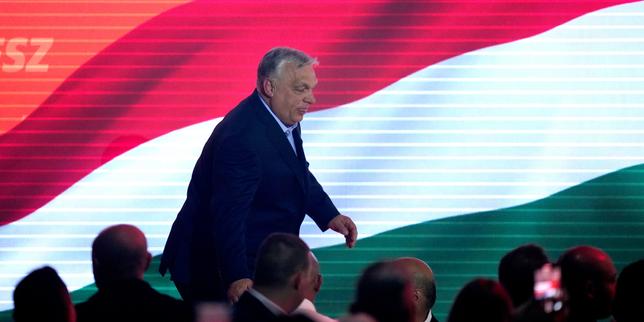
The Hungarian economic model, often marketed as a blueprint for national sovereignty and reindustrialization, has reached a point of diminishing marginal returns. While the administration of Viktor Orban has successfully maintained low unemployment and attracted significant Foreign Direct Investment (FDI), these metrics mask a foundational erosion of systemic competitiveness. The current crisis is not a transient byproduct of external shocks; it is the logical result of an economic architecture that prioritizes political loyalty over allocative efficiency.
The Dual-Economy Trap
Hungary’s economic structure is bifurcated between a high-productivity foreign export sector and a low-productivity domestic sector. This divergence creates a ceiling on national growth. The "Orbanomics" framework sought to address this by fostering a "national capitalist class," yet the mechanism used—state-directed capital allocation—has stifled the very innovation required for modernization.
- The Export Pillar: Dominated by German automotive manufacturers and, more recently, Chinese battery producers. This sector operates as an enclave with minimal technological spillover to the local economy.
- The Domestic Pillar: Composed of politically connected firms in non-tradable sectors such as construction, banking, and telecommunications.
This bifurcation leads to a misallocation of resources. Capital flows not to the most efficient firms, but to those with the highest degree of political alignment. In a market economy, firms compete on price and quality; in a clientelist system, firms compete for rent-seeking opportunities. The result is a stagnant domestic sector that cannot compete internationally, leaving the state entirely dependent on foreign multinational corporations for GDP growth and hard currency.
The Cost Function of Subsidized Industrialization
The Hungarian government utilizes aggressive fiscal incentives to attract heavy industry, specifically targeting the electric vehicle (EV) supply chain. While this boosts headline investment figures, the long-term cost-benefit analysis reveals significant vulnerabilities.
1. Energy Dependency and Infrastructure Costs
Hungary lacks the natural resources to support massive battery manufacturing plants. The energy intensity of these facilities requires a massive expansion of the power grid and increased imports of Russian natural gas and nuclear fuel. By doubling down on energy-intensive industry, the state has locked itself into a high-cost energy profile that is sensitive to geopolitical volatility.
2. Labor Scarcity and the Wage-Productivity Gap
Low unemployment in Hungary is a double-edged sword. With a shrinking workforce due to demographic decline and emigration of high-skilled labor, new industrial projects face a labor shortage. To staff these plants, the government has moved toward importing guest workers, a policy that contradicts its own sovereignist rhetoric. Simultaneously, wages in the tight labor market have risen faster than productivity.
When wages outpace productivity, the unit labor cost increases, eroding the primary competitive advantage Hungary held: cheap, skilled labor. Without a shift toward high-value-added services or advanced R&D, the country risks being "stuck in the middle"—too expensive for low-end manufacturing and too unskilled for high-end innovation.
The Institutional Decay and Risk Premium
The centralization of power has compromised the institutional guardrails that typically lower the cost of doing business. The degradation of the rule of law and the unpredictability of "extraordinary taxes" on specific sectors (retail, energy, banking) have created a significant "Hungary risk premium."
- Arbitrary Regulation: Sudden changes in the regulatory environment to favor domestic champions discourage long-term capital investment from diversified international sources.
- Corruption and Public Procurement: The concentration of public contracts within a narrow circle of insiders inflates the cost of infrastructure and public services. This is not merely a moral issue; it is an economic drain that reduces the multiplier effect of public spending.
The suspension of European Union funds is the most visible manifestation of this institutional friction. These funds were the primary engine of public investment for a decade. Their absence reveals the underlying fragility of the state's finances, forcing the government to borrow at significantly higher interest rates on international markets to bridge the deficit.
Monetary Policy Incoherence
The Hungarian National Bank (MNB) and the Ministry of Economic Development have frequently operated at cross-purposes, creating a volatile environment for the Forint (HUF).
The central bank has been forced to maintain some of the highest interest rates in the European Union to combat double-digit inflation and stabilize the currency. Conversely, the government has pushed for subsidized credit schemes to stimulate growth. This friction creates a "crowding out" effect where private, non-subsidized businesses cannot access affordable credit, while state-favored entities continue to expand regardless of market signals.
The volatility of the Forint increases the cost of importing energy and raw materials, further fueling the inflationary spiral. This creates a feedback loop where the state must intervene more aggressively to suppress prices (e.g., price caps), which leads to market shortages and further discourages domestic production.
The Battery Strategy A Strategic Bottleneck
The decision to position Hungary as a global hub for battery production is a high-stakes gamble on a single technological path. This "all-in" strategy ignores the rapid evolution of battery chemistries and the potential for technological disruption that could render current lithium-ion facilities obsolete within a decade.
By committing land, water, and energy resources to these massive projects, Hungary is sacrificing the opportunity to diversify its economy into digital services, biotechnology, or high-end engineering. The environmental externalities—specifically the depletion of groundwater in agricultural regions—create a long-term liability that is not reflected in the current GDP figures.
The Productivity Impasse
The fundamental failure of the Orban era is the lack of "Total Factor Productivity" (TFP) growth. Real modernization requires more than just building new factories; it requires an ecosystem of education, innovation, and competition.
- Educational Decline: Spending on education and R&D as a percentage of GDP has remained stagnant or declined in real terms. The workforce is being prepared for assembly lines rather than the knowledge economy.
- Lack of Startup Ecosystem: The dominance of state-connected capital means that independent entrepreneurs struggle to find venture funding or navigate a biased regulatory landscape.
Hungary is currently replicating the developmental model of the 1970s in a 2020s global economy. The reliance on heavy industry and cheap credit is a relic of a previous era that does not account for the complexities of modern global value chains.
The Strategic Pivot Required
To escape the current impasse, the Hungarian state must transition from a model of "growth through accumulation" to "growth through efficiency." This requires a dismantling of the clientelist structures that protect low-productivity domestic firms.
The first step is a restoration of institutional predictability to unlock frozen EU funds and lower the sovereign risk premium. Without this inflow of capital, the state will be forced into a cycle of austerity or high-interest debt that will stifle growth for years.
The second requirement is a radical shift in human capital investment. The focus must move from physical infrastructure to intellectual infrastructure. Subsidizing a battery plant provides jobs for today, but funding a world-class engineering university provides the basis for an economy that can survive the next industrial transition.
The final strategic move involves the diversification of the FDI portfolio. Relying almost exclusively on the automotive-industrial complex makes the Hungarian economy a derivative of the German business cycle. Active pursuit of FDI in software, fintech, and high-end pharma would provide the necessary hedges against the cyclicality of the manufacturing sector.
Failure to execute this pivot will result in a "lost decade" characterized by stagflation, where the country remains a peripheral assembly plant for more advanced economies, unable to break through the middle-income trap. The current trajectory suggests that the "Hungarian Model" is not a new path to prosperity, but a sophisticated method of managing relative decline.