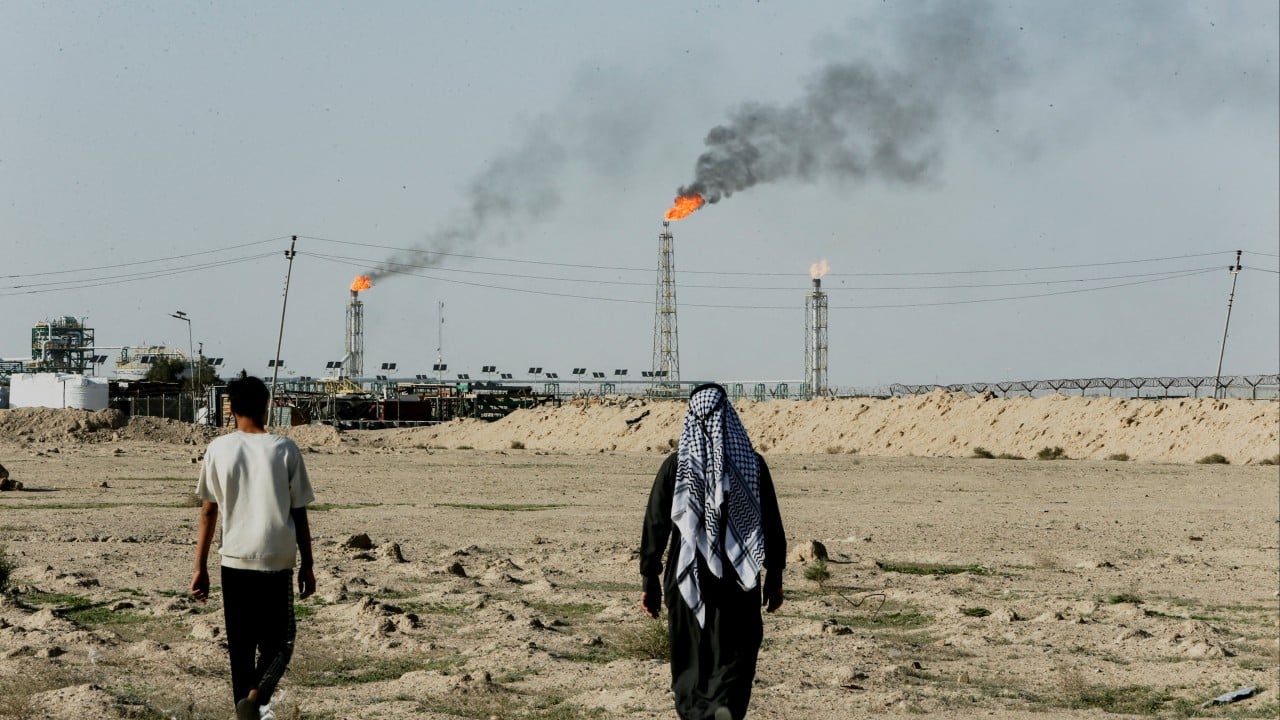
The evacuation of 14 million barrels of stranded crude oil from the Persian Gulf over a ten-day window in late June 2026 exposes a structural vulnerability in global energy logistics rather than a return to operational equilibrium. This volume, transiting the Strait of Hormuz at an average rate of 1.4 million barrels per day, represents merely a minor clearance of an extensive backlog accumulated since hostilities began on February 28, 2026. The resumption of these flows, enabled by a fragile United States-Iran Memorandum of Understanding, masks a deeper systemic crisis: the physical and economic degradation of Iraq's upstream extraction architecture and the severe limitations of its midstream infrastructure.
To evaluate the true impact of this transit surge, the situation must be parsed through the lens of infrastructure constraints, reservoir physics, and international trade dynamics. The 14 million barrels evacuated represent less than 15% of Iraq’s baseline monthly export capacity of roughly 100 million barrels. Relying on an isolated operational window to gauge the stabilization of the energy sector overlooks the severe logistical friction and capital destruction that occurs when a state's primary economic engine is abruptly throttled.
The Logistics of the Clearance Surge
The distribution of the evacuated volume reveals a complex maritime sorting mechanism operating under high-stress conditions. Tanker-tracking data indicates that the 14 million barrels were distributed across a fleet consisting primarily of Very Large Crude Carriers (VLCCs) and Suezmax vessels, each carrying between 1 million and 2 million barrels. The distribution pattern highlights the global nature of the demand pool, with cargoes bound for India, the Philippines, the Netherlands, Singapore, France, Greece, Malaysia, and the United States.
This multi-directional outflow demonstrates that while physical access to the strait was temporarily restored, the destinations reflect pre-existing long-term supply contracts rather than spot-market adjustments. The cargo clear-out was highly asymmetric:
- Vessel Classification Mix: VLCC crossings increased from fewer than two per day during the height of the blockade to over seven per day following the implementation of the maritime memorandum. This shift confirms that the volume recovery was driven by the deployment of massive hulls rather than an increase in total vessel traffic.
- The Bi-Directional Ballast Deficit: While outbound laden crossings rose significantly to nearly 11 per day, inbound ballast crossings lagged at approximately 9 per day. This deficit implies that the fleet depletion inside the Persian Gulf is not being matched by a corresponding return of empty hulls, signaling an imminent drop in loading capacity once the initial group of stranded tankers completes its exit.
- Route Dispersal and Risk Mitigation: Despite the establishment of temporary maritime corridors by Oman and the International Maritime Organization (IMO), tracking logs indicate that several vessels continue to deviate from standard lanes to hug the Omani coastline, sacrificing transit time to minimize exposure to unexploded ordnance and kinetic threats.
The operational reality of this clearance is bounded by a hard temporal ceiling. The resumption of flows was quickly challenged on June 25, 2026, when a commercial cargo vessel was struck by an unidentified projectile near the Omani coast. The subsequent decision by the International Maritime Organization to suspend its coordinated evacuation plan illustrates that the security premium remains high, making the current shipping volume highly volatile.
The Upstream Cost Function: Reservoir Damage and Shut-In Economics
The primary analytical error in standard coverage of the Hormuz reopening is the assumption that oil production can be dialed up and down without long-term technical or financial penalties. When the closure of the Strait of Hormuz forced Iraq to cut its active production from 4.4 million barrels per day down to approximately 1.5 million barrels per day, the country did not merely store wealth in the ground; it initiated a process of capital asset depreciation.
The suspension of extraction across premier southern assets—including West Qurna 1 and 2, Faihaa, Majnoon, Halfaya, and Buzurgan—inflicts specific types of technical damage on underlying geological formations:
Hydrodynamic Equilibrium Disruption
In massive sandstone and carbonate reservoirs like those found in the Basra governate, continuous extraction maintains a calculated pressure gradient. When wells are abruptly shut in, the sudden cessation of flow causes a redistribution of fluid phases within the rock matrix. Water-coning can accelerate, leading to premature water breakthrough once the wells are reopened, permanently reducing the ultimate oil recovery factor of the asset.
Wellbore Deposition and Skin Damage
Static crude oil within a high-temperature, high-pressure wellbore undergoes phase separation. Heavy components, such as asphaltenes and paraffins, precipitate out of the liquid phase and deposit on the reservoir face and wellbore casing. This creates "skin damage," a localized reduction in permeability that requires expensive chemical treatments or mechanical workovers to rectify before pre-crisis production rates can be achieved.
Associated Gas Flaring Imbalances
Iraq relies on associated gas from oil production to fuel its domestic electricity grid. Throttling crude extraction to 1.5 million barrels per day caused a corresponding collapse in gas feedstocks, forcing an increased reliance on expensive fuel imports and worsening structural blackouts in central provinces. The remaining operational wells had to be managed purely for gas optimization rather than ideal oil-reservoir management, further degrading well efficiency.
The economic cost of this production destruction is clear. At an estimated direct revenue loss of $200 million per day during the peak of the blockade, the Iraqi state experienced an immediate liquidity crunch. Because international oil sales operate on a 60-to-90-day collection cycle, the fiscal shockwave of the four-month shutdown will continue to impact public accounts long after the 14 million barrels have been delivered to foreign refineries.
The Midstream Bottleneck: Onshore Storage and Infrastructure Asymmetry
The fundamental operational mismatch in Iraq's energy architecture is the stark asymmetry between its extraction geography and its export alternatives. Approximately 99% of Iraq’s exportable crude is produced in the southern fields and routed directly to the Basra terminal complex on the Persian Gulf. This creates a single point of failure that cannot be bypassed by existing infrastructure.
The structural elements of this bottleneck reveal the limits of Iraq's alternative routing strategies:
[Southern Fields: Basra] ----> 99% of Export Volume ----> [Strait of Hormuz] (Blocked)
       |
       v (Infrastructure Deficit)
[Northern Route: Kirkuk] ----> 200k-250k bpd Capacity ----> [Ceyhan, Turkiye] (Testing)
The southern storage infrastructure lacks the capacity to cushion prolonged export disruptions. Onshore tank farms at Al-Faw and Basra have a total operational capacity that represents only a few days of normal baseline production. Once these tanks reached their maximum filling limits in early March 2026, the Ministry of Oil had no operational choice but to order immediate well shut-ins. The physical impossibility of storing the excess volume meant that even when tankers became available in late June, there was no buffer of ready-to-ship crude onshore to sustain an accelerated export campaign.
The northern export alternative via the Kirkuk-Turkiye pipeline remains functionally incapable of mitigating a southern export crisis. While technical teams are conducting hydrostatic testing on the remaining 100-kilometer segment to bypass the Kurdistan region, the maximum projected capacity of this line is capped at 200,000 to 250,000 barrels per day. Comparing this to the 3.4 million barrels per day that typically flow through the southern ports demonstrates that the northern pipeline is a minor regional link rather than a viable strategic substitute.
This creates an infrastructure trap. Iraq cannot redirect its southern volume north due to a lack of internal strategic bidirectional pipelines linking the southern production hubs to the northern export trunklines. The country is entirely dependent on the maritime security of the Persian Gulf, leaving its economy exposed to regional geopolitical shocks.
Geopolitical Repercussions and the OPEC Fracture
The financial pressure caused by the blockade has shifted Iraq's strategy within the Organization of the Petroleum Exporting Countries (OPEC). Having lost billions in vital export revenue, the Iraqi Ministry of Oil is aggressively petitioning the cartel for a significant upward adjustment to its baseline production quota once regional stability returns.
This position introduces major friction into OPEC's unity, which was already strained by the United Arab Emirates’ exit from the organization. As the second-largest producer in the bloc, Iraq’s demands clash with the broader group strategy led by Saudi Arabia, which focuses on maintaining strict supply constraints to support global prices. The arguments driving this policy shift are built on clear financial realities:
- The Revenue Deficit Recovery Mandate: Iraq’s national budget requires oil prices near $80 per barrel at full export capacity to cover its massive public sector wage bill. The four-month export halt has depleted foreign currency reserves and threatened the stability of the Iraqi dinar against the US dollar, making immediate volume maximization a matter of domestic political survival.
- The Market Share Displacement Risk: During the four months that Iraqi Basrah Light and Heavy crudes were absent from international markets, refiners in India and China adjusted their slate configurations to process alternative grades from West Africa and Latin America. Iraq is forced to price its newly cleared crude at a deeper discount to win back these market shares, depressing its netbacks and driving its push for higher overall production volumes to compensate for lower margins.
- The Threat of Quota Non-Compliance: Iraqi officials have indicated that if the organization refuses to grant a formal quota expansion to account for the country's unique wartime losses, Baghdad may independently increase output beyond its assigned limits, or reconsider its membership entirely.
A unilateral production surge by Iraq, combined with the unconstrained output of the newly independent UAE, would fundamentally undermine OPEC’s ability to manage global oil supply. This dynamic introduces structural downward pressure on the 2027 global oil price forecast, even as immediate geopolitical risk premiums remain volatile.
Strategic Outlook and Recommendations
The temporary movement of 14 million barrels through the Strait of Hormuz does not represent a resolution of Iraq's export crisis; it is an unblocking of delayed inventory. The core vulnerability remains completely unmitigated. To protect its economy from future disruptions in the Persian Gulf, Iraq must pivot away from its total dependence on maritime transit through the Hormuz chokepoint.
The immediate strategic priority must be the construction of a permanent internal pipeline network capable of moving crude bidirectionally between the southern fields of Basra and the northern export routes. Simultaneously, the state must invest heavily in expanding its onshore strategic storage capacity at the Al-Faw peninsula to create an operational buffer of at least 30 days of production. Without these structural infrastructure investments, Iraq's financial stability will remain entirely dependent on regional maritime security, leaving its economy exposed to the next inevitable disruption of the Hormuz chokepoint.