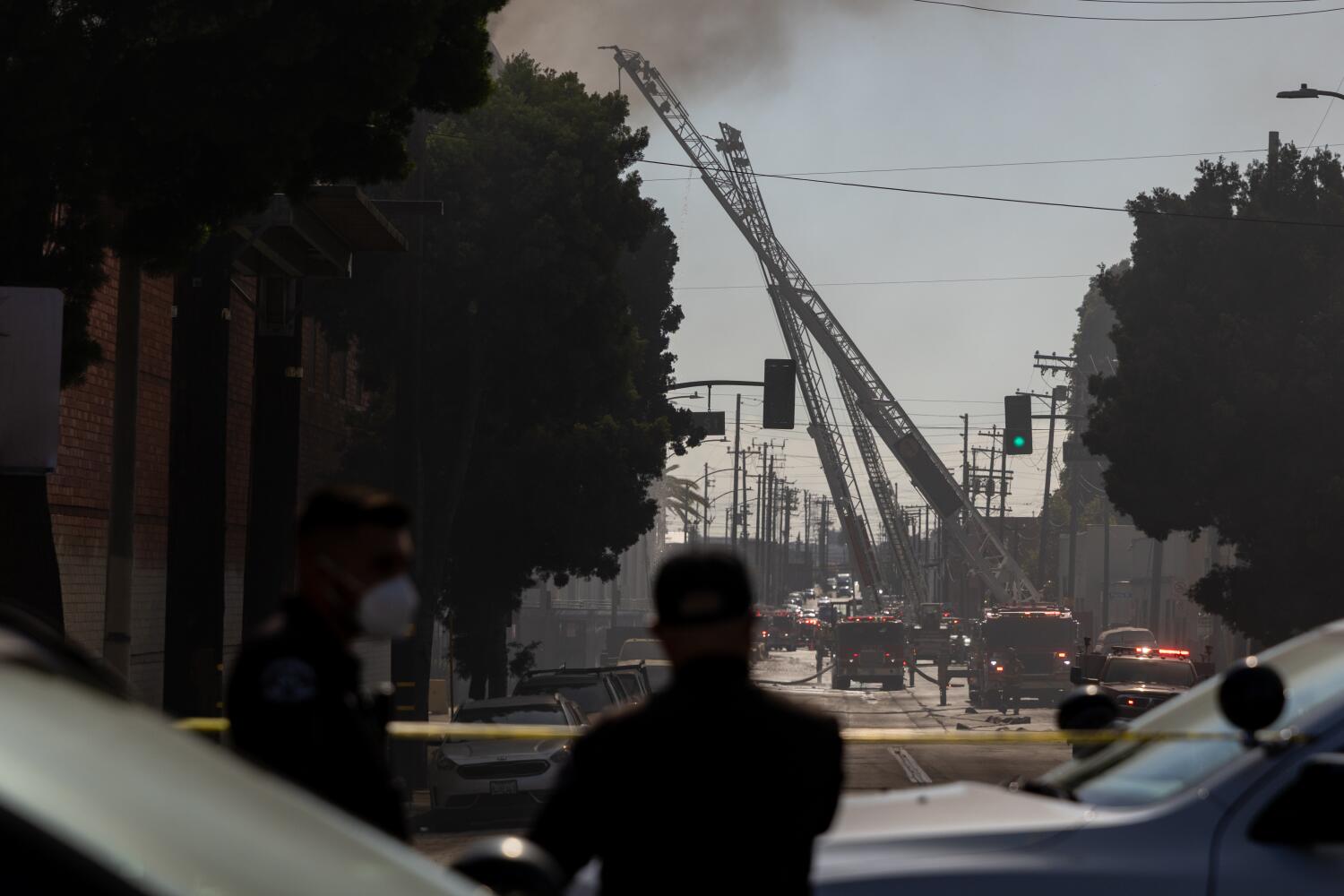
The physical architecture of a commercial cold storage facility turns a standard structure fire into a protracted environmental and public health crisis. When a fire ignited across a solar panel array on the roof of the 491,000-square-foot Lineage Logistics facility in Boyle Heights, it did not merely challenge traditional municipal firefighting tactics; it activated a complex, compounding system of chemical, structural, and biological risks. Navigating the aftermath of an industrial incident of this scale requires analyzing the distinct engineering mechanisms that sustain the burn, the localized air pollution dynamics, and the secondary biohazard vectors that emerge when large-scale refrigeration infrastructure fails.
Standard structural fires typically follow a predictable curve of suppression and cooling. Industrial cold storage blazes diverge sharply due to three structural factors that inhibit heat dissipation and physical access. Don't miss our earlier post on this related article.
First, the insulation paradox creates a self-sustaining kiln. Cold storage warehouses utilize thick layers of high-density polyurethane or polystyrene foam sandwiched between corrugated steel panels to maintain sub-zero temperatures. When a fire breaches these panels, the very materials designed to keep heat out begin to burn slowly from the inside out. The steel cladding acts as a thermal shield, reflecting heat back into the burning foam insulation and shielding the fire from external water applications. This causes a slow, smoldering combustion process that can last for days, resistant to high-volume ground-level master streams.
Second, the structural geometry creates zero-visibility bottlenecks. Cold storage layouts prioritize maximizing internal volume, resulting in massive, open-floor-plan freezers with few windows or access points. Once structural collapse begins or interior temperatures skyrocket, firefighters face a complete lack of visibility combined with physical barriers like collapsed solar arrays, dangling steel joists, and heavy industrial shelving. The inability to safely execute offensive interior operations forces emergency crews into a defensive, protracted strategy—relying on heavy equipment or aerial water drops from helicopters, which are rarely deployed in dense urban industrial zones. To read more about the context of this, WebMD provides an in-depth summary.
Third, the chemical risk profile alters tactical priorities. Cold storage units depend on massive centralized refrigeration units utilizing anhydrous ammonia ($NH_3$). While ammonia is an efficient, cost-effective refrigerant, it is highly toxic and flammable at specific concentrations. The moment an ammonia line is breached, suppression efforts must halt or shift entirely to defensive isolation until hazardous materials teams can secure valves and pump the remaining chemical volume off-site. This structural delay allows the underlying insulation fire to expand unchecked beneath the debris.
The regional atmospheric impact of a multi-day industrial smolder operates on different physical principles than a typical fast-burning wildland or standard residential fire. Ground-level smoke pooling occurs because smoldering combustion occurs at lower temperatures than flaming combustion. This incomplete combustion produces dense plumes of particulate matter ($PM_{2.5}$) that lack the thermal buoyancy required to lift high into the upper atmosphere. Instead of rising and dispersing, the smoke remains heavy, dense, and low to the ground.
This creates a severe atmospheric transport loop across the Los Angeles basin. During the day, onshore sea breezes push this low-lying smoke inland, funneling plumes eastward through downtown Los Angeles, Boyle Heights, and into the San Gabriel Valley, impacting communities miles away like South Pasadena, Glendale, and San Marino. At night, thermal inversions trap this pollution close to the valley floors, causing a sharp surge in ground-level particulate concentration even when regional regulatory air quality sensors register "moderate" averages.
Standard regulatory Air Quality Index (AQI) monitoring networks are often poorly optimized for acute industrial plumes. Regional sensors calculate ambient air quality on rolling multi-hour averages and are geographically spaced to measure regional smog rather than concentrated, moving plumes of industrial smoke. This structural lag explains why localized neighborhoods experience severe chemical odors and heavy haze while official digital dashboards report safe or moderate levels. High-density, hyper-local consumer sensor networks provide a more accurate, real-time assessment of the plume's movement, shifting rapidly from double-digit readings to hazardous levels exceeding $200 \mu g/m^3$ within minutes as wind vectors change.
Managing individual health risks during a multi-day industrial smoke event requires clear mitigation protocols that account for indoor infiltration.
- Mechanical Air Filtration: Standard residential HVAC systems do not filter out fine particulate matter ($PM_{2.5}$) or gaseous odors unless equipped with a MERV 13 or higher rated filter. Systems must be switched to a strict "recirculate" mode to prevent pulling outdoor smoke inside. In areas of dense smoke pooling, standalone air purifiers utilizing True HEPA filters paired with activated carbon layers are required to capture both the physical particulates and the volatile organic compounds (VOCs) generated by burning structural foam.
- Respiratory Protection Barriers: Standard surgical masks and cloth face coverings offer zero protection against $PM_{2.5}$ or industrial gasses, as they lack the filtration density and structural seal to prevent peripheral leakage. Only NIOSH-approved N95 or P100 respirators filter out the micro-fine particles that can penetrate deep into the lungs and cross into the bloodstream. These should be worn during any unavoidable outdoor activity within the smoke trajectory.
- Vulnerable Population Shifting: The threshold for respiratory distress is significantly lower for individuals with pre-existing pulmonary or cardiovascular conditions, such as asthma or chronic obstructive pulmonary disease (COPD), as well as older adults and young children. When indoor mitigation fails and local indoor air quality degrades, timely physical relocation to designated municipal cleaner-air shelters outside the smoke plume trajectory is the most effective intervention.
The immediate threat of toxic air pollution obscures a secondary, longer-term public health crisis: mass food spoilage and biohazard generation. When fire suppression requires the complete shutdown of a 500,000-square-foot facility's refrigeration systems, an estimated 85 million pounds of frozen food products transition into rapid biological decay.
This creates an immediate vectors and pest attraction issue. The structural breaches caused by the fire, combined with millions of pounds of decomposing organic matter, create an ideal breeding environment for rodents, flies, and other disease vectors. If left unmitigated, this organic mass poses an immediate biohazard to the surrounding residential communities.
Simultaneously, the environmental runoff presents a critical containment challenge. Firefighters must pour millions of gallons of water into the building over several days to cool the smoldering core. As this water cascades through millions of pounds of rotting food, dissolved chemicals, and soot, it transforms into highly contaminated industrial wastewater. If this runoff escapes the facility's footprint, it introduces high biochemical oxygen demand (BOD) and toxic contaminants directly into municipal storm drains and local watersheds, threatening broader ecological damage.
The strategic resolution of an industrial cold storage fire requires transitioning from emergency suppression to a coordinated environmental remediation framework. Once the hazardous material threats are neutralized and the smoldering insulation is completely suppressed, the immediate operational priority shifts to rapid waste extraction. This involves deploying specialized heavy industrial material handling equipment to systematically dismantle the unstable steel outer shell, allowing hazardous waste management crews to evacuate the decaying organic material before vector breeding cycles peak.
Municipalities must treat the site as an active industrial waste zone, deploying continuous boundary monitoring for volatile organic compounds and establishing zero-runoff containment barriers to catch all liquid effluent for off-site treatment. Only through a highly structured, multi-agency remediation strategy can the cascading structural, atmospheric, and biological threats of a cold storage disaster be fully neutralized.