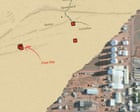
Geopolitical alignment rarely shifts through sudden declarations of war or abrupt treaties; rather, it transforms via infrastructural integration. Recent spatial data compiled by the Nautilus Institute demonstrates that United States military forces and defense contractors maintain control over or operational access to 110 defense facilities across Australian territory. This footprint represents more than half of Australia's total military installations. Evaluating this dense web of installations requires moving past superficial anxieties about formal alliances and examining the mechanics of military enmeshment. When a secondary power integrates its logistics, command nodes, and testing grounds into a primary superpower's force projection architecture, the threshold for independent political action approaches zero.
The Tripartite Matrix of Access
The structural footprint of foreign military access on sovereign soil is rarely uniform. In the Australian context, the 110 identified facilities distribute across three distinct functional tiers, each altering the host nation's operational autonomy in different ways.
The first tier consists of direct United States military control. Seventeen facilities on mainland Australia operate under direct Pentagon management. These locations, which include intelligence collection hubs like Pine Gap, function as sovereign-delineated nodes within global networks. Host-nation oversight of these installations is largely administrative rather than operational.
The second tier comprises bilateral access agreements. Australian-run military installations—numbering 75 across the continent—permit rotational deployment, joint exercises, and equipment staging under frameworks like the Force Posture Agreement. Facilities such as the HMAS Stirling submarine base near Fremantle or the Bradshaw field training area in the Northern Territory are legally Australian, yet their utility profiles are co-optimized for expeditionary warfare in the Indo-Pacific.
The third tier introduces corporate-military integration. At least 18 additional facilities grant direct entry to United States defense prime contractors—including entities like Lockheed Martin and Northrop Grumman—for manufacturing, testing, and prepositioning ordnance. Weapons assembly operations at sites like Port Wakefield and rocket motor production in Mulwala bind Australia's industrial base directly to foreign supply chains.
This three-tiered distribution reframes the geographic reality. The continent functions less as an independent defensive perimeter and more as a southern logistical pivot for the United States Indo-Pacific Command.
The Mechanics of Entanglement and Escalation
The core strategic risk facing a host nation with saturated military infrastructure is not a sudden, malicious coercion by its ally, but the steady erosion of non-belligerency options during a crisis. Strategic dependence is governed by functional necessity. When a superpower designs its regional deterrence posture around another nation's real estate, that real estate becomes a primary target in any adversary's counter-force calculations.
From the perspective of Beijing's military planners, the distinction between an Australian-operated base with United States access and a purely American base dissolves under operational analysis. Intelligence collection, submarine maintenance hubs, deep-space radar, and pre-positioned fuel reserves form an indivisible warfighting network. Consequently, any conflict involving the United States in the Western Pacific treats these 110 facilities as legitimate military targets, regardless of formal declarations by the Australian parliament.
This creates an involuntary tripwire effect. The presence of advanced communication and tracking assets means that withholding political consent to enter a conflict becomes practically impossible once hostilities commence. If an ally's forward-deployed forces rely on local infrastructure for targeting data and logistical sustainment, denying access mid-crisis would collapse the ally's operational capacity, triggering an immediate security fracture. Sovereignty is thus compromised long before a shot is fired, bound by the physical weight of shared infrastructure.
The Cost Function of Industrial Subordination
Proponents of expanded bilateral access often cite capability enhancement and regional deterrence as primary justifications. Host nations gain advanced technology, shared intelligence, and subsidized infrastructure upgrades. However, this exchange incurs hidden systemic costs.
Industrial capacity follows logistics. When domestic defense manufacturing is co-opted by foreign primes to produce guided weapons and rocket motors for external supply chains, local procurement priorities become subservient to foreign grand strategy. The host nation trades sovereign industrial self-sufficiency for specialized niches within a superpower's manufacturing ecosystem.
Furthermore, civil-military friction increases as base density rises. Local populations absorb environmental, security, and diplomatic externalities without possessing veto power over the strategic decisions generating those risks. The economic benefits of localized defense spending rarely offset the macro-strategic vulnerability introduced by serving as an un-evacuable staging ground.
Strategic Realignment Options
Unwinding structural enmeshment of this magnitude presents severe institutional friction. Decades of bureaucratic alignment and intelligence sharing create a path dependency that resists simple political redirection.
To restore strategic optionality, an exposed middle power must enforce strict legal firewalls between joint exercises and foreign expeditionary campaigns. Procurement strategies must prioritize indigenous manufacturing autonomy over integration into foreign prime contractor pipelines. Infrastructure access agreements require sunset clauses and explicit veto provisions over the storage of offensive strike assets during peacetime.
Without deliberate structural decoupling, the accumulation of localized defense facilities will permanently foreclose neutrality. The trajectory of base saturation leads inevitably to a single outcome: operational integration precedes political commitment, turning logistical hosting into active belligerence by default.