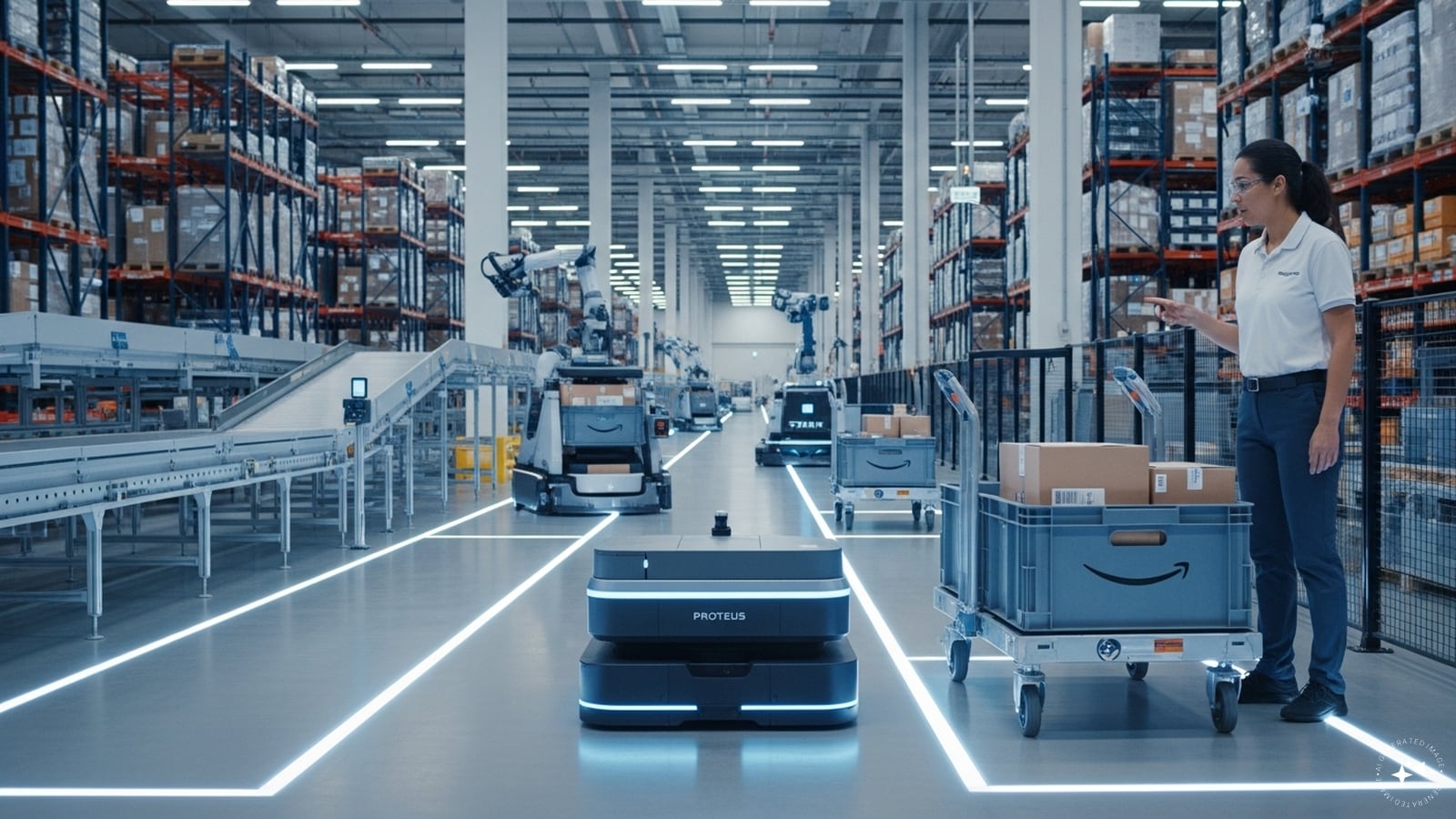
Amazon’s deployment of €10 billion into its European fulfillment network alongside the introduction of its next-generation Proteus autonomous mobile robot (AMR) represents a calculated shift in supply chain unit economics. While market observers frequently interpret concurrent announcements of physical automation and a 25,000-person headcount expansion as a paradox, the reality is dictated by the structural demands of multi-tier fulfillment systems. Amazon is not substituting labor with capital; it is reallocating labor to high-cognition bottlenecks while using capital to compress internal cycle times.
The capital expenditure addresses a fundamental physical constraint in e-commerce logistics: the distance-to-throughput ratio. By transitioning the Proteus AMR from restricted dock zones to facility-wide operations, Amazon is targeting the variable cost structure of horizontal inventory transport. Understanding the strategic implications of this initiative requires isolating the precise mechanisms of human-machine interaction, the spatial constraints of modern fulfillment centers, and the macro-level capital allocation strategy underpinning the infrastructure expansion.
The Operational Mechanics of the Next-Generation Proteus AMR
The initial iteration of Proteus, confined exclusively to inbound and outbound dock environments, served a singular purpose: moving heavy, standardized cart payloads along fixed, predictable corridors. The next-generation model removes these geographic boundaries, operating directly on active warehouse floors alongside human personnel. This shift alters the facility’s risk and performance profile.
The Conversational Interface as a Throughput Lever
The integration of natural language processing (NLP) into the AMR control architecture replaces traditional programmatic dispatch systems with unstructured text-based routing. The tactical utility of this interface breaks down into three core components:
- Elimination of Software Intermediaries: Floor supervisors and inventory managers communicate tasks directly via conversational prompts without using terminal-based warehouse management systems (WMS).
- Dynamic Path and Priority Calculation: Rather than executing rigid linear queues, the robot interprets instructions, evaluates contextual floor conditions, and calculates its own priority, route, and timing.
- Reduction in Latency: Bypassing specialized coding or interface execution minimizes the time elapsed between identifying an inventory bottleneck and dispatching transport assets.
This interface configuration introduces specific system risks. Unstructured natural language inputs are inherently prone to semantic ambiguity compared to deterministic software commands. If a conversational prompt lacks explicit contextual boundaries, the underlying model architecture must resolve the ambiguity without stalling or creating physical conflicts on the floor.
Spatial Integration and Complementary Systems
The facility-wide mobility of the new Proteus is designed to work in tandem with specialized hardware subsystems to achieve end-to-end automation of localized fulfillment workflows. Two distinct systems operate as downstream dependencies to this mobility:
- STARK (The Tote-Handling Layer): A collaborative robotic system engineered to extract full inventory totes from conveyor lines and stack them onto transport carts. Proteus acts as the horizontal link, moving these cart payloads across long distances once STARK completes the vertical and localized sortation.
- Vulcan (The Tactile Feedback Layer): A robotic system equipped with haptic and touch sensors designed for precise object manipulation. Vulcan solves the item-level pick-and-place bottleneck, allowing Proteus to remain optimized purely for heavy bulk transit.
By scaling STARK across 15 European sites by 2027 and deploying Vulcan alongside Proteus, Amazon is assembling an interconnected material-handling stack. Each system addresses a separate variable in the warehouse cost function: Vulcan handles item variability, STARK manages container sortation, and Proteus minimizes transit time.
Deconstructing the Headcount Paradox
The projection of 25,000 new jobs alongside a massive robotics infusion appears counterintuitive only under an oversimplified model of automation. In high-velocity fulfillment operations, adding autonomous machinery shifts the labor demand curve rather than eliminating it.
+-------------------------------------------------------+
|  AMR Deployment (Proteus) Moves Bulk Heavy Cartages   |
+-------------------------------------------------------+
                           |
                           v
+-------------------------------------------------------+
|   Compresses Internal Cycle Times (Faster Sorting)    |
+-------------------------------------------------------+
                           |
                           v
+-------------------------------------------------------+
|   Elevates Total Facility Throughput / Volume Cap    |
+-------------------------------------------------------+
                           |
                           v
+-------------------------------------------------------+
| Demands Non-Automated Labor Scale (Quality, Flow)     |
+-------------------------------------------------------+
The Redistribution of Labor Units
Human labor is highly inefficient at moving 400-kilogram carts across linear kilometers of concrete floor. Conversely, human vision and fine motor skills are remarkably efficient at unexpected exception handling, quality control, and inventory flow optimization.
When Proteus assumes the physical transport burden, it removes a primary source of physical fatigue and operational friction. The 25,000 planned workers are required because the resulting compressed cycle times accelerate the entire facility’s velocity. Higher velocity generates a greater volume of incoming and outgoing inventory packages, which expands the absolute requirement for human intervention in non-automated sectors of the supply chain.
The Upskilling Economic Pipeline
To sustain this workforce transformation, Amazon is pairing its network expansion with a $1 billion global investment into its Career Choice program, which operates as a component of the larger $2.5 billion Future Ready 2030 framework. This training strategy targets technical proficiencies directly linked to the new hardware footprint:
- Mechatronics and Robotics Maintenance: Transitioning traditional warehouse personnel into technicians capable of servicing Proteus, STARK, and Vulcan fleets.
- Data Logistics and Flow Management: Training workers to oversee the software layers directing autonomous assets.
From a strict corporate finance perspective, funding internal technical training lowers long-term talent acquisition costs. The capital invested in upskilling creates a stabilized labor pool capable of maintaining proprietary automation infrastructure, insulating Amazon from regional shortages of highly specialized technical labor.
The Strategic Imperatives Behind the €10 Billion CapEx
Amazon’s €10 billion European capital allocation strategy addresses distinct competitive pressures: regional infrastructure fragmentation, stringent regulatory environments, and the aggressive delivery expectations of Western European consumer bases.
                          [ €10B CAPITAL INJECTION ]
                                       |
                +----------------------+----------------------+
                |                                             |
                v                                             v
    [ Fulfillment Center Upgrades ]               [ Last-Mile Infrastructure ]
    - Proteus Floor Integration                   - Sub-Same-Day Site Buildouts
    - STARK / Vulcan Integration                  - Amazon Now Node Expansion
                |                                             |
                +----------------------+----------------------+
                                       |
                                       v
                     [ Composed Margin Optimization ]
                     - Lower Variable Cost per Unit
                     - Compressed Order-to-Ship Latency
Sub-Same-Day Logistics and Spatial Densification
The investment funds a significant structural adjustment to the physical distribution network, including the launch of more than 25 sub-same-day delivery sites across Europe. This micro-fulfillment strategy directly counters the legacy model of massive, centralized distribution centers located far from urban centers.
To compress the order-to-ship window down to a sub-30-minute target for services like Amazon Now, the inventory must sit physically closer to the consumer. Urban fulfillment nodes are smaller, have higher real estate costs per square meter, and experience severe spatial constraints. In these dense environments, maximizing throughput per square meter is critical. Advanced robotics like STARK and the next-generation Proteus allow for dense vertical storage and tighter configurations that human-only operations cannot safely or efficiently navigate.
Regional Vulnerabilities and Operational Boundaries
The deployment of this capital and technology is subject to clear constraints that differ significantly from Amazon's domestic US market:
- Diverse Regulatory Frameworks: European labor laws and works council mandates require deep integration of safety architectures before autonomous mobile robots can mingle freely with human workers on warehouse floors.
- Brownfield Retrofitting Costs: Upgrading existing European facilities to support facility-wide AMR navigation requires substantial outlays for flooring remediation, localized network infrastructure, and safety zone re-demarcation. This is fundamentally more capital-intensive than designing greenfield robotic sites from scratch.
- Energy Grid Demands: Operating thousands of localized, fast-charging autonomous units across dozens of regional nodes escalates the peak power draw of fulfillment centers, requiring localized energy storage or grid upgrades.
The Competitive Endgame in Automated Fulfillment
This scale of capital allocation reshapes the competitive landscape of third-party logistics and e-commerce fulfillment. Competitors operating at lower capital scales cannot match the unit-cost reductions yielded by an integrated ecosystem of conversational AMRs, tactile sorting arms, and dense sub-same-day fulfillment networks.
The long-term play for Amazon is the structural reduction of variable fulfillment expense as a percentage of net sales. By converting variable human labor tasks—such as moving heavy bulk cartages across kilometers of floor space daily—into a fixed capital asset depreciation schedule, Amazon achieves a highly defensible cost advantage.
Enterprise logistics directors and competing retail networks must evaluate their automation roadmaps against this benchmark. Survival in high-density markets depends on transitioning away from point-solution automation, such as standalone conveyor loops or isolated sorting arms. True cost parity requires an interconnected, multi-layered robotic framework where autonomous transport assets communicate fluidly with human operators and mechanical sorters to compress internal facility cycle times to their absolute physical limits.