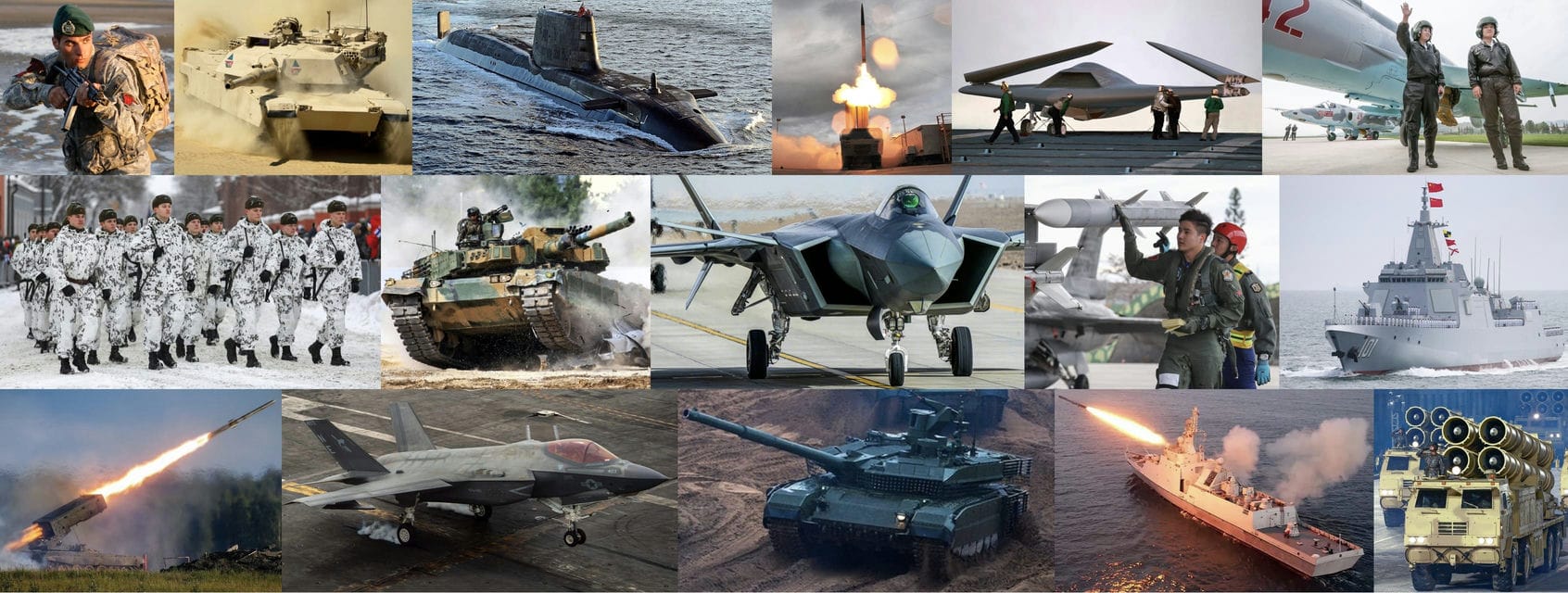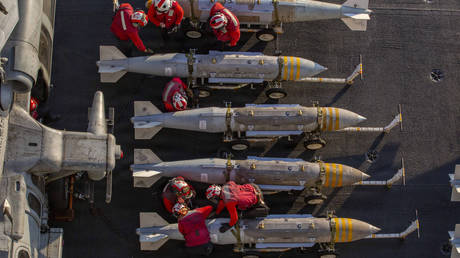
The United States is burning through its missile stockpiles faster than it can replace them. That's not a clickbait headline or a far-off hypothetical. It's the current reality facing the Pentagon. If you look at the sheer volume of munitions expended in the Middle East over the last year, alongside the steady flow of hardware to Eastern Europe, the math simply doesn't add up for a sustained, high-intensity conflict elsewhere.
You’ve probably heard the term "arsenal of democracy." It's a nice sentiment. It suggests an endless well of industrial might ready to pivot at a moment's notice. But that well is running dry. Decades of "just-in-time" manufacturing and defense consolidation have left the U.S. military with a glass jaw. We’re great at designing the world’s most sophisticated hardware, but we’ve forgotten how to build it at scale.
The Missile Gap Is Real and It’s Growing
Admiral Samuel Paparo, the head of U.S. Indo-Pacific Command, recently admitted something that should make every taxpayer uneasy. He noted that the heavy use of interceptors like the Standard Missile 6 (SM-6) is eating into the readiness of American forces in the Pacific. Think about that for a second. The very weapons meant to deter a peer competitor in Asia are being fired at low-cost drones and aging rockets in the Red Sea.
It’s a mismatch of epic proportions. We’re using million-dollar missiles to swat down five-figure drones. While it keeps shipping lanes safe in the short term, it creates a massive strategic vulnerability. Every SM-6 or Patriot missile fired today is one that won't be in a vertical launch system if a larger conflict kicks off.
The defense industrial base isn't a light switch. You can’t just flip it on and expect 5,000 missiles to roll off the line tomorrow. These are complex machines with fragile supply chains. We’re talking about specialized solid-rocket motors, high-grade ball bearings, and microelectronics that often come from the very countries we’re worried about fighting.
Why We Can’t Just Build More
I’ve looked into why production lines are stalled, and the answers are frustratingly bureaucratic. For years, the Pentagon prioritized "efficiency." They bought just enough to get by, which signaled to private companies that they shouldn't invest in massive factory floors or large workforces.
If you’re a CEO of a defense firm, you aren't going to build a billion-dollar plant if the government only signs one-year contracts. You need stability. Without multi-year procurement deals, these companies keep their operations lean. Lean is great for a balance sheet but terrible for a world on fire.
The Labor Shortage Nobody Mentions
It isn't just about the parts. It’s about the people. The graying of the defense workforce is a massive problem. We have a generation of master machinists and engineers retiring, and we haven't done enough to recruit the next wave. You can’t learn how to build a hypersonic glide vehicle or a stealth coating overnight. It takes years of institutional knowledge that’s currently walking out the door.
The Component Bottleneck
Then there’s the "chokepoint" issue. Often, a single factory in one town is the only place in the entire country that makes a specific valve or a particular type of thermal battery. If that factory has a fire, or a strike, or just a bad quarter, the entire production of a major weapon system stops. It’s a single point of failure that we’ve allowed to persist for the sake of saving a few bucks during peace time.
Deterrence Is Only as Good as Your Magazine Depth
Hard power is about more than just having the best tech. It’s about having enough of it to convince an adversary that they can't win a war of attrition. Right now, our "magazine depth"—the total number of rounds we have ready to go—is looking dangerously shallow.
The Center for Strategic and International Studies (CSIS) has run multiple wargames on potential Pacific conflicts. In almost every scenario, the U.S. runs out of long-range precision-guided munitions in less than a week. Seven days. After that, we’re back to using "dumb" bombs and short-range systems that put pilots and sailors in much greater danger.
If an adversary knows you’re out of bullets by Tuesday, they’re going to be a lot more aggressive on Monday. That’s the core of the problem. Our shrinking inventory isn't just a logistics headache; it's a direct threat to global stability.
The Cost of Staying Focused on the Last War
We’ve spent twenty years fighting counter-insurgencies. That required a certain type of gear: MRAPs, small arms, and light surveillance drones. It didn't require massive amounts of long-range anti-ship missiles or advanced air defense.
Now, the world has shifted. We’re back to an era of Great Power Competition, but our manufacturing is still stuck in that 2005 mindset. We’re trying to sprint while wearing lead boots. The Pentagon is trying to pivot, but the momentum of the "military-industrial complex" is hard to shift.
Honestly, it’s kind of embarrassing. The world's largest economy shouldn't be struggling to produce basic 155mm artillery shells. Yet, here we are, scouring the globe for old stockpiles to keep our partners afloat because our own factories can't keep up with the burn rate.
What Needs to Happen Right Now
This isn't a problem we can talk our way out of. It requires a fundamental shift in how the U.S. thinks about its industrial strength. We need to treat factory capacity as a weapon system in its own right.
- Sign the Checks for the Long Haul. Congress needs to get comfortable with multi-year contracts. Give the industry the certainty it needs to build new lines.
- Onshore the Critical Stuff. We cannot rely on global supply chains for the most sensitive components of our missiles. If we can't make it in Ohio or Alabama, we shouldn't be building the weapon around it.
- Cut the Red Tape. It shouldn't take ten years to move a weapon from a prototype to a production line. The acquisition process is bloated and slow. We need to move at the speed of the threat, not the speed of the paperwork.
- Expand the Workforce. We need a massive push into vocational training and high-end manufacturing education. Making missiles should be seen as a critical national service.
The reality is that peace is expensive, but war is much more so. If we don't fix the weapon shortage now, we're basically inviting a conflict we aren't prepared to finish. It's time to stop treating the defense budget like a jobs program and start treating it like the survival manual it's supposed to be.
Start by demanding transparency on stockpile levels. Ask your representatives why we’re okay with a "one week" supply of the most important tools in the shed. Pay attention to the Defense Production Act and how it’s being used—or not used. The clock is ticking on our ability to replenish what we’ve already spent, and the world isn't getting any quieter. America's status as a superpower depends on its ability to actually produce the power it claims to have.