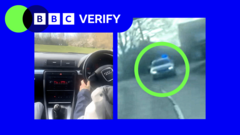
The phone screen glows in the dark bedroom, casting a cold blue light across a ceiling. It is 2:00 AM. Somewhere down the hall, a floorboard creaks, but the teenager scrolling through the endless vertical feed does not hear it. Their eyes are locked on a hyper-saturated video.
Inside the frame, a speedometer climbs past one hundred miles per hour. The digital numbers blur. Neon streetlights streak into jagged lines of white and amber, smearing against the side windows of a hatchback. The soundtrack is not the roar of an engine, but a pulsing, bass-heavy track trending on the platform. The car swerves, slicing between two family sedans with inches to spare. The caption features a row of laughing emojis and a challenge tag.
Another swipe. Another stunt. Another adrenaline spike delivered straight to an exhausted brain.
We built networks to connect humanity, yet we engineered systems that monetize velocity. To understand why videos showing dangerous driving are not just easy to find on social media, but practically impossible to escape, we have to look past the algorithms and examine the human hunger for a front-row seat to catastrophe.
The Currency of Danger
Safety is boring.
That is the ugly truth of modern media architecture. A video of a driver using their turn signal, maintaining a sensible distance, and merging with polite caution generates zero engagement. It disappears into the void, seen by nobody. But a video of a modified coupe fishtailing around a tight urban corner at midnight? That triggers an immediate, visceral reaction.
Consider a hypothetical scenario, based on hundreds of documented cases across major platforms. A nineteen-year-old in a mid-sized sedan mounts a GoPro to their dashboard. They are anonymous, invisible to the millions of people populating the digital ecosystem. They want to matter. They want their existence validated by numbers on a screen. So, they turn off their headlights for ten seconds on a dark stretch of highway, capturing the plunge into pitch blackness.
When they upload the clip, something strange happens. Within an hour, the view count ticks upward. Ten. A thousand. Ten thousand. Comments begin to flood in. Some users type warnings, telling the creator they are an idiot. Others drop flame emojis, praising the audacity.
To the platform code, anger and applause look identical. Both are engagement. Both signal that human attention has been captured. The recommendation engine registers the sudden spike in comments and shares, making a cold, mathematical deduction: people want more of this. Within minutes, the clip is pushed out to thousands of strangers who never asked to witness a high-speed game of Russian roulette on public asphalt.
The Architecture of the Loop
Why does this content thrive so effortlessly on mainstream feeds? The answer lies in the mechanics of modern distribution networks.
Platforms rely on continuous feedback loops. Every second a user pauses on a video—even if that pause is driven by sheer shock or moral outrage—counts as a retention metric. The system does not possess a moral compass. It does not look at a video of a street race weaving through heavy traffic and think, this is illegal and dangerous. It looks at the retention curve. It notes that seventy percent of viewers watched until the car narrowly missed a concrete barrier.
That is the hook.
When we talk about dangerous driving footage proliferating online, we are often looking at the symptom while ignoring the design. Algorithms are mirrors reflecting our darkest psychological impulses back at us. We slow down to gawk at car wrecks on the highway, creating rubbernecking traffic jams that stretch for miles. Social media simply takes that ancient morbid curiosity, digitizes it, and strips away the physical consequences.
You are sitting on your living room couch, wrapped in a blanket, sipping tea. You are entirely safe. Yet your pulse races as a smartphone screen shows a vehicle careening out of control at ninety miles per hour. Your brain experiences the physiological rush of mortal danger without the physical cost. It is a synthetic thrill. And like any synthetic substance, tolerance builds quickly, demanding increasingly extreme doses. Today it is a lane-splitting motorcycle video at sunset. Tomorrow it is a flat-out street race through a residential intersection.
The Invisible Cost
The screen goes dark when you turn off the phone. But the digital world bleeds into the physical one with terrifying regularity.
Traffic enforcement agencies across the globe have noted a disturbing correlation between viral driving stunts and real-world copycat behavior. When impressionable minds watch influencers or anonymous accounts rack up millions of views—and the associated social clout—by breaking every rule in the motor vehicle manual, a dangerous normalization occurs. The highway stops being a shared public utility governed by mutual trust and becomes a personal stage.
Think about the driver taking their children to soccer practice on a Tuesday morning. They are checking their mirrors, obeying the speed limit, singing along to the radio. They are playing by the social contract.
They cannot see the kid three towns over who spent the entire previous night absorbing hyper-accelerated driving clips until three in the morning. They cannot know that this kid views their morning commute not as a journey, but as an obstacle course to be conquered for digital approval.
When the inevitable collision happens, the screen goes black for the person who recorded it. The clout vanishes. The comments stop. But the physical wreckage remains, heavy and irreversible, in the real world where resets do not exist.
We have created an environment where the most reckless among us are granted a megaphone, and the rest of us are forced to watch the show, wondering how long the road can hold us all before it finally gives way under the weight of our collective obsession with speed.