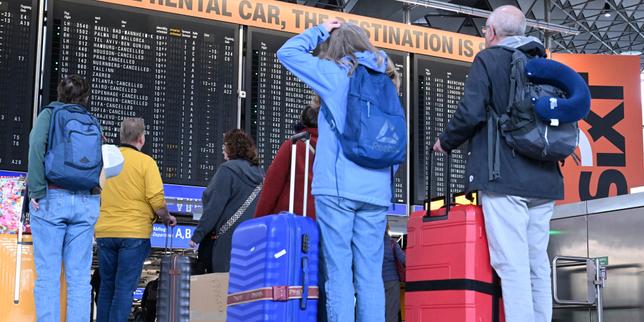
The air inside Terminal 2F at Charles de Gaulle Airport smells of stale espresso, synthetic carpet cleaner, and panic.
It is 11:45 PM. The last departure board has just flickered from a crisp, hopeful green to a blunt, digital red: Annulé. Cancelled.
For a hypothetical traveler we will call Sarah, a freelance graphic designer trying to reach Nice for a career-defining meeting, that single word does not just mean a delayed flight. It means a cascading collapse of her next forty-eight hours. The hotel room she cannot check into but must still pay for. The client who will sit alone in a café tomorrow morning, assuming Sarah simply lacked the professionalism to show up.
Historically, this is the exact moment where the power dynamic between a human being and a multi-billion-dollar aviation conglomerate completely disintegrates.
Sarah approaches the customer service desk. Or rather, she approaches the fortress of plexiglass and exhausted staff. She is handed a black-and-white photocopy explaining her "rights" under an aging European framework known as Regulation EC 261/2004. The text is dense, written in the impenetrable legalese of Brussels bureaucrats, and utterly useless when you are trying to figure out where you are going to sleep in twenty minutes. The airline agent offers a voucher for a sandwich that expired two hours ago and a shrug that translates to: Not our problem.
But the tide is shifting.
Behind the scenes of these nightly airport tragedies, a massive legislative overhaul by the European Union is quietly rewiring the architecture of passenger rights. The EU is finally addressing a reality that every traveler knows in their bones: the existing system was built for an era of aviation that no longer exists, and it has left passengers holding the bag for industry failures.
The Fiction of the Flawless Schedule
For decades, the aviation industry operated on a comfortable myth. The myth suggested that a ticket was a sacred contract. If you paid the fare, the airline would move you from Point A to Point B with reasonable punctuality. If they failed, the law would step in to make you whole.
The reality, as anyone who has traveled in the last five years can attest, is a chaotic game of operational roulette.
Airlines discovered loopholes in the old European framework large enough to fly a Boeing 777 through. The most famous of these is the "extraordinary circumstances" clause. Under the old rules, airlines did not have to pay compensation if a delay was caused by something outside their control. It sounds reasonable on paper. Weather, air traffic control strikes, and political unrest are genuine anomalies.
However, carriers quickly realized they could categorize almost anything as an extraordinary circumstance. A mechanical failure that should have been caught during routine maintenance? Extraordinary. A crew member timing out because of the airline's own scheduling mismanagement? Extraordinary.
The burden of proof fell entirely on the passenger. To fight a denied claim, an ordinary citizen had to become an amateur aviation detective, hunting down weather reports from obscure meteorological databases or tracking the tail numbers of aircraft across transatlantic routes just to prove the airline was lying. Most people simply gave up. The cost of the fight exceeded the price of the ticket.
Turning the Legal Screws
The European Union’s new mandate is designed to dismantle this asymmetric warfare.
First, the definition of what constitutes an "extraordinary circumstance" is being radically tightened and explicitly codified. No more grey areas. No more corporate gaslighting. If a part breaks on a plane, that is now legally recognized as an inherent risk of running an airline, not an act of God. The carrier owns the malfunction, and they own the financial consequences.
More importantly, the new regulations target the weaponization of bureaucracy.
Consider the current process for claiming compensation. It resembles a digital gauntlet designed by a sadist. You must find a hidden link on a website, upload PDFs of boarding passes you threw away three weeks ago, and wait months for an automated rejection email.
The EU’s updated framework introduces mandatory, standardized, automated compensation systems. If a flight is delayed past a specific hourly threshold without a legitimate, pre-verified safety justification, the airline’s system must trigger the compensation process automatically. The money should land in the passenger’s account with the same frictionless speed that the airline used to extract it during booking.
The law is also forcing airlines to look at the human cost of the delay, not just the financial ledger. Under the reinforced guidelines, if an airline strands passengers overnight, they are no longer permitted to point toward a list of fully booked airport hotels and wish them luck. They are legally required to actively secure accommodation, arrange transport, and ensure vulnerable passengers—families with young children, the elderly, individuals with disabilities—are prioritized. Not via a voucher. Via actual, physical logistics handled by airline personnel.
The Corporate Pushback and the Real Cost of a Ticket
Predictably, the aviation lobby has responded with warnings of economic doom. They argue that tightening passenger protections will inevitably drive up ticket prices. They claim that the financial penalties will cripple low-cost carriers, ending the era of the €19 weekend getaway to Barcelona.
There is a profound dishonesty to this argument.
When an airline sells a ticket for less than the price of a decent meal, they are not performing an act of charity. They are running a calculated risk model. They are betting that everything will go perfectly. When it does not, the true cost of that cheap flight does not vanish; it is simply transferred to the passenger on the terminal floor who has to spend €300 on a last-minute hotel room and miss a day of work.
The new EU regulations do not make flying more expensive. They simply force airlines to internalize the actual cost of their operational risks. If a carrier cannot afford to take care of the human beings it promises to transport, then its business model is fundamentally broken.
The View from the Tarmac
Let us return to the terminal floor.
The real victory of these new European rules is not the cash payout. Money cannot buy back the missed wedding anniversary, the botched job interview, or the final hours spent with a dying relative. What the law restores is something far more valuable: agency.
When Sarah stands at that desk under the new framework, she is no longer a supplicant begging for corporate mercy. She is a citizen backed by the full regulatory weight of a twenty-seven-nation bloc. The airline agent is no longer holding a shield of bureaucratic ambiguity; they are holding a ticking financial clock.
The aviation industry has spent a generation treating passengers like cargo that complains. We have been squeezed into smaller seats, charged for the air we breathe, and abandoned the moment the gears of the system grind to a halt.
The European Union's move to reinforce passenger rights is a reminder that the convenience of global commerce cannot be built on the systematic degradation of human dignity. It establishes a civilized baseline. It says that when you buy a ticket, you are buying a promise, and if that promise is broken, you will not be left alone in the dark, searching for a clean patch of floor to sleep on.


