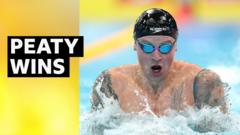
Adam Peaty isn't just back. He's dominant. If you thought the greatest breaststroker in history was ready to fade into the background after his recent mental health struggles, his performance at the British Swimming Championships just shattered that narrative. He didn't just win the 100m breaststroke title. He threw down a time that puts the entire world on notice before the Paris Olympics.
He clocked 57.94 seconds. That’s the fastest time in the world this year. It's the kind of speed that makes other elite swimmers look like they're moving through syrup. When Peaty hits that gear, the race for gold usually becomes a race for second place.
The 57.94 second statement
People love a comeback story, but they often forget how grueling the actual work is. Peaty had been away from the top step of the podium for a while. He took time off to deal with "the grind" and the mental toll of being at the top for nearly a decade. Seeing him dip under the 58-second mark again is massive. It's the first time he's gone that fast since he won gold at the Tokyo Olympics.
This wasn't some lucky heat. It was a calculated display of power. He led from the first stroke and never looked like losing. The crowd in London knew they were watching something special. You could feel the shift in energy as he touched the wall. He looked at the clock, saw the time, and let out a roar. That wasn't just about a medal. That was about reclaiming his identity.
Winning the British title is one thing. Doing it in a time that currently leads the global rankings is another. It changes the conversation for Paris. Before this, people were asking if he could still compete. Now, they're asking if anyone can actually beat him.
Why this time matters for the Paris Olympics
If you follow swimming, you know the 100m breaststroke is Peaty’s house. He owns the world record at 56.88 seconds. Nobody else has even broken 57 seconds. But for the last two years, he looked vulnerable. Qin Haiyang of China swept the breaststroke events at the World Championships, and for a moment, it looked like the throne had been vacated.
Peaty’s 57.94 is a psychological weapon. It tells his rivals that the "Project 56" version of Adam Peaty is still in there. To win in Paris, his competitors now know they probably have to go 57-mid. That’s a tall order for anyone not named Peaty.
Success in swimming is about more than just lung capacity. It's about rhythm and timing. Breaststroke is the most technical of all the strokes. If your timing is off by a fraction of a second, you lose your glide. Peaty looked perfectly synced. His stroke rate was high, but his distance per stroke remained efficient. He wasn't spinning his wheels. He was cutting through the water.
Mental health is the real victory here
We need to talk about the elephant in the room. Peaty has been incredibly open about his struggles with depression and burnout. In a sport where you spend six hours a day staring at a black line at the bottom of a pool, it’s easy to lose your mind. He’s admitted to hitting rock bottom. He’s talked about using alcohol to cope and feeling like the weight of expectation was crushing him.
Seeing him happy on the podium matters more than the time. He looks lighter. He looks like he actually enjoys being in the water again. That’s dangerous for everyone else. An Adam Peaty who is swimming for himself, rather than out of obligation, is a faster Adam Peaty.
The sports world often demands athletes be robots. We want them to win, show up, and win again without complaining. Peaty broke that mold. He stepped away when he needed to. He prioritized his brain over his trophy cabinet. This British title is the validation of that choice. It proves you don't have to break yourself to be a champion. You can heal and still be the best in the world.
The technical breakdown of the race
Peaty’s start was explosive. He has always had one of the best pull-outs in the game. He stayed submerged for the maximum allowed distance, surfacing with a clear lead. His first 50 meters were aggressive, but it was the turn that really sealed it.
Most swimmers fade in the last 15 meters of a 100m breaststroke. The lactic acid build-up is brutal. Your legs feel like lead and your lungs feel like they're on fire. Peaty’s conditioning looked elite. He maintained his body position high in the water even when the fatigue started to kick in.
- Reaction time: He was off the blocks instantly.
- Turn efficiency: He didn't lose momentum against the wall.
- Finish: He lunged for the wall with perfect timing, not getting caught between strokes.
These small details are what separate a 58.5 from a 57.9. It’s the result of thousands of hours of repetition. He’s refined the art of the 100m breaststroke to a point where it looks like a different sport when he does it.
The rivalry with Qin Haiyang
We can't ignore the looming shadow of the Chinese team. Qin Haiyang has been the dominant force while Peaty was away. He’s been consistently hitting 57s. The showdown in Paris is going to be the highlight of the swimming program.
Peaty has the experience. He has the Olympic gold medals. He knows how to handle the pressure of a final when the lights are brightest. Qin has the recent momentum. This time at the British Championships sets the stage for a heavyweight fight. Peaty isn't just a participant anymore. He's the co-favorite.
Stop doubting the greats
There's a tendency in sports media to write people off the second they show a flaw. We saw it with Tiger Woods, we saw it with Michael Phelps, and we saw it with Peaty. When he lost at the Commonwealth Games, people said he was done. They said his "invincibility" was gone.
Maybe the invincibility is gone, but the excellence remains. He doesn't need to be unbeatable to win. He just needs to be better than the seven other guys in the lanes next to him. This performance was a reminder that you should never bet against a generational talent who has a point to prove.
He’s now heading into his third Olympics. Most breaststrokers peak in their early twenties. Peaty is proving that with the right coaching and mental approach, you can extend that peak. He’s more mature now. He’s not just a powerhouse; he’s a tactician.
What happens next for Peaty
The focus now shifts entirely to the final preparations for Paris. This time has already qualified him for the team, so the pressure of selection is gone. He can go back to the training block and fine-tune the small things.
If he can shave another half-second off this time by July, he’ll be in the territory of his own world record. That’s a scary thought for the rest of the world. He’s found his spark again.
Don't expect him to race much between now and the Olympics. He'll likely go back into a heavy training phase. He’s built a foundation with this 57.94. Now it's about building the house. If you're looking for a bet for a gold medal in Paris, Peaty just made a very strong case for himself.
Keep an eye on the world rankings over the next month. As other countries hold their national trials, we'll see if anyone can respond to Peaty's time. For now, the King is back on his throne, and the rest of the world is playing catch-up.
Go watch the replay of the final 25 meters. Pay attention to his head position. It never bobs. It stays perfectly still while his body surges forward. That's the hallmark of a master. He’s not fighting the water; he’s commanding it. Paris isn't ready.