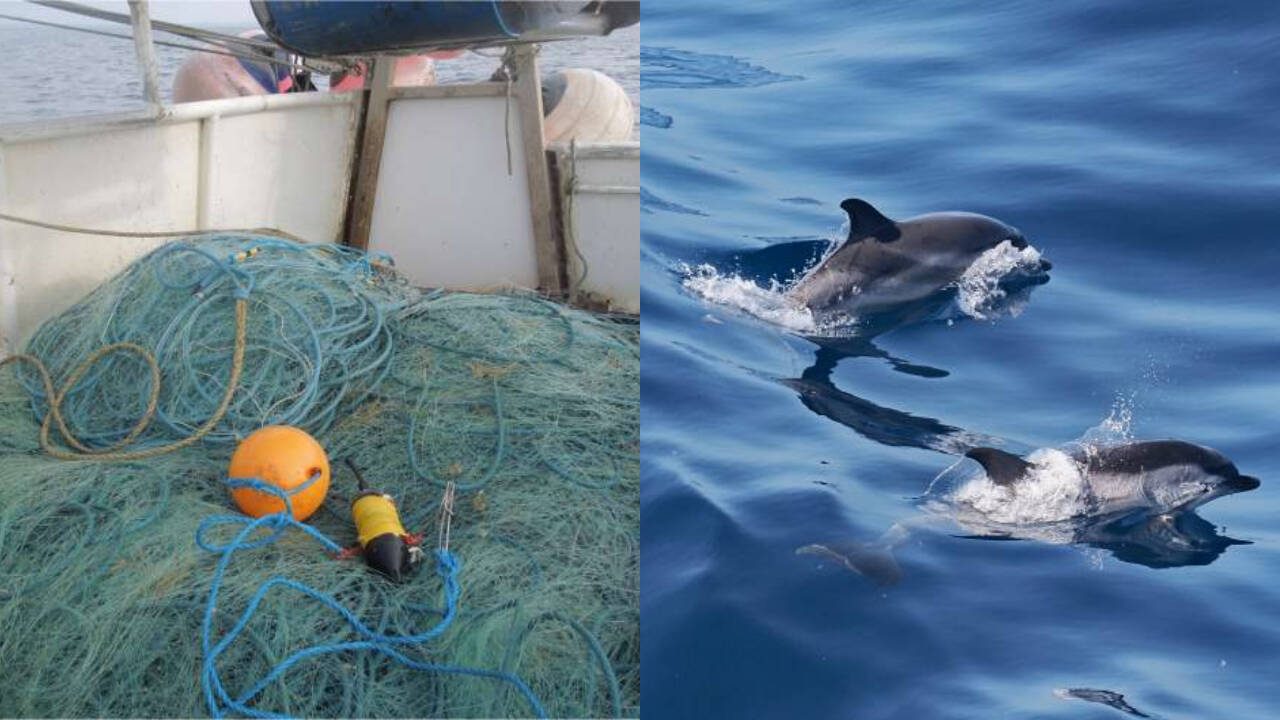
Passive acoustic monitoring rarely catches terminal biological events in real time. When researchers from the University of St Andrews and the Scottish Oceans Institute published findings on a static gillnet deployment off Cornwall, they documented something previously unquantified: the exact acoustic and behavioral signature of a harbour porpoise bycatch event.
The structural failure of marine conservation historically lies in the invisible nature of commercial fishing gear interactions. Thousands of kilometers of static nets line coastal shelves, operating as silent interceptors. Understanding how a foraging animal transitions from a dynamic navigation state to fatal entrapment requires breaking down the physical parameters, sensory limitations, and acoustic signaling mechanisms exposed by this rare recording. Don't forget to check out our recent post on this related article.
The Sensory Deficit and Foraging Mechanics
Harbour porpoises rely on high-frequency echolocation clicks to map their environment and locate benthic prey. Yet, biological sonar is directional and optimized for target acquisition rather than wide-angle obstacle mapping. When two porpoises foraged around the static gillnet off Cornwall, they successfully navigated the synthetic fibers for several minutes. If you want more about the background of this, The Guardian provides an in-depth summary.
The transition from avoidance to entanglement occurs through a specific operational failure:
- Target Fixation: Pursuit of mobile prey forces the animal to narrow its acoustic beam, blinding it to passive, thin-filament barriers outside the focal cone.
- Material Transparency: Monofilament and multifilament nylon exhibit minimal acoustic reflectance, returning insufficient echo energy for effective echolocation at close ranges.
- Spatial Compression: As tidal currents shift gear configurations, the safe passage threshold between the net and the seabed narrows unpredictably, reducing reaction times below the biological threshold for motor response.
The Acoustic Signatures of Entrapment
Once the young porpoise became entangled, the passive monitoring hydrophones captured an immediate shift in acoustic output. The audio stream recorded over fifty distinct rapid-click sequences and burst pulses. These are classified not merely as navigational clicks, but as physiological stress responses.
The structural composition of these signals serves two distinct biological functions:
- Afferent Pain Signaling: Involuntary vocalizations triggered by muscular constriction, oxygen deprivation, and mechanical friction against the net fibers.
- Conspecific Notification: High-intensity acoustic bursts directed at the second porpoise remaining in the immediate vicinity, functioning as an alarm or social cohesion call.
The second animal did not immediately flee. The acoustic data reveals an exchange of call types, demonstrating that cetacean social structures maintain proximity during crises, even when that proximity exposes the secondary animal to identical environmental hazards.
The Macroeconomic Friction of Mitigation
Addressing the estimated one thousand annual porpoise fatalities in UK gillnets requires evaluating the constraints of the fishing industry. Complete elimination of static-net fishing is economically unviable and politically untenable. Therefore, technological interventions must target the physical interface between gear and animal without disrupting catch yields.
Current engineering strategies focus on three variables:
- Acoustic Reflectivity: Embedding heavy metallic oxides or high-density particulates into nylon threads to elevate echo return strength, making the net visible to porpoise sonar.
- Breakaway Thresholds: Designing weak links into net panels that yield under the specific tensile force a porpoise can exert, allowing escape while retaining commercial fish species.
- Biomimetic Deterrents: Deploying localized acoustic pingers that emit predator-mimicking frequencies or chaotic white noise, creating a repulsion zone around the gear.
Deploy these technological variables within regional monitoring frameworks such as the UK Bycatch Monitoring Program and CIBBRiNA to transition from retrospective necropsy analysis to real-time spatial management. Scale acoustic sensor arrays across high-density static net corridors to map seasonal entanglement hot spots, pairing sensor triggers with mandatory gear modifications in designated high-risk zones.