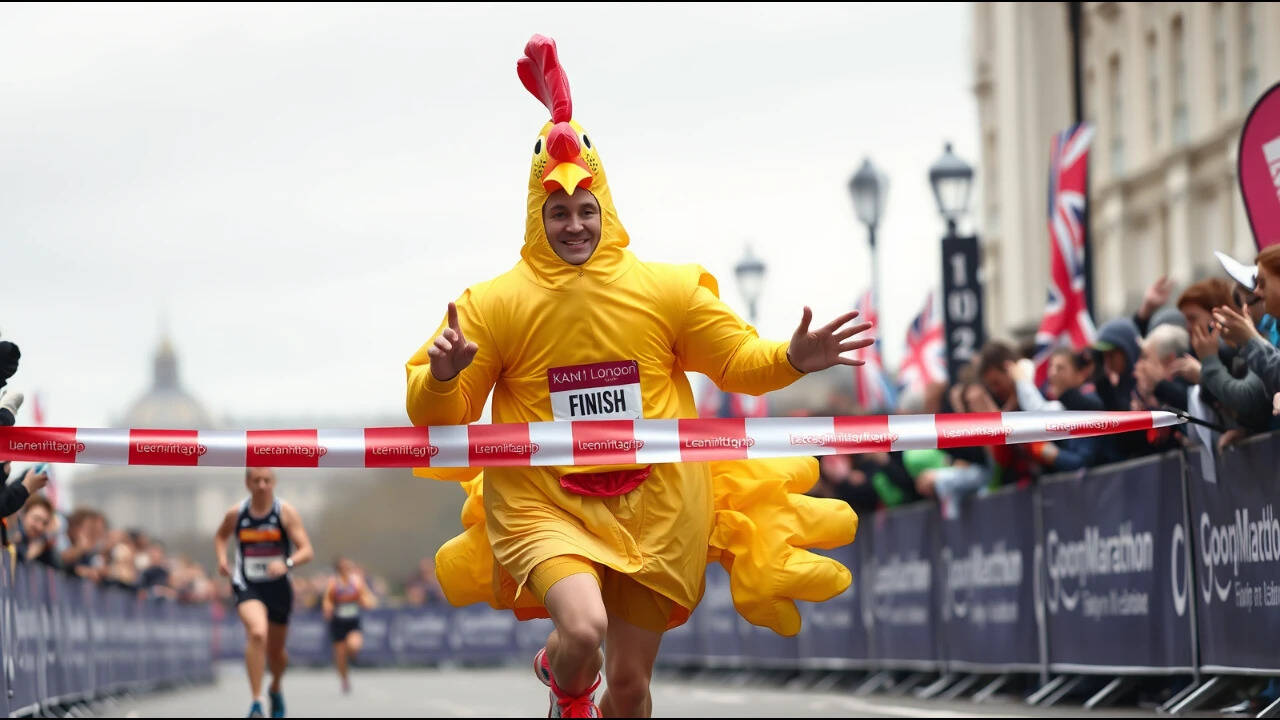
The air inside a polyester chicken carcass does not circulate. It warms. It thickens. It smells faintly of a warehouse in New Jersey and whatever sweat was left behind by the person who rented it three weekends ago for a suburban sweet sixteen.
Jacob didn't care about the smell. He cared about the zipper.
If the heavy-gauge plastic teeth on the spine failed at mile two, the record was gone. The Guinness adjudicators do not smile upon deflation. They have clipboards. They have stopwatches that tick with the cold, unfeeling rhythm of an operating theater. If a feather plume droops below regulation height, or if a wing-tip loses its structural integrity due to a popped seam, you are no longer a man running in a costume. You are just a damp man dragging a yellow tarp across a concrete bridge.
We have built an entire culture around suffering efficiently. We buy shoes made of carbon-plated foam that make our feet feel like spring-loaded pistons. We track our sleep cycles with titanium rings and obsess over our cadence on digital wrist-displays. Every mile is quantified. Every calorie is prosecuted. We have sterilized endurance until it looks like a spreadsheet.
And then someone puts on a beak.
Consider what happens when you strip away the aerodynamic vanity of spandex. When you run as a domestic fowl, aerodynamics are not just ignored; they are aggressively mocked. A stiff headwind off the river doesn't slow you down—it fills your breast cavity until you are effectively a kite with legs. You cannot see your feet. You cannot check your splits. You are navigating the world through a mesh peephole situated somewhere near the bird's sternum, gasping for oxygen through synthetic felt while thousands of strangers cheer for a poultry product.
Jacob stood at the starting corral of the marathon beneath an autumn sky the color of wet slate. Around him were the sleek silhouettes of modern racing culture. Men in singlets so light they looked like spiderwebs. Women with calves like forged iron, eyes fixed on the horizon of a personal best. They stretched their hamstrings with clinical precision.
And then there was Jacob, standing there like an escaped Macy's Thanksgiving Day parade float that had taken a wrong turn at Columbus Circle.
People laughed. They always laugh at the bird. That is the bargain you strike when you volunteer for the absurd. You become the comic relief in someone else's Sunday morning routine. They point. They take smartphone photos. They shout things about KFC.
What they don't see is the math.
To break a Guinness World Record for speed while encased in a bulky, wind-catching mascot costume, you cannot simply be fast. You have to be unreasonable. A standard marathon runner fights physics; a runner in an inflatable chicken costume fights physics, thermodynamics, and the cruel architectural design of an outfit meant for entertaining toddlers at a car dealership.
The heat builds within minutes. Without adequate ventilation, your core temperature climbs into a zone usually reserved for mild fevers. Sweat pours down your forehead, pools in your eyebrows, and drips blindingly into your eyes, and you cannot reach up to wipe it away because your arms are trapped inside bloated, stuffed wings that flap uselessly with every stride.
This is where the human element reclaims the sport.
We run because we are looking for a border. We want to find the place where comfort ends and something truer begins. Most of us find it in the quiet ache of a grueling tempo run or the empty lungs of a hill repeat. But Jacob found it inside a battery-powered fan humming quietly against his lower back, pushing a steady stream of outside air into a yellow nylon envelope just fast enough to keep him from suffocating.
The gun went off.
The pack surged forward, a disciplined wave of carbon plates and compression socks. Jacob went with them, his orange webbed foam feet slapping the asphalt with a rhythmic, comical thud. Thwack. Thwack. Thwack.
For the first three miles, running in a giant fowl is an exercise in chaotic balance. Every time you swing your arm, the wing catches the air and tries to throw your shoulder out of alignment. Every time you lean into a turn, centrifugal force threatens to roll you over like a loose-laced football. The crowd roared, but the sound was muffled, filtered through layers of synthetic fabric and the high-pitched whine of the inflation motor.
By mile six, the novelty wore off for the spectators, but it intensified for the man inside. This is the crucible of long-distance running, stripped of its modern aesthetic. The heart rate monitor strapped to his chest was beeping softly beneath the yellow skin, registering numbers that made no logical sense for a casual Sunday jog. His legs felt heavy, not from lactic acid, but from the invisible anchor of drag.
We spend so much of our lives trying to reduce friction. We want our careers seamless, our technology frictionless, our days optimized down to the minute. We curate our lives so nothing rubs us the wrong way.
And yet, here was a man who deliberately strapped a giant wind-sail to his spine just to see if he could outrun the clock.
The halfway mark came and went in a blur of orange slices and shouted encouragement. "Go chicken!" a child screamed, holding out a sticky hand that Jacob high-fived with a clumsy, stuffed paw. He didn't smile back—he couldn't, not with his teeth clenched against the burn in his thighs—but the gesture mattered. In that split second, the absurdity of the costume dissolved the barrier between the athlete and the crowd. They weren't just watching a race anymore; they were participating in a collective suspension of disbelief.
By mile twenty, the marathon becomes a psychological negotiation. This is where the race truly begins, long after the legs have stopped listening to the brain. In a normal uniform, you stare at the pavement, watching your shadow lengthen, bargaining with your own internal monologue.
Inside the chicken, the world narrows to a few square inches of mesh. You cannot see the horizon. You can only see the yellow canvas inches from your nose, damp with your own breath, and the white painted line of the road sliding underneath your foam-covered feet.
The motor hummed on. The batteries, strapped securely to his waist in a nylon pouch, were holding their charge, but every step felt heavier, as if the air inside the suit had turned to water. His shoulders screamed from the awkward leverage of the wings. His lower back cramped from the unnatural posture required to keep the head of the bird upright against the drag of the wind.
Every fiber of his being whispered the same reasonable, comforting lie: Stop. Take it off. Unzip the spine. Let the air out. Be normal.
That is the quiet terror of any ambition, whether you are wearing spandex or feathers. The easiest thing in the world is to quit when things get ridiculous.
He didn't quit.
He leaned into the wind instead. He shortened his stride, keeping his center of gravity low beneath the bulbous yellow chest, and began to tick off the blocks like an accountant auditing a ledger of pain.
People lined the final straightaway three deep. The noise hit him like a physical wave—not the polite, scattered applause of the early miles, but a rolling wall of sound. They weren't cheering because it was fast. They were cheering because it was human. They saw the struggle. They saw the absurdity. They saw a man who had chosen to make things exceptionally difficult for himself on a Tuesday morning, and in doing so, had turned a stretch of gray asphalt into a theater of quiet triumph.
When he crossed the mat, the official clock flashed a time that made the clipboard-holders blink twice and look down at their stopwatches with a sudden, unprofessional grin.
The record was broken.
Jacob didn't throw his arms in the air in a triumphant V. He couldn't. He simply stopped running, bent double with his hands on his knees inside the cavernous yellow belly of the bird, and let out a long, shuddering breath that fogged the plastic mesh of the beak.
Someone rushed forward with scissors to cut the zip-ties securing the battery pack. Someone else handed him a paper cup of water that missed his mouth entirely on the first try, spilling cool relief across the front of his soaked shirt.
The suit began to deflate. The proud, rounded chest slowly caved in. The head slumped forward, losing its cartoonish arrogance as the air hissed out of the seams, returning to the flat, lifeless fabric it had been before the morning started.
Standing there in the cool autumn air, shivering in a puddle of his own making, Jacob looked less like a record-breaker and more like a man who had just returned from a very strange planet.
We measure our lives in milestones that make sense on paper. We want the promotion, the house, the clear path, the validated metrics of success. We want the world to recognize our speed without ever having to wear the feathers.
As the wind caught the deflated yellow nylon and rolled it across the grass like a discarded wrapper, the crowd slowly drifted away toward their cars and their brunch reservations. The records would be entered into a digital database somewhere in London, stored on a server that hummed quietly in the dark, untouched by sweat or laughter.
The finish line was empty now. The chalk was fading in the mist. But somewhere out there, in the quiet space between what is sensible and what is magnificent, another runner was already lacing up their shoes, wondering just how ridiculous they could afford to be.