Archaeologists analyzing preserved human hair and ancient seeds from a 2,800-year-old tomb in western China have identified the earliest direct chemical evidence of people using cannabis for its psychoactive effects rather than just for fiber or food. By testing hair strands and burial artifacts from the Jiayi cemetery in Turpan, researchers detected specific cannabinoid compounds—including THC and its metabolic byproducts—proving the deceased ingested or inhaled potent cannabis shortly before death. This discovery pushes back the timeline of intentional, mind-altering cannabis consumption by centuries, shifting the historical narrative from accidental agricultural byproduct to deliberate ritual or medicinal use.
The headlines write themselves, and most outlets took the easy route. They saw "2,800 years old" and "cannabis high" and immediately framed the discovery as an ancient stoner anecdote. That framing misses the actual story. Finding burnt seeds in a brazier is one thing; finding metabolized compounds locked inside human keratin is another entirely.
Keratin doesn't lie. Unlike pottery shards or plant remains tossed into a burial pit, human hair acts as a biological tape recorder. When a person consumes a psychoactive substance, the bloodstream carries those compounds to the hair follicles, trapping them inside the growing shaft. Because hair grows at a relatively predictable rate of about one centimeter per month, chemical analysis of preserved strands offers an indisputable timeline of what entered a human body in the final weeks or months of life.
The Turpan Basin and the Chemistry of Preservation
To understand why this evidence survived for nearly three millennia, you have to look at the geography of the Turpan Basin in Xinjiang. It is one of the driest, hottest, and lowest-lying places on Earth. Moisture is the enemy of organic archaeology, and Turpan has almost none. When the people of the Subeixi culture buried their dead in the Jiayi cemetery around 800 BCE, the hyper-arid climate immediately desiccated the bodies, naturally mummifying skin, textiles, wooden artifacts, and hair.
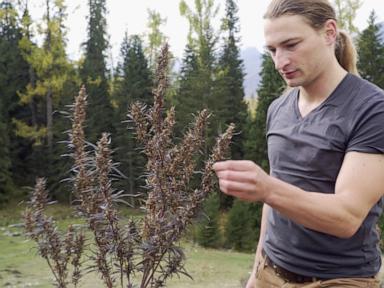
In 2008, excavators uncovered a particularly notable burial at Jiayi. Inside the tomb lay the remains of a Caucasian male, roughly 35 years old at the time of death, resting on a wooden bed. Across his chest, someone had arranged thirteen nearly whole cannabis plants, each measuring close to a meter in length, placed diagonally like a botanical shroud.
For years, physical proximity was the only evidence archaeologists had. You can bury someone with thirteen marijuana plants, and skeptics will still argue the plants were meant for weaving rope, pressing oil, or feeding livestock in the afterlife. Hemp was a staple crop across ancient Eurasia. Proving that ancient populations bred and consumed specific strains for their psychoactive properties required moving beyond botany and into forensic toxicology.
Researchers achieved this by using liquid chromatography-tandem mass spectrometry on the preserved hair and plant remains. They were not just looking for raw tetrahydrocannabinol (THC), which degrades over centuries into cannabinol (CBN). They were looking for metabolites—the specific chemical signatures created only when a human liver processes THC. Finding those metabolites inside the hair shaft eliminated the possibility of post-mortem contamination from the surrounding burial plants. The man hadn't just been buried with cannabis. He had consumed it while alive.
Distinguishing Industrial Hemp from Psychoactive Strains
The debate over when humans first realized cannabis could alter consciousness has divided botanists and archaeologists for decades. Wild cannabis naturally produces low levels of THC, usually less than one percent, alongside higher concentrations of cannabidiol (CBD), which does not produce a high. To get a reliable psychoactive effect, humans had to actively select, cultivate, and breed plants with higher THC profiles.
This requires deliberate agricultural intervention. You don't accidentally breed high-THC cannabis while trying to make stronger rope. In fact, the traits that make cannabis ideal for textiles—tall, fibrous stalks with minimal branching and low resin production—are the exact opposite of the traits that produce potent flowers.
The Jiayi tomb findings, alongside earlier chemical analyses of wooden braziers from the Jirzankal Cemetery high in the Pamir Mountains, confirm that ancient Central Asians understood this distinction. At Jirzankal, dating to roughly 500 BCE, researchers found residue of high-THC cannabis burned on superheated stones inside wooden bowls, indicating a communal inhalation ritual. The Jiayi hair analysis pushes that behavioral timeline back another 300 years, showing that by 800 BCE, populations along the early Silk Road corridors were already targeting specific chemical profiles.
| Evidence Type | Location | Approximate Date | Primary Chemical Finding | Historical Implication |
|---|---|---|---|---|
| Preserved Hair & Seeds | Jiayi Cemetery, Turpan | 800 BCE | THC metabolites in human keratin | Direct proof of pre-mortem consumption and metabolic processing |
| Wooden Braziers | Jirzankal Cemetery, Pamirs | 500 BCE | Elevated CBN ratios on burnt stones | Evidence of communal inhalation and deliberate high-THC selection |
| Botanical Shroud | Yanghai Tombs, Turpan | 750 BCE | 789 grams of dried, pounded female flowers | Intentional harvesting of seedless, resin-rich plant material |
Look closely at the Yanghai Tombs, located just a short distance from Jiayi. Excavations there previously revealed a leather basket and a wooden bowl containing nearly two pounds of finely ground cannabis. Botanical inspection showed that the male plant parts—which produce almost no THC and exist primarily to pollinate the females—had been systematically removed. Anyone who has ever studied modern cultivation knows that separating male plants from females to prevent pollination is the foundational technique for maximizing resin and THC output. Ancient farmers in the Tarim Basin were practicing sophisticated horticulture thousands of years before modern botany existed.
Why Did They Use It
Modern observers love projecting contemporary habits onto the past, imagining ancient people sitting around campfires passing a pipe for recreation. The archaeological context suggests something far more structured, heavy, and utilitarian.
In the ancient world, the line between medicine, religion, and social cohesion did not exist. Life in the Turpan Basin during the first millennium BCE was brutal. The Subeixi people were agro-pastoralists navigating extreme temperature swings, parasitic infections, dental abscesses, and traumatic injuries from horseback riding and territorial conflict. Without modern pharmaceuticals, a plant capable of dulling severe pain, reducing inflammation, stimulating appetite, and inducing sleep was a vital medical resource.
There is also the shamanistic dimension. In the Yanghai burial, the man buried with the stash of pounded cannabis was identified by researchers as a likely shaman, accompanied by a bridle, a harp, and specialized wooden implements. Across early Eurasian steppe cultures—including the Scythians, whom the Greek historian Herodotus famously described inhaling hemp vapors inside small felt tents—psychoactive plants served as tools for spiritual mediation. Altering consciousness wasn't an escape from reality; it was viewed as a mechanism for communicating with ancestors, diagnosing illness, or guiding the dead.
The arrangement of the thirteen whole plants across the chest of the man in the Jiayi tomb reinforces this ritualistic purpose. The plants were harvested locally, roots intact, and laid out with clear geometric intent. They were not tossed in as casual grave goods. They were positioned as an integral part of the funerary rite, perhaps intended to ease the transition into the afterlife or signify the deceased's elevated status within the community.
The Limits of Forensic Archaeology
As compelling as hair analysis is, we need to be honest about what the data cannot tell us. Science reporters often overstate the precision of ancient toxicology, treating a positive chemical test as a complete behavioral profile. It isn't.
First, chemical analysis of 2,800-year-old tissue cannot tell us the exact method of ingestion. While the Jirzankal braziers point toward inhalation of smoke, the Jiayi man could have consumed cannabis as a tea, a tincture, an infused food, or through smoke. Hair traps the metabolites regardless of whether the compound entered the bloodstream through the lungs or the digestive tract.
Second, measuring exact potency from millennia-old samples is fraught with variables. THC degrades steadily over time when exposed to heat, light, and oxygen, converting into CBN. While a high ratio of CBN in ancient residue proves that THC was originally present in significant amounts, calculating the precise percentage of active THC the user experienced is largely an educated estimate. We know the cannabis was psychoactive, and we know it was stronger than wild hemp, but comparing its potency to modern commercial strains is scientifically reckless.
Finally, a single tomb—or even a cluster of tombs in the Turpan Basin—does not represent all of ancient humanity. Preservation bias dictates what we find. We have astonishing data from Xinjiang because the desert preserved the hair and the plants. Meanwhile, contemporaneous cultures in wetter climates—across Europe, southern China, or the Indian subcontinent—may have been cultivating and consuming psychoactive cannabis just as early, leaving zero organic trace in the acidic, damp soil.
The Silk Road Transmission Engine
What makes the Turpan discoveries truly significant is geography. The Turpan Basin sits directly on the northern route of what would later become the Silk Road, serving as a critical bottleneck between East Asia and the Eurasian steppe.
People did not stay put in the Bronze and Iron Ages. Nomadic pastoralists, traders, and migrants moved constantly through the mountain passes of the Pamirs and the Tian Shan range, carrying livestock, bronze metallurgy, grains, and ideas with them. As these groups interacted, cannabis genetics moved along the same corridors.
Wild cannabis likely originated on the northeastern Tibetan Plateau or in Central Asia, existing as a ubiquitous weed around human settlements where nitrogen-rich waste accumulated. As human groups migrated and traded, different populations isolated different traits. Eastern Asian cultures largely favored the plant's strong fibers for textiles and paper, as well as its nutrient-dense seeds for food. Central Asian steppe cultures, moving through high-altitude environments and practicing ecstatic spiritual traditions, locked onto its chemical properties.
When traders and nomads converged in oasis hubs like Turpan, those distinct traditions collided. The chemical evidence locked inside the hair of the Jiayi burial is physical proof of that intersection—a moment when agricultural selection, regional trade networks, and human biology aligned to turn a common weed into one of the most consequential psychoactive substances in human history.